Famous Swiss Foods: Chocolate

Post by Lauren

Maybe one reason that the Swiss don’t celebrate Valentine’s Day is that it is it is an occasion for chocolate EVERY DAY here.

General Facts:
-The Swiss eat the most chocolate in the world. The average Swiss eats 25 lbs of chocolate per year compared to the 11.7 lbs consumed by Americans.
-The Swiss eat 54% of their chocolate production, only exporting 46%

Personal fact: Gabe and I eat four pieces of amazing Swiss chocolate every night after dinner. We haven’t gained any weight. In fact, Gabe has lost weight.

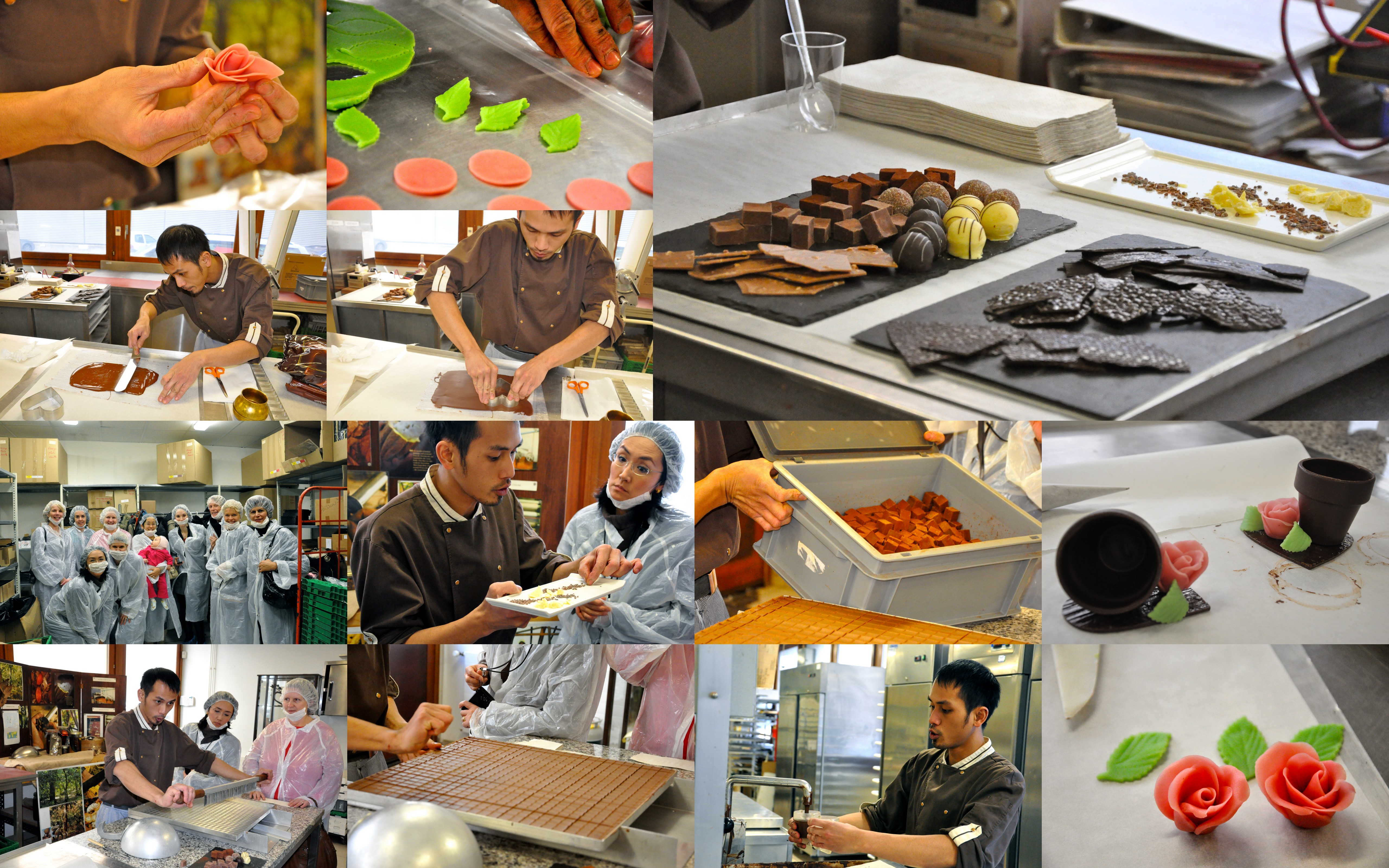
I was lucky to get a tour of Stettler last week. I felt like Charlie let loose in the chocolate factory.

It was 100% in French so I caught about half of the information being that I haven’t learned all my vocabulary for chocolate production yet. However, one doesn’t need to catch every word to be blown away.

This “chocolate laboratory” is in Geneva and is just one of the many chocolate factories and tours in Switzerland. If you are a francophone, I would highly recommend checking this particular one out.

Valentine’s Day and other non-events

Post by Lauren

Before coming to Geneva we knew that American holidays like Memorial Day, 4th of July, Labor Day, and Thanksgiving would not be celebrated in our new country. Throughout the year, we have also learned that thematic ones like Halloween are also not as popular on this side of the pond.

Today’s holiday of Valentine’s Day also falls into this bucket. It is simply not a big thing here….or at least compared to the $17.6 billion USD Americans will spend on Valentine’s this year. I have seen a few heart shaped window displays and a few gentleman toting flowers on the bus, but its really a dime a dozen. The plus for ex-pats is that you would have zero trouble booking a restaurant with your sweetie on February 14th. Not that it matters to us — we planned a nice quiet dinner at home.

When it comes to other life events, I learned recently that they do not do “baby showers” or “wedding showers” in most other cultures. I discovered this in the summer when I was trying to explain to my French tutor that I attended a lot of baby showers in the US because all my friends were having kids nowadays. When I said “douche de bébé”*, you should have seen the look I got. I pulled out my photo album to further explain and demonstrate the concept – pages of my pregnant friends and games and gifts. However, she still wrote it down in her day journal because she thought it was such a funny concept.

And its not just a French/Swiss thing. Last week, we threw a baby shower for some moms at a local women’s shelter who had just given birth. The women had varying origins in Africa and the Middle East. We had to explain the concept as “an American tradition” before we started the refreshments and gifts as this type of events wasn’t familiar.

In case you would like more information on baby showers, check out S’s blog as she recently hosted a beautiful multi cultural attended one for friends M & C.

*Doucher is the French verb for shower.

Moonlight Snowshoeing

Post by Lauren

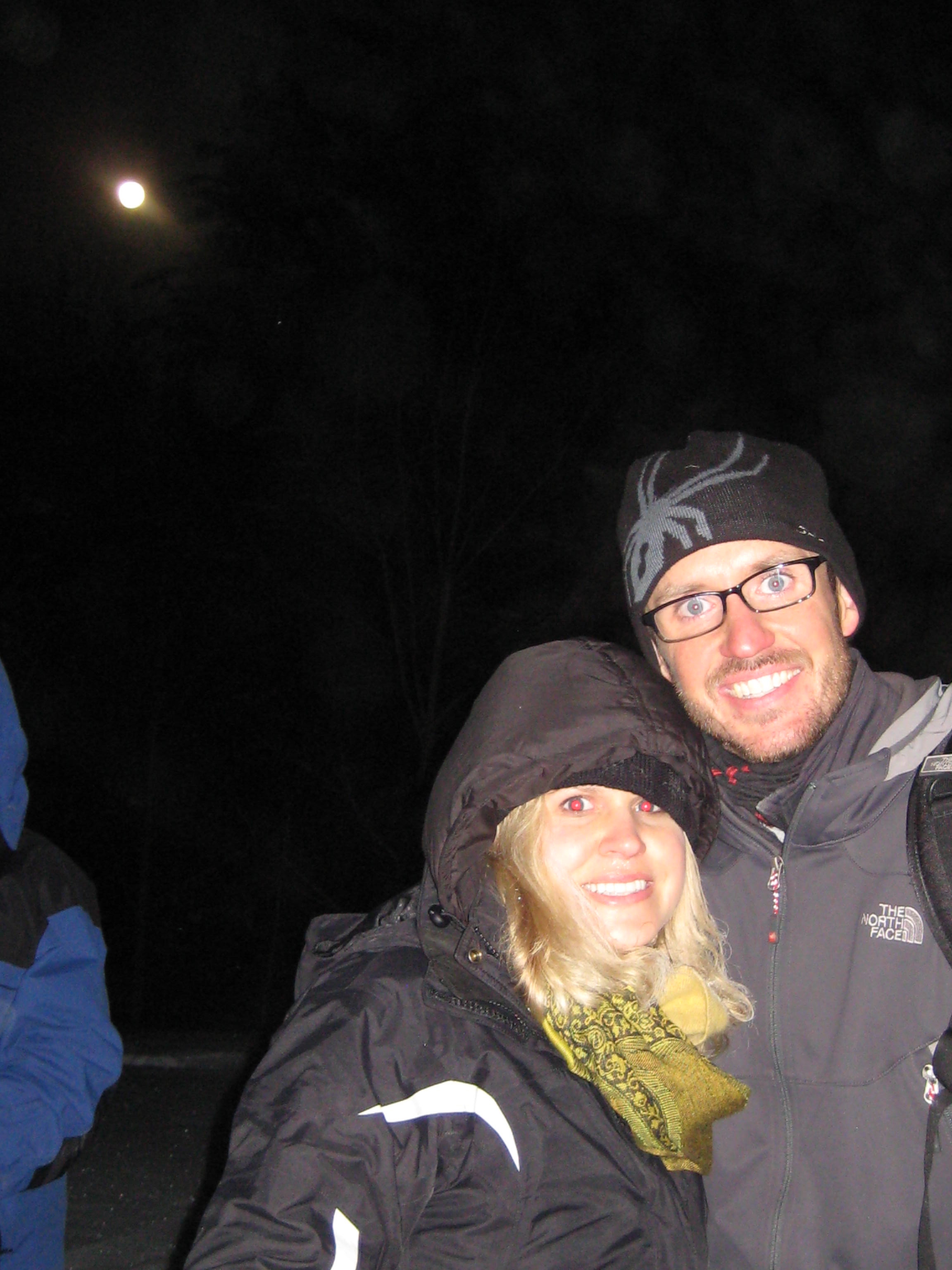
On the night of Gabe’s birthday, we went snowshoeing in the Jura mountains, around St. Cergue, with AIWC. It was the night of the full moon and it was beautifully clear.

I wish I could share lots of images to capture the beauty but it was so cold on the hike that there was no way I was going to take my hands out of my two pairs of gloves to snap photos.

How cold is too cold to remove hands from gloves? Negative 14 degrees.

I did manage a few shots as we started and finished.

Getting geared up in our snowshoes

Unfortunately, I got a bit faint about 10 minutes in… I think the combination of altitude and the chill with the exercise got to my body and I had that feeling that I was going to pass out. We had some experienced snowshoers in the group and they assured as that this was normal due to all the changes in temperature and pressure with the sudden movement. Luckily, they were right and I started to even out in dizziness as we pressed on. It was a good thing as the bus had already departed from our drop off point and it was still a 45 minute hike in the snow to our pick up point.

So thankful the group was so kind and patient to me, especially those who were experienced. Glad to report that I wasn’t eaten by coyotes and didn’t freeze to death in the wilderness and we made it to the end destination of a fondue restaurant.

We left our snowshoes before heading into the fondue restaurant

Since we really had to work for it, it may have been the best fondue we have ever had.


Gratitude Friday: 33 Years

Post by Lauren

This Friday’s gratitude post goes out to my husband, since Wednesday was his trente-troisième anniversaire.

Everyday spent with him is a gift.

Last Friday night, we had a triple birthday celebration with A & A as their birthday’s all fell within a week. We went to Mr. Pickwicks Pub for an evening out with Geneva friends. They gave us “the VIP room” (aka “The Champagne room”) for the celebration.

I made some chocolate and nutella cupcakes and L & L brought a lovely cake.

I speak for both Gabe and I that it is really nice that we have met such great people here in Geneva….it makes celebrating occasions like this a lot more joyous.

Here are a few photos from the night:

Bon weekend, everyone!

Ice Ice Baby

Post by Lauren

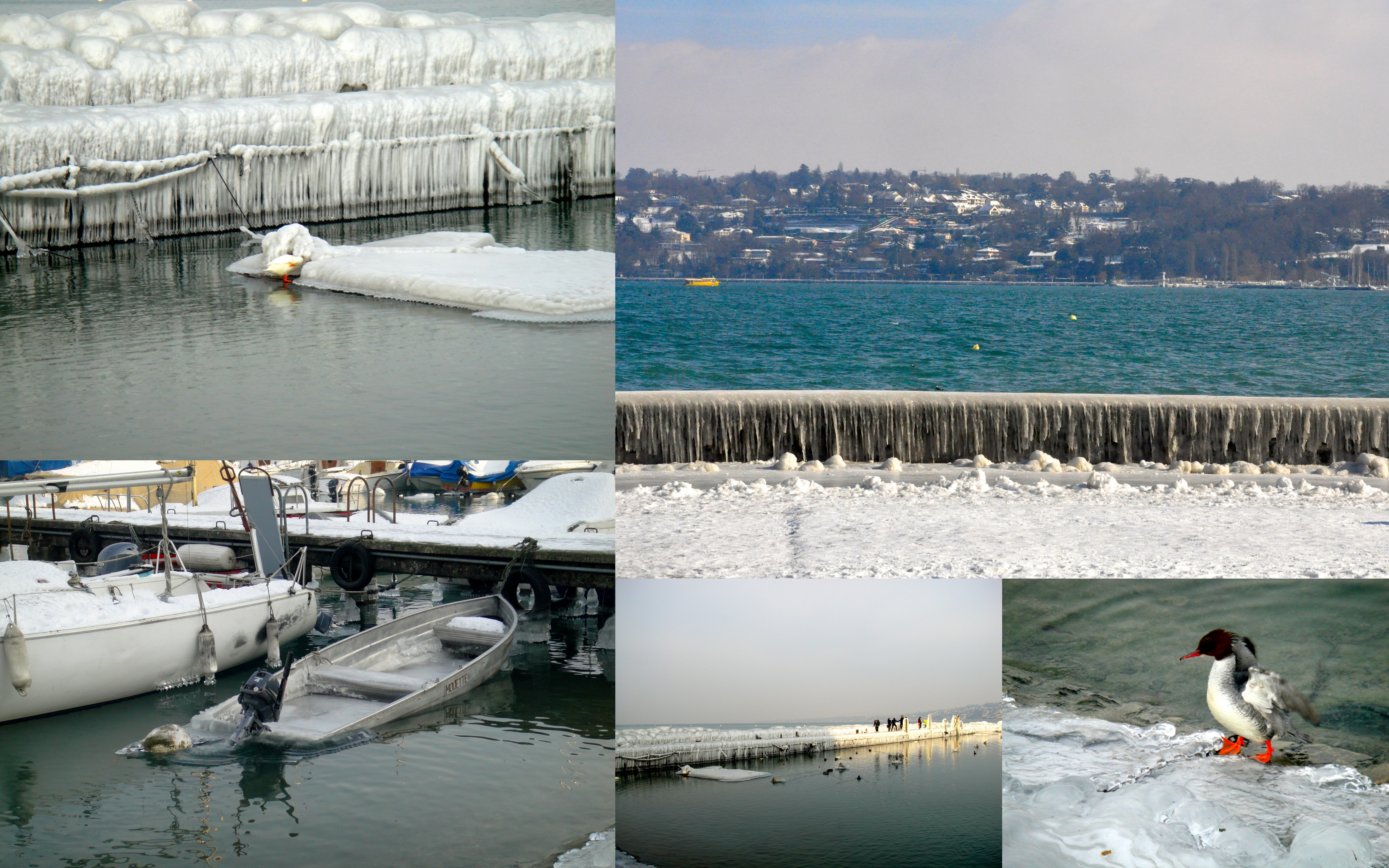
It’s frickin’ cold here. Definitely the most cold weather that I have ever experienced in my life. And wind to top it off. Every day for the past week, it has been below 0 F with the wind chill. I can’t really describe adequately except provide these examples:

–Extra layers. I don’t go outside of the house without 3 tops, and tights under my pants.

— Residual layer wearing – When I come back inside, I wear no less than a hoodie sweatshirt, a down coat and my stocking cap for 2 hours after returning. After a few cups of tea, I can gradually take off the coat.

— Random body reactions – There have been a few times that it is so cold my nose starts bleeding. I was waiting for the bus yesterday and felt a drip. When I touched my cotton glove to my face, I got blood. Eww. Also, my legs have started making little scratchy strawberries from being dry.

–Dread of showering – its so cold in our apartment that showering requires immediately diving under the covers for bringing the body to normal temperatures.

I took these photos during the course of the week. Near the lake, things have “iced” over.

I saw this photo on a friend’s Facebook page from a nearby suburb, Versoix, where L & L live. Hope these folks didn’t need their car for a few days!

Credit: One Big Photo

On Monday, the ice made a major water main burst near the commercial centre. Currently the buses are still out of whack from the traffic disruption.

However, it has not appeared that the ice has stopped the time yet. The flower (now ice) clock is still ticking away….

The flower clock

If you like the ice photos, check out some recounts from our friends’ blogs posts here and hereas well as there is a video news report here where you can see more crazy photos.

Hopefully everyone is staying warm wherever you are!

Guests: How Spelling Errors can be Deadly

Post by Lauren

One thing I noticed on my first trip to Europe is that you need make sure to know city names in the native language. Example: when going to Venice or Florence, look for Venezia or Firenze, their Italian names.

This was amplified when we moved to Switzerland. There are 4 official languages, so you always need to know the other versions for each city so you are sure you know where you are going.

To make matters worse, many cities sound the same.

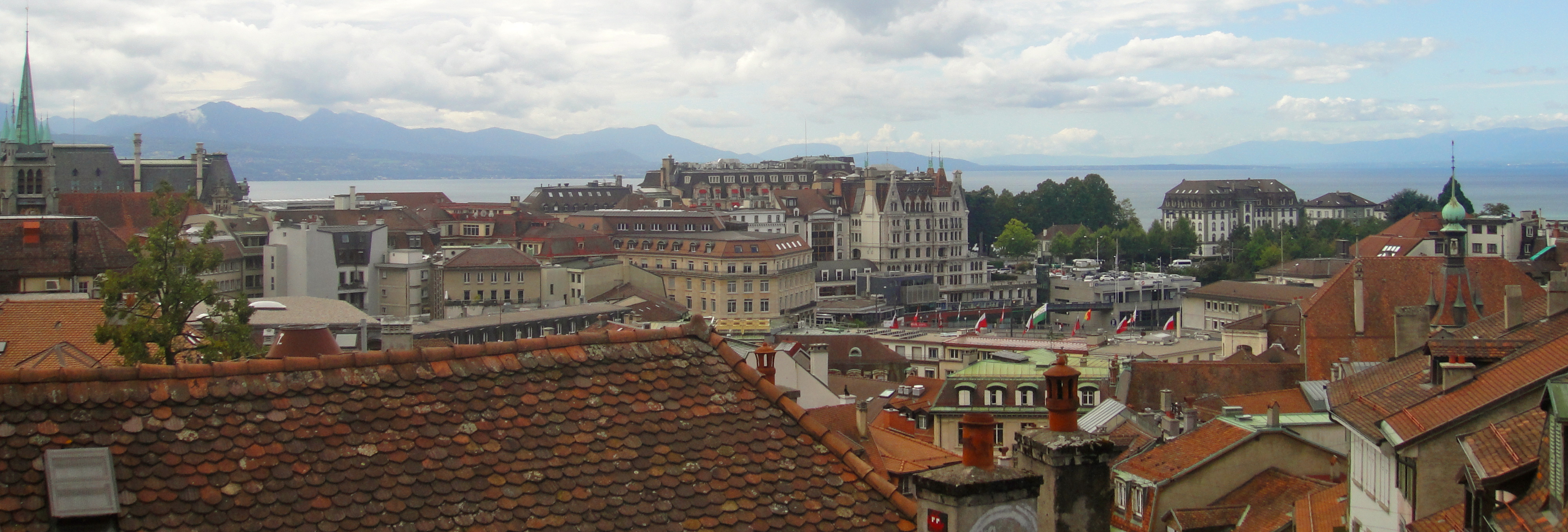
Lausanne sounds like Lucerne a little. When we have had friends come, it has been a tripping point. Wait…are we going to Lausanne or Lucerne? Or are they the same? They are both cities in Switzerland but not near each other at all.

Complicating that with the multiple language concept, Lucerne is French. It is Luzern in English, Lucerna in Italian and Lozärn in Swiss-German. If I saw Lozärn on a train board, I am willing to bet bet I would think it was just a variation of Lausanne.


This is Lausanne, not Lucerne.

In fact, in WWII, the British Air Force got confused and bombed Geneva instead of Genoa (Italy) on June 11, 1940 in three successive waves. Four Swiss people died because of the mistake and a dozen were injured. They are noted to have gotten off-position and said, “We thought it was Genoa.”

How terrible to die of a spelling error.

To our visitors, please note Geneva is Genève in French, Genf in German, Ginevra in Italian and Generva in Romansch. We don’t want you to end up in Genoa, Italy.

Guests: How to Tell Time Here

Post by Lauren

A few months ago, I did a post on the metric system and how difficult it is to get used to when you are used to another system.

Another cultural difference is in reading time.

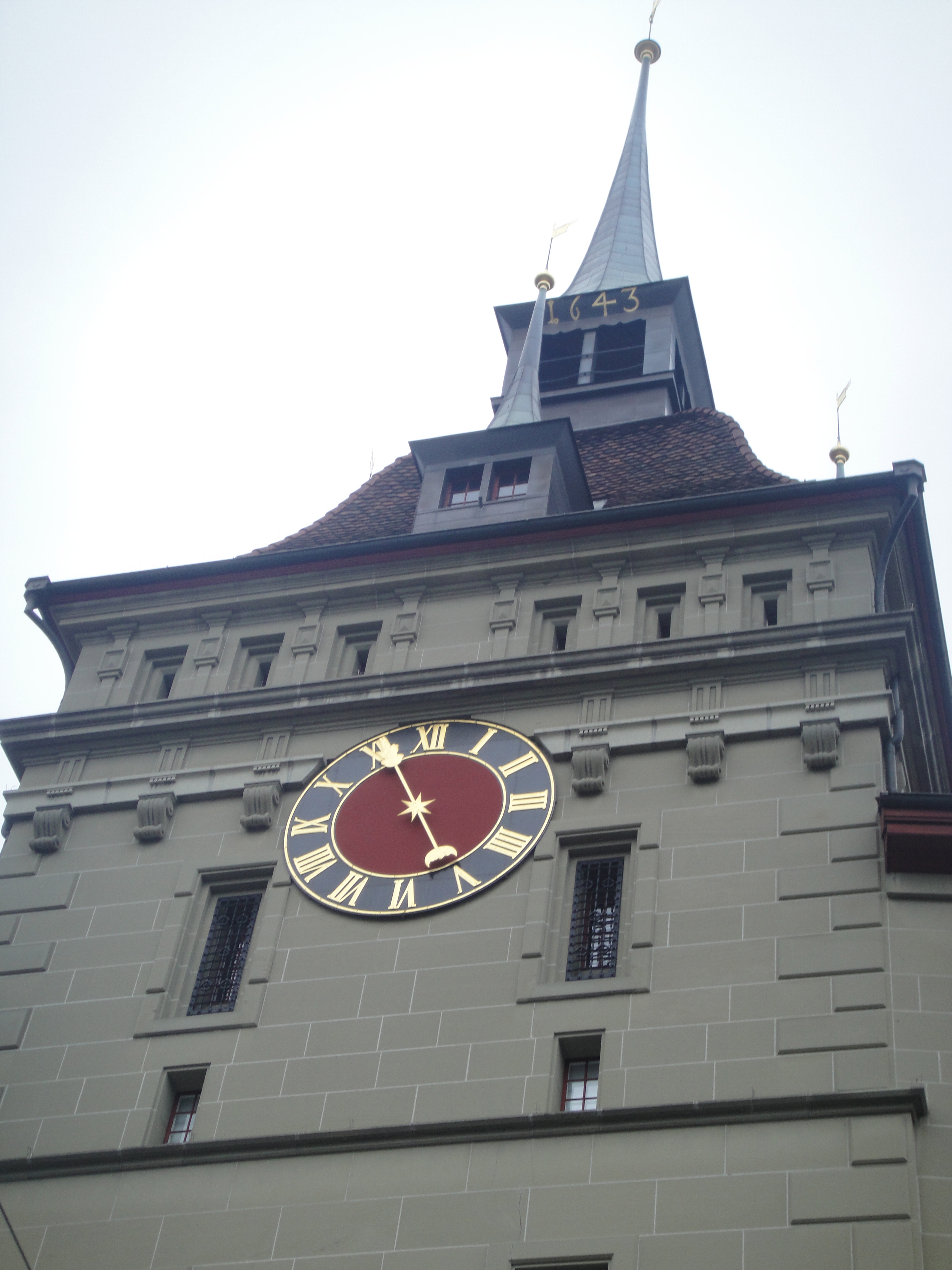
Clock tower in Bern


In Europe they use military time most of the time So, I get invitations for lunch at 13:15 and for French class at 14:30.

But, sometimes not. And that makes it really difficult when taking appointments over the phone. When arranging our next rendez-vous, I heard my French teacher say at “à douze heure” [ah-douz-urr] but she really said “à deux heure” [ah-dooz-urr]. One is 12 and one is 2. I asked for clarification once I saw her pencil it into her afternoon instead of mid-day and she quickly told me no one says 12pm, only “midi”. Okay, glad we have that solved.

They don’t use a.m. and p.m. here. I do some copywriting for the women’s club. As a habit, I write things like a certain group meets at 11am and constantly get reminded that it simply doesn’t apply. It’s 11:00. The other day I was tutoring English to a French lady at the women’s home and tried to explain the concept of a.m. and p.m. She commented that it was very odd we had that.

To keep complicating things, dates are listed here in Day / Month / Year vs. Month / Day / Year. So the grocery item marked 12/04/2012 actually expires in April instead of December of 2012. When you have mixed US and Swiss pantry items and medicine, it can get a bit confusing.

How does this apply to guests??
Please note that when filling out any paperwork, doing the date Day / Month / Year is important. Also, when you buy any type of train or airfare, pay attention to the date in this format and the time in this format. This would also be key for buying tickets to a show or museum. An 8:00 ticket would be in the morning vs. 20:00 in the evening. A train ticket on 2/3/12 is March 2nd, not February 3rd.

Guests: How to Ride the TPG (bus/tram)

Post by Lauren

It is likely that we won’t make you ride the public transport by yourself for your first time, but it is good to get a lesson on how it works. Once you know how to buy a ticket and how to go the right direction, it is easy!

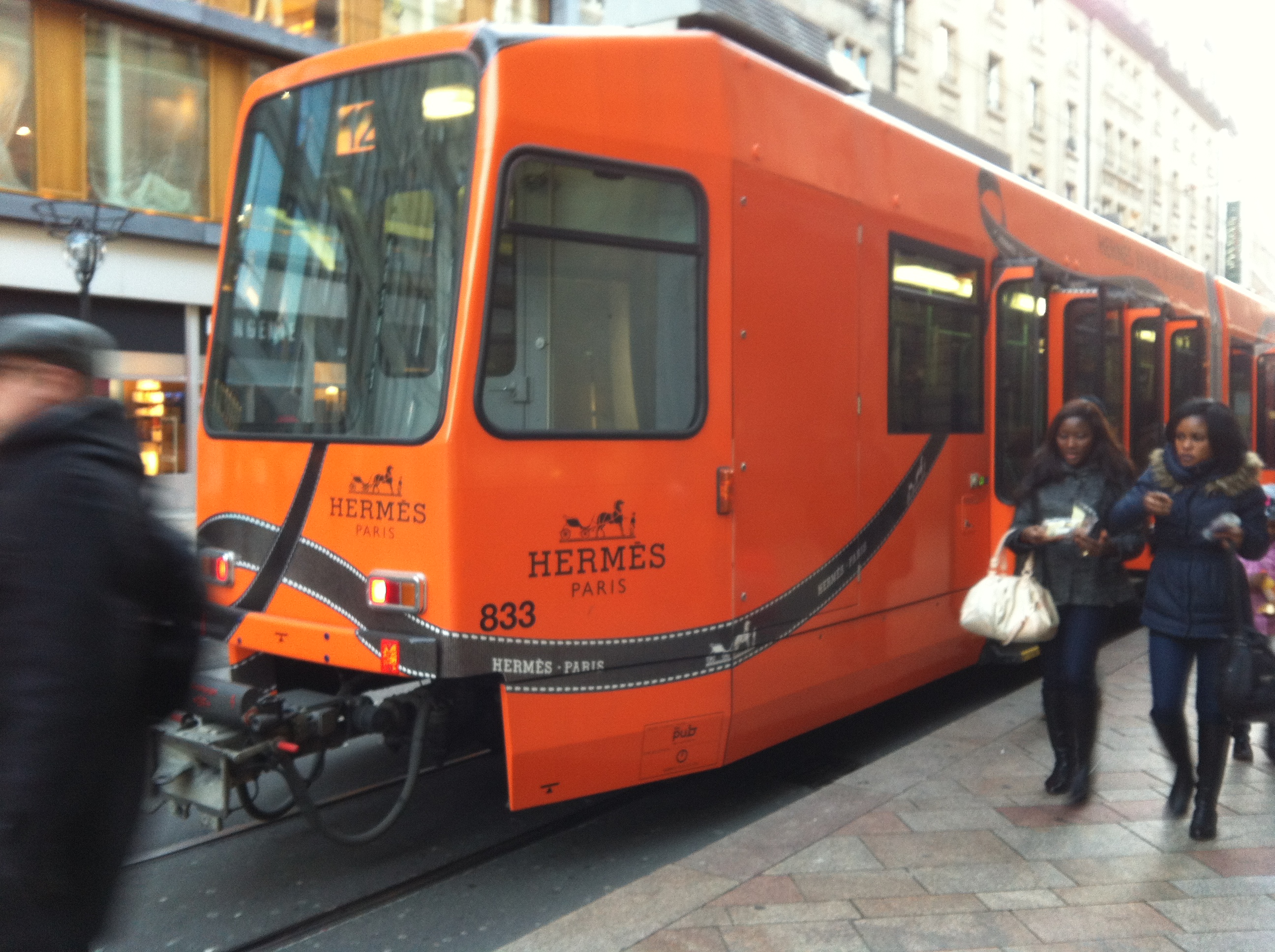
Switzerland is so rich they have an Hermes tram

The first thing to know is that you must have a ticket. If you are caught without it, it is something like 100 CHF payable on the spot. If you don’t have 100 CHF, they will walk with you to an ATM.

The second thing is that you do not actually have to show that ticket to anyone unless you are “checked” by a TPG officer (rarely happens). But tuck it in a safe place in case that happens on your journey.

The third thing to know is that you must have change handy to buy a ticket. In Switzerland, everything under a 10 CHF note is in change (see A’s post for the breakdown). If it is not exact change, it gives you a receipt that you can cash in for your change. There are only two offices and the lines are long, so I recommend putting in exact change. Or, you can always give your credit receipts to me as a present.

Here is how to buy a ticket:

Make all your decisions first or some angry Swiss person will get peeved you are taking too long. The Swiss like to buy their ticket right as the train is approaching so that they can maximize the hour, so if you don’t want to get yelled at in French, think about the following:

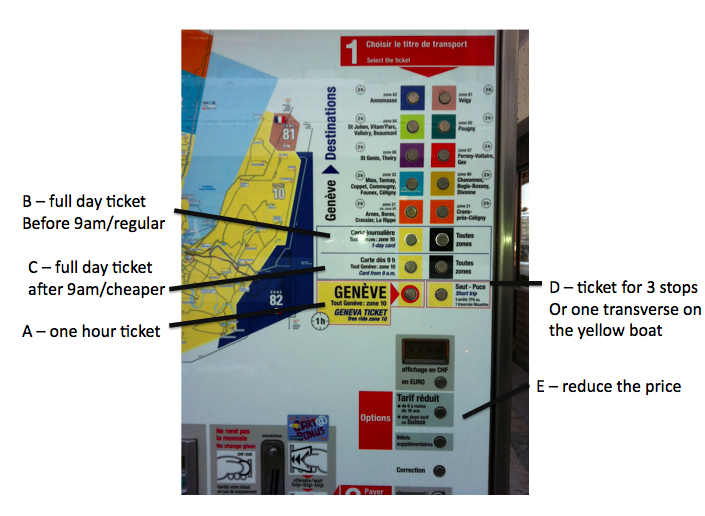
1. Decide how many separate times you’ll take public transport in the day. If just once or twice, you should just get a ordinary one-hour ticket [A] for 3.50 CHF. If you want to use it a few times, you should get a day ticket so that you can use it all day long.
1. If you are getting a day ticket, check your watch. If its after 9am, you are entitled to a cheaper full day ticket [B] for 8 CHF. If it is before 9am and you still want a regular full day ticket, hit [C] for 10.60 CHF.
2. If you are entitled to a half fare ticket (if you have a half fare card or Swiss Flexi Pass) hit [E] before inserting your money and it will make a reduction. For a one-hour ticket, it becomes 2.50 CHF, 5.60 CHF for a reduced full day and 7.60 for a full day regular.

Then the machine shows you how much you owe, you slip in the change, and voila! out comes your paper ticket. Put it somewhere safe so you can access it if checked.


But wait, how do I know where I am going???

You should know the number you want to take by referencing a map, or having us tell you which one to take. The tram runs two ways though so be careful to go the right way. They will be labeled with their end destination. You should reference on a map which direction you want to go, based on where you are. Each tram/bus stop also has the list of stops for each # on a sign that you could look at as well.

Careful that some lines have different destinations to provide frequency during rush hour. For example, the #5 in the northern direction goes to Aeroport usually (the end of the line) but sometimes there is also a #5 Nations. If you are going to the Aeroport (end of the line), don’t get on the Nations #5 or it won’t go far enough.

Here are some others that I know do this:
#12 Palettes and #12 Carouge
#14 Meyrin and #14 Cern
#8 OMS and #8 Appia

What is the difference between a bus and a tram?
They work in effect the same way. You have to hit the red button on the bus to make it stop for you. However, on a tram, it stops every time. You only have to hit the red button to open the doors so that you can exit.

Why do some buses have numbers and some letters?
The numbers travel in town and the letters travel out further into the countryside.

Are there other public transportation methods I can use?
Why yes, you can take the mouettes, the boats. For a one-way, you can buy a ticket simple [D] for 2 CHF that is good for one crossing or riding the bus/tram only 3 stops (usually you ride it more than 3 stops so that is why I didn’t mention it above). Your hour pass or day pass also covers travel on these, if you already have that type of ticket, you are good to go.

Is there anything else I need to know?
Yes….when your stop is approaching, you need to stand up and by the door. If you do not show initiative to exit, the people waiting to get on the tram/bus could end up boxing you in. As the cheerleaders say,” Be aggressive…be be aggressive.”

And…watch your wallet/purse. Pick pocketing is very common in Geneva. Just be smart!

Guests: How to Ride Swiss Trains

Post by Lauren

Swiss Trains are AMAZING. They run on time and get you to pretty much any place in Switzerland.


Handy map of Switzerland and its train system: http://www.swisstravelsystem.ch/fileadmin/pdf/STS-GB-M-11-EN-WEB.pdf

Here is some basic information on what approaches to take when buying train tickets:

DISCOUNTS FOR ANYONE:

Half fare card = 150 CHF to obtain – knocks all train / boat / cable-car purchases in half.
*You can just use it to reduce your fare in half
OR
    *Holders of half fare card may purchase day cards for 64 CHF which provide unlimited travel for a whole day on all SBB trains and Post Buses. Day cards after 9am are 48 CHF but can’t be used Sat, Sun or holidays
How it works: you must buy in Switzerland upon arrival. You must have a small passport photo.

Pro: If you are here a long time and are traveling long distances, it could be worth it

Con: It is a year pass, non transferable, and you wouldn’t be able to use it rest of year – unless you visit us again 🙂

DISCOUNTS, ONLY FOR TOURISTS:


Swiss Pass – must buy not in Switzerland at ST offices and travel agents or  www.swisstravelsystem.ch in advance of your trip. Covers all travel on rail, buses and boats and some cable ways. Must validate at airport upon landing in Switzerland. 4 day = 260 CHF, 8 day = 376 CHF, etc. Must be concurrent days. You get 15% discount for 2 adults.

Note: you must validate it to start or you’ll get in trouble

Pro: If you travel every day long distances, this is a good value

Con: Must be used in concurrent days so isn’t a good value if you are resting in cities or in Geneva other days
OR

Swiss Flexi Pass – allows between 3 and 6 days travel within one month. You get 15% discount for 2 adults. On the travel days, you can have free travel on most public transport. On days in between, you can travel for half the fare. You are also entitled to receive a discount on many gondolas, funiculars and mountain trains.
3 days = 249 CHF
4 days = 302 CHF
5 days = 349 CHF
Note: you must validate it for the days you use it

Pro: Makes a lot of sense if you are here for a week and we are traveling a lot in Switzerland
For more, see this: http://www.myswissalps.com/swissflexipass.asp?lang=EN

OR, BUY AS YOU GO

Supersaver single tickets – provide large discounts on selected long distance routes – http://sparbillette.sbb.ch  (limited in number and only 14 days out).
Pro: Good to know about for one-off trips

Con: you can’t book up until 14 days in advance

OR

We can buy as we go on the machines at the train station. You can see timetables and quote trips at:

http://www.sbb.ch/en/home.html

Pro: flexibility
Con: not as many savings

General Tips:

What is best is to do the math for the individual trips. Example, If you invest in a 150 Half fare card, you can deduct the fares in half, but do the number of trips make up the 150 CHF investment? With the Swiss Flexi pass, are your savings more than adding up the trips? If not, it might be cheaper to buy as you go. Use this URL to quote one-off trips:
http://www.sbb.ch/en/home.html

Please note that with day passes, Swiss passes and Swiss Flexi passes, you must Validate your ticket in an orange machine, provided on all platforms by inserting the ticket into the slot.

Some things to know about Swiss trains:

-The big train signs that show where to go to catch it always list the end destination. If you are not going to its’ end destination, make sure to note the other stops to confirm it is your train. It will then give you a “Voie” or “Bin” which means the # of the track your train will come on. Sub tips:
-If your destination isn’t listed and its more than 15 minutes until yours departs, don’t assume you are in the wrong place. Trains come through every 10-15 minutes so yours will show up soon if you are the correct Voie.
-Once its time for yours, your board will change. Then the next train that arrives is safe to get on. Also use the clock shown to verify. If its 13:29 (1:29pm), then its too early for the 13:42. If its 13:35-13:40, then this is about the time when it will arrive.

-Take heed to make sure you enter the trains marked 2 if you are in 2nd class. Otherwise, you might be contributing to Switzerland’s economy more than you want. We learned this the hard way.

-They don’t check your ticket to get on the train, but shortly into the trip, someone comes by. You must have all forms of documentation – for example, your ticket plus your half fare card together.

-They have bathrooms

– They do have a drink/food cart and on longer trains, a dining car. However, the food cart doesn’t look appealing and is expensive so consider bringing your own snacks and food (plus a bottle of wine!)

-You do not get assigned seats unless you are going to another country (France, Italy) or riding a scenic train (Glacier Express, Golden Pass, Bernina Express, William Tell). But you might get booted at some point from yours if you are sitting in someone’s who is doing a trip like this.

-If you ride the scenic trains, you need a reservation in addition to your ticket. We can help you get that at the station.

-You can generally get off in a city that looks appealing for a few hours, and hop on a later train to your destination

Bon voyage!


Guests: What you need to know!

Post by Lauren

We have visitors coming soon!! The next few posts are all about what you need to know when you visit us.

Logistics wise:

-We live in Geneva, so the GVA airport is the best to fly into. It is only 20 minutes driving or a 30 minute bus ride from our house.

-If we are picking you up: when you exit baggage claim, there is only one exit to the GVA airport so don’t worry about getting lost! We’ll be there waiting!

-If for some reason you are taking public transportation, please note that you can get a free transportation ticket in the baggage claim area, good for one hour. Make sure to get it at the time when you are leaving so you maximize the hour.

Push the button to get a free TPG ticket. Wait until right before you leave to maximize the hour!


What to Bring:

-Many of your small electronics may not work. We have a Swiss hairdryer, so don’t bother to bring yours. Use your curling irons and straigteners at your own risk as the electricity is known to eat them.

-We have a Swiss converter for you to use while you are here. But, if you are going to another country, you may want to buy one in advance for that country since the Swiss one is special.

-If you want to pack lighter and bring only a few outfits, you are welcome to do laundry while you are here. Just know that it takes 5 hours for one load. I will also make you do it so you get to see how fun it is!

-If you have any specific medicines you use or think you might need, bring them. They don’t have things like cold medicine, Pepto Bismol, etc. here. We do have a stock of American Advil and common pain killers though.

-If you have any special things you like, such as Lipton Tea or Sweet & Low, you may want to bring a stash. We don’t have that stuff here either.

-Same goes for snacks. It’s good to maybe bring a stash of your favorite stuff for day trips since a bag of chips at a convenience store will cost 8 francs. Also, they might not have a selection you like.

-We have towels, washcloths and linens so you don’t need to bring that stuff.

-We also have practical things like soap, shampoo, conditioner, lotion, band-aids, etc at our home so you can pack less of that. However, if you like a certain kind, feel free to bring it.

-If we are traveling during your stay to hotels, do bring a little bottle of conditioner if it something you like to use. European hotels don’t provide this. One of my pet peeves!!

-We only have one bathroom, so you may want a light robe or something to walk around in.

-The water is completely safe here and yummy. They have fountains everywhere. Bring a bottle to save money on buying bottled water.

-A large daybag or backpack could be handy for the plane carry-on and you
could also take it on our day trips.

-Women should bring a purse that zips fully and is secure. The main type of crime in Europe is pickpocketing, not violent crime, so you should select a purse that can be
closed up easily.

-If you are doing a smaller trip without us, you are welcome to borrow a backpack or small suitcase of ours.

Finances and Budgeting:

-Depending on where we go, you could need Swiss Francs and Euros (over the border). We recommend that you use an ATM card to take out money at an ATM here. There are a lot of ATMs at the Geneva airport, and around town. You could get them before you leave the US, but most banks charge $10 or so to order them for you, which is more than your fee will be taking the cash out here.

-You can use your credit card for big activities like train tickets, cable car rides and hotels. But, please be warned you’re your card could have a fee associated with it, at 1-2% for International purchases. Also, do not assume you can use your credit card at restaurants, convenience stores, or for street food….this is more of a cash society and they are often not taken.

-Call your credit card company beforehand if you plan to use your card while you are here….just to avoid it being shut off when they see a European purchase

-Switzerland is expensive! We can make meals at home as much as you like, such as breakfasts and dinners, but here is what to budget:

-Breakfast out if not provided by us or hotel: around 10 CHF for coffee & a pastry
-Lunches out: 15 CHF minimum but most places are 20-30 CHF
-Dinners out: 20-30 CHF minimum
-A soda or a water at a cafe: 5-6 CHF
-Train tickets: One hour away – about 30 CHF, two hours, about 50 CHF. See tomorrow’s train post for savings.
-If we’ll be taking public transportation, it only takes coins (3.50 CHF/one or 8-10 CHF/day), so keep your change. Also note that it doesn’t give change so its good to have lots of change handy so that you have the right amount.

-The exchange rate fluctuates between 10-20% over the dollar. So just know that if its marked CHF, its 10-20% more than the USD depending on when your visit is.

Other Travel tips:

-Make a color copy of your passport to slip into each luggage that you bring. Just in case it is stolen, its easier to recover with a copy.

-Always be aware of your belongings. Keep purses and backpacks in your lap on public transportation vs. at your side or on your back. Keep purses in your lap when eating at a restaurant vs. on the back of your chair. If you sit your backpack down on the ground when you are eating, loop your foot through the strap so that it can’t be grabbed. We don’t mean to scare you as you’ll be safe….the crime is just limited to theft. However, we know many very smart and alert people who have been robbed in Europe. Just remember, it is these people’s profession and they are GOOD at stealing.

-If you are traveling without us, its good practice to pick up a hotel card so you always have it in case you get lost, you can use it to get directions or a cab ride.