Reason # 37 I wish I knew German

Post by Lauren


Introducing Sven. He is a Volvo. He is our method of transportation when we aren’t using Geneva public transportation or trains. Like in the case of Gruyeres that is best explored by car because of how remote it is. Its only a 1 1/2 hour drive, but via trains/buses, it would be more like 4 hours. Also, sometimes its cheaper to use a car if you have multiple passengers vs. buying train tickets. Of course, it could provide more room for issues in driving or directions, but that is part of the fun.

Sven is always very dependable. Until this weekend. He starting acting up in Vevey, when we stopped for coffee and a peak at the shoreline.

The guys looked under the hood, but we decided to press on to our trip to Gruyeres. After cheese tasting, Sven had some trouble starting. Uh-oh. It was a Sunday, we were in the middle of no-where. And it was raining. We kept on going to the castle, etc. and just kept our fingers crossed Sven was going to be able to be revived upon our return to him. We made sure to leave by 6pm, so we could figure out from an open restaurant how to do the train home if we had to. There wouldn’t be any prayer of an open service station on a Sunday. Questioning why? See a previous post.

We enjoyed our trip and descended down the mountain hill in the rain, hoping and praying Sven wouldn’t disappoint. He sputtered out. After seven attempts, he started.

Immediately after we took off, he displayed this warning:

None of us knew German. We assumed he was telling us he was going to blow up. Oh no, and now we were out of walking distance to assistance for the train route. Andreas hurriedly pulled out his Blackberry and translated. And it translated “trunk open”. We stopped, closed the front hood, and Sven pulled off his warning. We laughed. Disaster averted.

So, thus, another reason I wish I knew a different language. We could actually know what our car needed. But then again, what is the fun in that?

Gratitude Friday: Le cours de français est fini

Post by Lauren

it was an easy gratitude selection this week….French bootcamp is done! I even got a diploma!!

Kidding aside about the completion, I am very grateful that I had the opportunity to take this intensive course. Being immersed for 8-10 hours a day definitely accelerated me and my speaking. The University of Geneva hosted a wonderful program and I was really impressed by the organization of such an endeavor with all students being at different levels and no common language to teach in. It’s remarkable how we can all learn a language being taught in that same language we don’t fully know yet. They had fun, creative electives to lighten up the classroom teaching. I enjoyed the lunchtime story-telling and singing classes the best.

And, a big thanks to my very supportive husband for encouraging me to take it even though we had to foot the bill for the course ourselves. And also since many evenings, I would be a french zombie…trying to formulate questions and responses in French before realizing i didn’t have to do that with him. Thank goodness 🙂

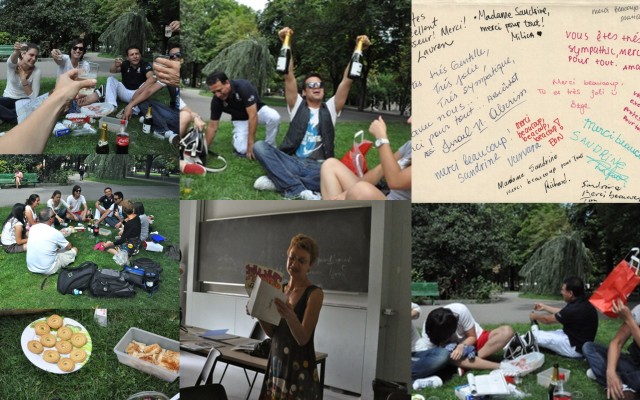
We had a class picnic today to celebrate the final day. I thought it was everyone bring your own, but about half the people brought a delicacy from their country. Ozge made handmade cheese pastries from Turkey, Sabrina brought cookies from the Dominican Republic, Milica brought chocolates and fig newton type things from Serbia, and the Brazilian guys brought mango juice. Ricard ran out and bought some celebratory champagne which we enjoyed in the park as well, especially the distraction the popping made to all the other students!

We also gave our teacher, Sandrine, a card. I thought you’d enjoy seeing it as well.

Bon week-end everyone!

I can’t count to 100 anymore

Post by Lauren

One of the most frustrating things about speaking French in Geneva has to be the numbers 70-99. See, in French, once you get to 70, you have scary numbers that are math problems in themselves.

For example, 70 is 60+10 or soixante dix. When you progress to 71, 72, you add by a number already in its teens. So for 71, its 60+11, so soixante onze. And then for 72, its 60 + 12 so soixante-douze. And so on….

However, then for 80, its 4 x 20. And for 81, 82, you add by one, two, etc. So, for 81 it is 80+1, so quatre-vingts et un. 82 is quatre-vingts deux. And so on….

When you get to 90, it is 4 x 20 + 10. Back to the number in the teens. So, for 92, for exampe, its quatre-vingt-douze. And so on….

Why in the world don’t they use the same system? Why different names and different things to add, like 1 sometime and 11 sometimes?

And, this might be enough to give you a headache. Especially when you are at a store and they spit out numbers really fast.

However….enter…..solution!! I found out that in Switzerland, they use septante and nonante for 70 and 90. Then add by 1‘s. Ingenious. Those are easy!!! I was pumped I wouldn’t have to remember the really hard France French way.

In Lausanne, one town over, they use huitante for 80. Even better!! I started wishing I lived in Lausanne.

I made this chart for this blog post to help explain. I realize this may have been 15 minutes I’ll never get back as you are likely just skipping through the nonsense on this post.


But, alas…..when you go to different stores in Switzerland, they use a combination of all the above numbers. It’s unpredictable. So, not only do you have to know the really hard numbers, but you have to know all 3 versions.

Just imagine giving out a telephone number or even writing one someone gives you. It goes like this….

+41 079 589 78 92

You could be standing in one part of Switzerland. Imagine it…..

–5 miles away in France, one would say: plus quatre-vingt / zero soixante dix-neuf / cinq cent quatre-vingt-neuf / soixante dix-huit / quatre-vingt-douze

–5 miles away in Geneva territory, one would say: plus quatre-vingt / zero septante-neuf / cinq cent quatre-vingt-neuf / septante-huit / nonante-deux

–Yet, in Lausanne territory, where you are standing, you’d say: plus quatre-vingt / zero septante-neuf / cinq cent huitante-neuf / septante-huit / nonante-deux

Got that #?

A Page from the Swiss Rule Book: Recycling

Post by Lauren

I am all about protecting Mother Earth. However, here in Switzerland, it really requires a lot of knowledge and time to keep up with your recycling. I really don’t know how I would manage if I were working full-time and had to do all of this, especially with the limited hours that the bins are available for use and stores are open. Also, they have “garbage police” that track down any offenders via rooting though your garbage for clues about your identity.

So, here is a breakdown of what is required:

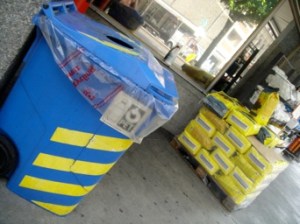
Aluminum – cans go to a special aluminum bin that is normally located in your neighborhood recycling area. Note that my closest one is on the walk to the women’s club, so I take aluminum on days I have French.

Batteries & Lightbulbs – you have to take these back to the store you bought them. Usually the bin is right before you get into the store. We haven’t had this happen yet but good to know.


Compost – you are required collect your natural food scraps and put it in the special bin for compost. They make special bags for this but I have been using the bags that my salad comes in to dump since the teeny bags are about 1 CHF each.

Glass bottles – these go to a neighborhood collection site. The closest one is 3 blocks away, on my way to the post office. Usually this bag gets quite heavy as I despise going to the post office. Note the bag can get very full if you have a dinner party with beer and wine.

WARNING – you are only allowed to do this within certain hours, 8a-8pm, and NEVER on Sundays or holidays. My friend Alysoun and her husband were severely reprimanded by two separate neighbors for breaking this ordinance on the last Swiss holiday during the middle of the day, which was on a Monday.

Milk bottles – these have to actually go back to the grocery store, they usually go to the milk section inside the store – there is a little hole in the wall you insert your old bottles into. This has to happen during store hours, 8:30-7pm and when you know you are going to the store. One day, I carried three empty milk bottles around all day because I knew I was going to hit the Co-op that afternoon.

Paper & cardboard – this goes in your building’s bin. If your building doesn’t have a bin, you have to tie it up neatly in a 1’ x 1’ bundle tied with twine and put it on the street a certain day.


PET / Plastic Bottles – these have to be collected from the store you brought it from since it is the liability of the store from making profit of selling plastic bottles. So when you go grocery shopping, you need to return them with you. Sometimes these bins are just outside of the store, sometimes they are in the store.


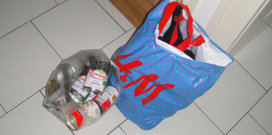
While I feel very eco-responsible, I do miss single stream like we had in the US. And I never leave the house without a bag of something to recycle. I am a continual bag lady. This is typically the size of the load I carry out each day:


We had been keeping everything in the kitchen for convenience:

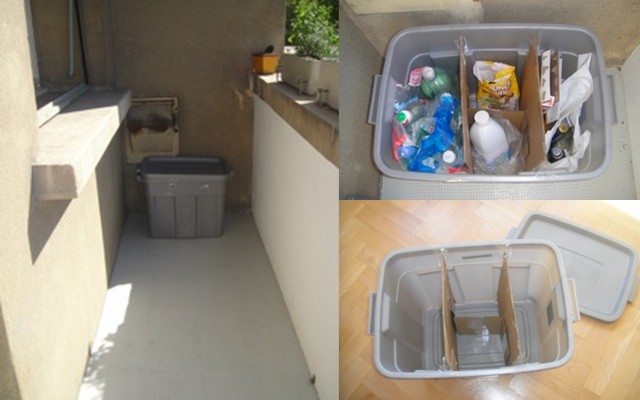
However, I finally couldn’t take the eyesore and smell, so I invented a new bin using a Rubbermaid tote. It sits outside on our kitchen balcony.

Happy Recycling Everyone!

The Liger of Kitchen Appliances

Post by Lauren

The history:
Those who knew me circa 2006 knew that my absolute favorite animal in the whole world was a Liger. I even dressed up as one for the work Halloween party.

For those of you who haven’t seen Napoleon Dynamite, this wondrous creature that was half lion and half tiger, pictured below.

Part 2:

When you move to Switzerland, none of your appliances and electronics work on the electrical system, here, with the exception of chargers, etc.

What this means is you have to go out and buy new everything. The hard part is that they are generally 3-4 times what they are back home. So, Gabe and I had to seriously consider what appliances to “invest in” in our time here.

Obviously, the TV made the cut to purchase. I also added a printer, an iron, and a vacuum.

When it came to the kitchen, we bought a coffeemaker. We had to make a difficult choice on a warming appliance.

See, Gabe fell in love with my toaster oven when we were dating. A toaster oven was what I was used to – I don’t think we had a toaster when I was growing up. Anyhow, he loved how easy it was to warm up meals, or make things more than just toast. And when his roommate moved out in Atlanta, he had lived without a microwave in Atlanta for about 8 months and had managed. I wish I owed stock in Chipotle during that time.

While I loved the toaster oven as well, it seemed to be a big trade-off. I mean, our oven is almost the size of a toaster oven here. So, I really didn’t think it was saving on electricity or ramp-up time to start our oven like it would’ve in the US. But, there was something intriguing about the idea of ditching the nuke-machine.

In the end, we decided to go with the toaster oven. This is until we went shopping and much did our eyes delight find….drum-roll….toaster oven and microwave combos!!!

The Liger of Kitchen Appliances

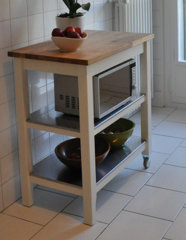
I was skeptical at first, but couldn’t really turn down this fabulous idea down. I mean, can your microwave grill or microwave as the same time??? It is the “liger” of kitchen appliances.

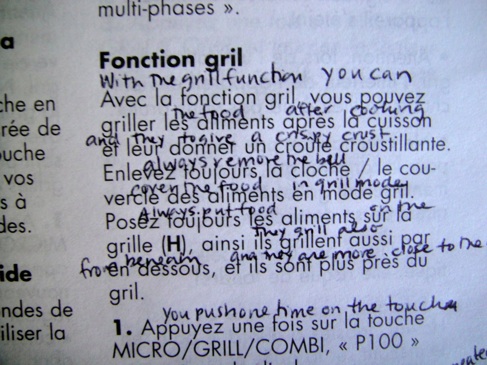
I read up on the instructions….translating so that I could use it to toast the grain bread I normally had with my lunch. And I tried, doing exactly what these instructions said.

Something was lost in translation

Apparently, something was lost in translation as my result was a pop, smoke and some burned bread with black holes in it. Note: with the metal insert for grilling, it can cause much havoc if things aren’t done right.

Does anyone living in Switzerland have one of these liger microwaves and know how to properly use it? In the meantime, I am only using this bad boy for microwaving so I don’t burn our apartment building down.

Rain, rain go away…..

Post by Lauren

When it rained in Charlotte, it wasn’t a big deal. I mean, it was a good water cooler topic, with people commenting, “ummm…i think its supposed to rain today” and “man, did you hear that crazy storm last night?” but it really wasn’t a show stopper. Mainly because we had cars there. And you’d hop in your car that was really close to the office entrance and drive that car to a grocery store and park really close and then home which was virtually by your door or even completely sans rain with a garage. And you could keep rain gear in your car if the occasion arose to need it.

And as we continue, this post is not meant to discourage public transportation. I am a huge fan and it would rank in one of the top 3 reasons I love Geneva. But, I am certainly developing a whole new appreciation for city-dwellers all over the world. They have this completely different life than what I am used to.

And……sometimes it is not glamourous.

I got my first taste of this when I walked / trammed / bussed home a large house plant from IKEA over the course of a 2 hour adventure. Quite different from my experience buying a plant in the US. Before, I’d roll up to the Home Depot about a mile from my house, pull my car really close, use a cart to load it, and I was set. It would take 10 minutes tops and I wouldn’t break a sweat. A little different carrying a fern a mile and then getting boxed into a tram and needing a rescue effort to get out and home.

And, now, I am learning from rain. Life goes on when it rains, but in a city, it is quite different. You have to be prepared, or else be drenched.

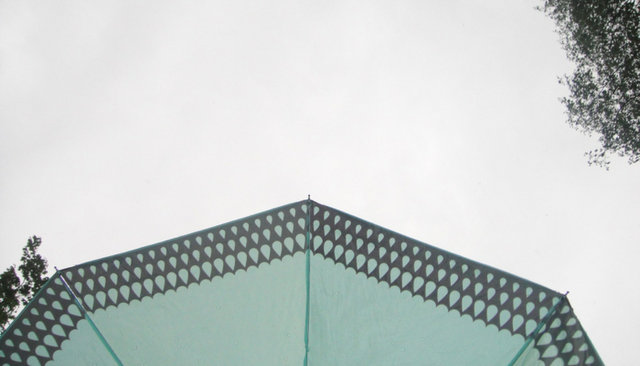
#1 – You have to remember your umbrella. And if you live on a lake, there is a chance of rain most days, so you really should bring it with you at all times. And since we don’t use cars, this means – carry on your person. Here are the contents I already have in my bag this week:
– normal purse stuff – wallet, phone, camera, passport, etc.
– gym clothes and shoes – since i go before French, and then have to carry my clothes and shoes for the next 12 hours. This would be better if Globo Gym didn’t require a clean set of shoes upon entrance, but it is what it is and i have to carry them around in my purse all day after my session
– toiletries from showering at the gym – makeup, hair, comb
– my school books, papers, pens, pencils, highlighters, French dictionary, reading glasses
– my breakfast and lunch for the day – the lunch line is too long with our 15 min break
– my umbrella and rain coat
It makes me tired listing this out. The umbrella and rain coat are the items that really push it though.

# 2 – You have to accommodate your umbrella at all times. On the tram, while you are walking if its not raining anymore but the thing is wet, in stores ( got yelled at for bringing mine in store the other day), and when you reach your destination – whether it be temporary or permanent.

# 3 – You have to navigate your umbrella. On a city street, this can get awkward. I had a showdown with a lady in my neighborhood on the teeny sidewalk. Who was going to jump of the sidewalk and risk death by bus? I ended up raising mine really high to the sky to avoid either of us going into the street…not easy when you are 5’ 2”. However, I am worried I might lose an eye over here to an umbrella showdown.

# 4 – You are permanently damp and icky. But at least everyone is. Just today, I had an appointment with the chiropractor at 6:30. It required an hours worth of connections to get there. It just so happened one of my transfers that I wasn’t familiar with was in the middle of a big downpour burst and doing the turmoil, my umbrella broke and I was soaked to the bone. Good thing I had my gym clothes with me, as guess what I did?

There’s always a bright side to being a bag lady I suppose.

A few tid-bits of Genève history

Post by Lauren

Now that I am a student, I am learning more about the history of Genève. We actually have some cultural excursions built into our summer French course. On Monday, a professor gave us a walking tour of the area around the University. She said it was the last time she was going to teach us anything in English, so I figured I better report on this one as my facts might get a little screwy in the future when I am trying to digest them en français.

Henri Dufour was one of most important men in Geneva history. He was a Swiss army officer, and engineer and topographer. He helped found the Red Cross along with Henry Dunant.

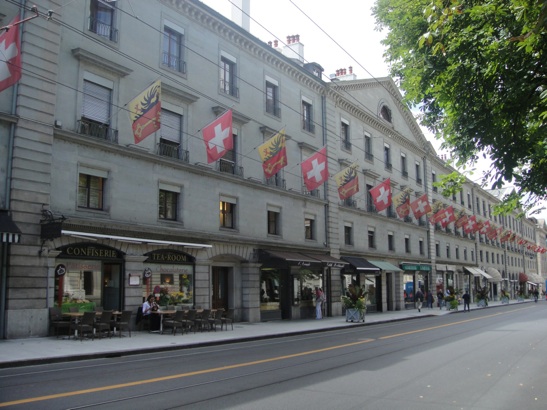
Our professor said that the windows along Rue de Confederation were designed to maintain the same perspective the entire length of the street. Good to know if I ever decide to paint it!


T

he population of Geneva doubled by 10,000 in one year in the 16th Century as French and Italian Protestant refugees fled from their countries into Switzerland to escape the massacres. Since it was a walled city for its own protection, they ran out of room and had to go upward. See the different stories and window patterns as you go up?

Note, that in the Reformation, that is why Geneva became the center of commerce and trade – it now housed an extraordinary amount of watchmakers, jewelers, & bankers.

It still be it is harder to find an apartment now in Geneva than back in the day. Current vacancy rate is 0.17% – yes, that is a tenth of 1 percent, not 17%.

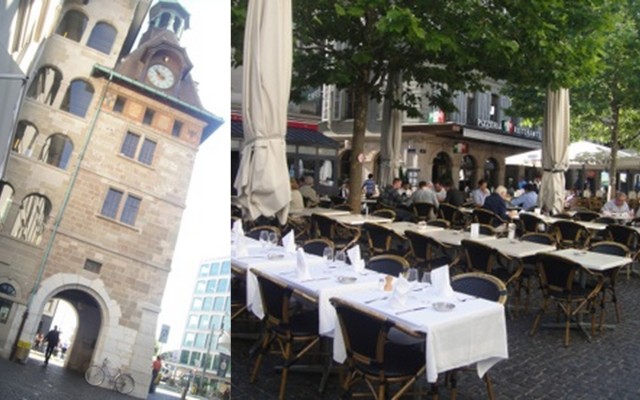
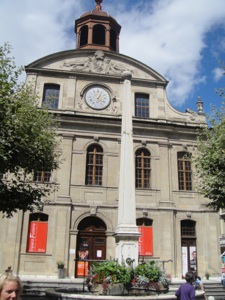
Place de la Fusterie and Molard used to be actual ports. Water once was were cafés now are. There were different ports for different goods, like water, food and stone.

Place du Molard, current times

Place du Fusterie, current times

They had to eventually push the Rhone out to make more room for the population. Temple de la Fusterie was a French Protestant Temple after they pushed back the water. Globo Gym is located directly between these two. If only they knew back then.

Pierre du Nitron

We have seen this little rock many a day, but never knew its significance. It was brought in by the glaciers and used to be a place for human sacrifice in the Iron Ages. Later, when the mountain elevations of Switzerland were being mapped, this rock was apparently used as a surveying basis for determining heights for all of Switzerland.

Okay, that is it for now as I need to be a good student and study more French. Au revoir!

I always wanted to be a débutante

Post by Lauren

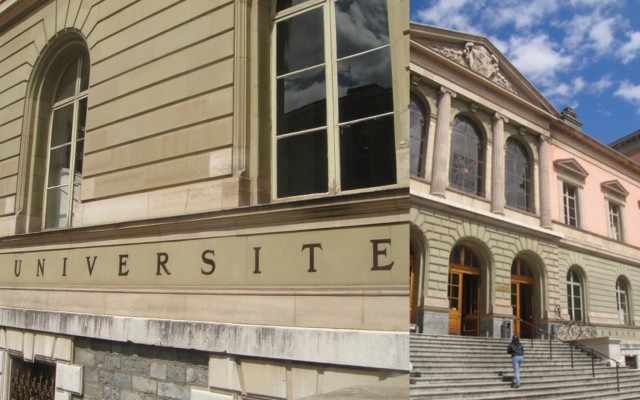
It’s official….I am now a student of the University of Genève. Actually, I am just taking a 3 week intensive French course. The unfortunate thing about it is that I’ll have to turn in my handy student ID on August 6th. I was looking forward to the student discounts!!

We had to take a knowledge test yesterday and then all anxiously arrived early today to see what class we were placed in. I am an A2. Which means, I am not the lowest in the bunch, but still a beginner. And did you know that “beginner” in French is “débutante” ? Sweet, I always wanted to be a débutante.

University of Geneva

It turns out, A2’s are a little bit advanced for my pace. The teacher only speaks in French to teach us. Plus, I am the only one in my classroom who doesn’t already know a second language. People are working on their 3rd, 4th and 5th ones. I am a bit behind but am determined that I will get better faster by swimming in the bigger pond.

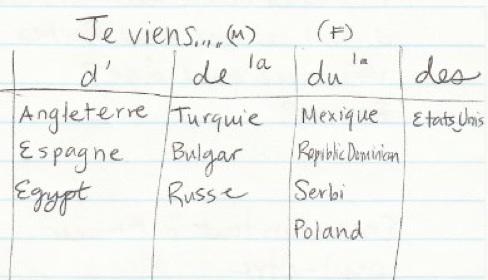
In my class, we had to say where we are from and group whether it was masculine or feminine. Here are a few of the countries. Guess which one I am from?

Origins of our class

I missed one because I couldn’t understand her, but it sounded exotic. Also, I shouldn’t leave out the fact that our professor lives part time in Switzerland, France and Morocco. These next 3 weeks are going to be interesting…..


Why our life looks like the NYSE

Post by Lauren


I actually hope that by the time I post this, I am over my down-funk that I have been living in all week.

But I knew that it would likely come…….

In acclimation class, we learned about the various stages of culture shock. This is the true terminology, but I realize that when I use the phrase “culture shock”, it comes across as strong or extreme. I think maybe a better way to describe it is “culture disorientation,” so for the purpose of this blog post, I’ll use that vocabulary.

For those who aren’t familiar, the textbook stages of “cultural disorientation” go like this:

1. Initial excitement
2. Initial anxiety
3. Arrival fascination
4. Initial culture shock
5. Surface adjustment
6. Internal shock
7. Acceptance & adaptation
8. Return anxiety
9. Reintegration shock

However, it is not guaranteed how long you stay in each stage as well as both spouses can be in different stages or move along the continuum at different paces.

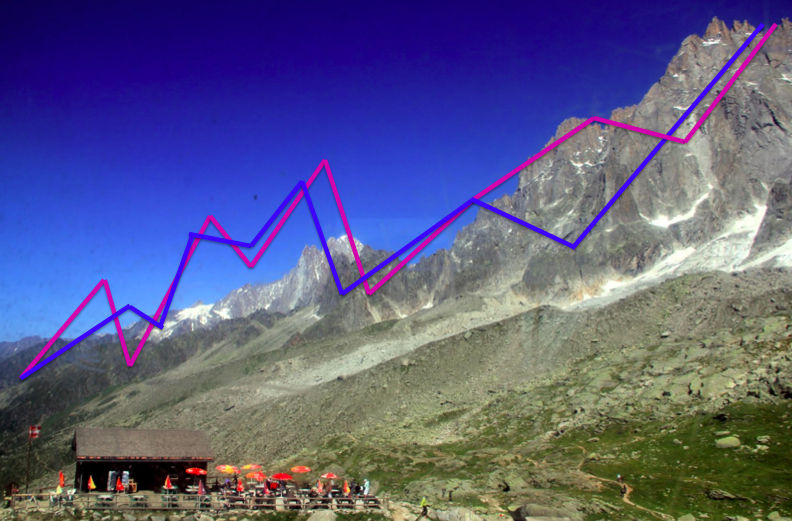
Here is a depiction of this with our 8 weeks here in Geneva. The pink is me and the blue is Gabe. I actually don’t even know where we are on the numbered list…..maybe somewhere between 3 and 5.

“How can you be blue in the land of cheese and chocolate?” one might say. “Don’t the Alp views you see daily give you a high all the time?”

We would probably be happy non-stop if it weren’t for culture disorientation – a reaction to the loss and to the ambiguity created by the unknown rules of the new culture. So, at our downturns, some may seem reasonable (we miss friends and family) but some others may seem a little silly (laundry, not being understood, not understanding).

However, sometimes the little things can have pretty big effects. The textbook explanation is that these little things get at the core of your self image – on how you view yourself as a person. You used to be capable, but in this new situation, you are not. While you were seen one way amongst your community in your home country, in this new country, people react to you and see you differently. While you expect to miss your friends and family, you don’t expect to feel like a different person some days because of your environment.

Here is an example…..after standing in a really long line at the grocery store, I happened to have a zucchini in my basket. When the cashier got to it, I hadn’t known to put a produce sticker on it from the machine in the produce department. So, it didn’t have a barcode for her and she growled some French disdain at me. I didn’t know enough French to explain that I didn’t know and I was sorry, that they could put it back, or I could put it back, whatever was easier to keep the line moving. I just kind of muttered “je suis désolé” which i thought was “I’m sorry” and just stood there pitifully while they got a manager to come take the zucchini, weigh it, bring it back and plop it on the register with even more disdain for me and my idiocy. The people in line behind me gave me exasperated looks like I ruined their day.

And this happens every day – I don’t necessarily get down on myself that I didn’t know how to do things – that is to be expected. But, some of the disorientation comes when people perceive you as something you never believed yourself to be. In the US, that situation would have gone differently for me because I knew the language and norms of my local grocery. I would handled myself fine. And it gives me empathy for those visiting the US and how they are treated if English isn’t their primary language and they are just starting to learn, like I am here.

And of course, the peaks of this experience are well worth these downturns. As I share on Gratitude Fridays, these highs are just incredible. The highs are just balanced by the valleys too; as is life – full of ups and downs.

Like the top photo, I am sure our experience in the end will turn out soaring like this mountain range. However, I just wanted to share a little more on this subject, and it gives me a reason to use PowerPoint, which i miss and used to be really good at 🙂

Gratitude Friday: Cosmopolitans Anyone?

Post by Lauren

This Gratitude Friday, my post is both a vocabulary lesson and a story of my appreciation for this new word.

Before moving to Switzerland, my definition of the word “cosmopolitan” consisted of : #1 the pinky yummy martini, #2 the magazine, and #3 maybe an adjective to describe a swanky metropolitan environment.

Pre-Geneva me knew cosmopolitan as this

I realized I was a bit naïve in this area when our cultural trainer Gary kept referring to Geneva as “cosmopolitan”. See, we’d been there just a month prior and I wouldn’t have described it as using the word cosmopolitan, as I knew it. In fact, what came to mind was beautiful, ancient, wordly and a bit ecclectic.

However, thanks to Wikipedia, I learned the proper definition of cosmopolitan is:
–A city/place or person that embraces its multicultural demographics
World citizen, one who eschews traditional geopolitical divisions derived from national citizenship
Cosmopolitanism, the idea that all of humanity belongs to a single moral community
–Cosmopolitan Society/Cosmopolitan City, where people of many ethnicities, religions and cultures meet and live in close proximity (especially applied to busy sea ports)

Well, in living in Geneva, I think I would agree with those better than my prior vocabulary.

In fact, Geneva is quite an anomaly compared to the rest of Switzerland. In training, we learned about Swiss stereotypes, how our personalities matched to their customs, and how to adjust our behaviors accordingly. However, Geneva is more “Swiss-light”, with a big influence from France, and an even bigger cosmopolitan influence.

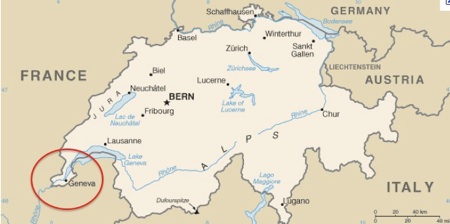
One big reason is the proximity to France and influence of French culture, food, language, and architecture. Fast Fact: the canton of Geneva shares only 4 km of border with Switzerland, but 108 km with France. I read that most Swiss Germans don’t even consider Geneva really part of Switzerland at all!


the tail is not wagging the dog here


However, probably the biggest reason is the cosmopolitan nature of Geneva. Based on the numerous humanitarian agencies, world organizations, and corporations headquartered here, 40% of Geneva residents are foreigners. There are people here from all over the world, living, working, and bringing their cultural influences in. Just in my own experiences, there are 40 nationalities represented at my church and 54 at my women’s club. It’s mind boggling!

So, onto Gratitude Friday. I absolutely love this about Geneva: interacting with people from completely different backgrounds as me and the exposure to all of their opinions, interests & beliefs.

Here are just a few specific examples of this :

In my Monday French classes, there is a South African woman, an Ethiopian woman, a Dutch woman, a British woman and me. Our teacher, Esther, is Swiss and was a teenager during WW2 here. All learning French together, we all have different accents and interpretations of words which is really entertaining and Esther considers it her English lesson at the same time.

Last week, Esther asked what the lady from South Africa thought of Nelson Mandela’s leadership, and it was a really neat education for me to hear firsthand from someone who lived there to hear about her own experiences. Prior to living in Geneva, I had never had this opportunity – all I learned was from movies and books.

In my photography group, there are three ladies from the Netherlands, a few Americans, one from the U.K., one from Australia, and one from Brazil. We all bring different things to the table. I really enjoy how much time the women from the Netherlands take to find out how you are doing and to learn about you. I always felt so much in a whirlwind that I am not sure if I have done this enough with people.

Friend and fellow blogger, Lady J, has taught me about Singapore and her time in Japan and I love her passion for her favorite foods and her dedication to bringing those flavors to Geneva in a beautiful way.

At Canadienne Buffets, we have been so lucky to meet great people from China, South Africa & Australia who we really have enjoyed hanging out with and learning about their experiences.

So much to be grateful for this week when it comes to the word cosmopolitan!

Bon weekend!