Guests: What you need to know!

Post by Lauren

We have visitors coming soon!! The next few posts are all about what you need to know when you visit us.

Logistics wise:

-We live in Geneva, so the GVA airport is the best to fly into. It is only 20 minutes driving or a 30 minute bus ride from our house.

-If we are picking you up: when you exit baggage claim, there is only one exit to the GVA airport so don’t worry about getting lost! We’ll be there waiting!

-If for some reason you are taking public transportation, please note that you can get a free transportation ticket in the baggage claim area, good for one hour. Make sure to get it at the time when you are leaving so you maximize the hour.

Push the button to get a free TPG ticket. Wait until right before you leave to maximize the hour!


What to Bring:

-Many of your small electronics may not work. We have a Swiss hairdryer, so don’t bother to bring yours. Use your curling irons and straigteners at your own risk as the electricity is known to eat them.

-We have a Swiss converter for you to use while you are here. But, if you are going to another country, you may want to buy one in advance for that country since the Swiss one is special.

-If you want to pack lighter and bring only a few outfits, you are welcome to do laundry while you are here. Just know that it takes 5 hours for one load. I will also make you do it so you get to see how fun it is!

-If you have any specific medicines you use or think you might need, bring them. They don’t have things like cold medicine, Pepto Bismol, etc. here. We do have a stock of American Advil and common pain killers though.

-If you have any special things you like, such as Lipton Tea or Sweet & Low, you may want to bring a stash. We don’t have that stuff here either.

-Same goes for snacks. It’s good to maybe bring a stash of your favorite stuff for day trips since a bag of chips at a convenience store will cost 8 francs. Also, they might not have a selection you like.

-We have towels, washcloths and linens so you don’t need to bring that stuff.

-We also have practical things like soap, shampoo, conditioner, lotion, band-aids, etc at our home so you can pack less of that. However, if you like a certain kind, feel free to bring it.

-If we are traveling during your stay to hotels, do bring a little bottle of conditioner if it something you like to use. European hotels don’t provide this. One of my pet peeves!!

-We only have one bathroom, so you may want a light robe or something to walk around in.

-The water is completely safe here and yummy. They have fountains everywhere. Bring a bottle to save money on buying bottled water.

-A large daybag or backpack could be handy for the plane carry-on and you
could also take it on our day trips.

-Women should bring a purse that zips fully and is secure. The main type of crime in Europe is pickpocketing, not violent crime, so you should select a purse that can be
closed up easily.

-If you are doing a smaller trip without us, you are welcome to borrow a backpack or small suitcase of ours.

Finances and Budgeting:

-Depending on where we go, you could need Swiss Francs and Euros (over the border). We recommend that you use an ATM card to take out money at an ATM here. There are a lot of ATMs at the Geneva airport, and around town. You could get them before you leave the US, but most banks charge $10 or so to order them for you, which is more than your fee will be taking the cash out here.

-You can use your credit card for big activities like train tickets, cable car rides and hotels. But, please be warned you’re your card could have a fee associated with it, at 1-2% for International purchases. Also, do not assume you can use your credit card at restaurants, convenience stores, or for street food….this is more of a cash society and they are often not taken.

-Call your credit card company beforehand if you plan to use your card while you are here….just to avoid it being shut off when they see a European purchase

-Switzerland is expensive! We can make meals at home as much as you like, such as breakfasts and dinners, but here is what to budget:

-Breakfast out if not provided by us or hotel: around 10 CHF for coffee & a pastry
-Lunches out: 15 CHF minimum but most places are 20-30 CHF
-Dinners out: 20-30 CHF minimum
-A soda or a water at a cafe: 5-6 CHF
-Train tickets: One hour away – about 30 CHF, two hours, about 50 CHF. See tomorrow’s train post for savings.
-If we’ll be taking public transportation, it only takes coins (3.50 CHF/one or 8-10 CHF/day), so keep your change. Also note that it doesn’t give change so its good to have lots of change handy so that you have the right amount.

-The exchange rate fluctuates between 10-20% over the dollar. So just know that if its marked CHF, its 10-20% more than the USD depending on when your visit is.

Other Travel tips:

-Make a color copy of your passport to slip into each luggage that you bring. Just in case it is stolen, its easier to recover with a copy.

-Always be aware of your belongings. Keep purses and backpacks in your lap on public transportation vs. at your side or on your back. Keep purses in your lap when eating at a restaurant vs. on the back of your chair. If you sit your backpack down on the ground when you are eating, loop your foot through the strap so that it can’t be grabbed. We don’t mean to scare you as you’ll be safe….the crime is just limited to theft. However, we know many very smart and alert people who have been robbed in Europe. Just remember, it is these people’s profession and they are GOOD at stealing.

-If you are traveling without us, its good practice to pick up a hotel card so you always have it in case you get lost, you can use it to get directions or a cab ride.
Snowy Geneva

Post by Lauren

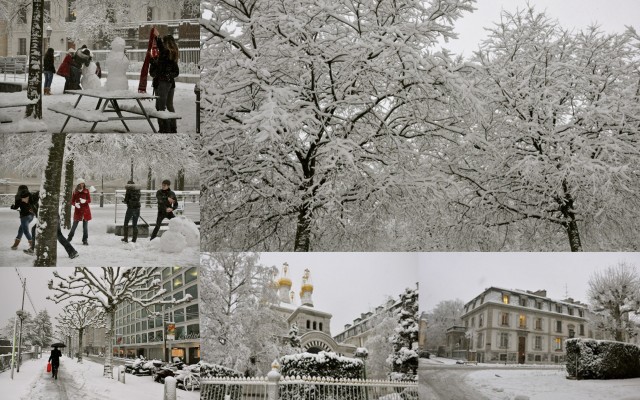
We were able to see snow a few times in December before we left for Christmas holiday in Thailand, but Tuesday we got a big dousing of the white stuff.

In Charlotte, when we got snowstorms, it was quite like the world was going to end. Bread and milk was ravaged at the grocery stores. People stayed in. The city didn’t have the proper equipment to clear the roads (why would they invest if it only happens every so often?) so it was a major event. To those who lived in the North, they always made fun of us Southerners and our approach. But, I always adopted the perspective that if I had my laptop at home, I’d rather work a few hours in the morning safely rather than get out into the elements early with the crazy drivers.

In Geneva, it was similar to Charlotte — they actually didn’t clear the roads all day. I heard that when it snows big, they have to borrow the snow plows from neighboring mountain towns because they don’t have any. They actually didn’t clear the sidewalks either. I tried to follow in footprints to avoid getting the 6 inches or so of snow into my boots. I saw three people fall really hard. One in front of the #12 tram at Bel Air. Luckily, she was scooped up by friends and the tram did see her spill so it stopped in time.

However, in contrast to Charlotte, I went to the store for routine shopping, and the bread and milk aisles were still in-tact. I easily made my purchases and if we were in North Carolina, those would be all gone by that point in the morning.

It was really lovely to walk around in the white. Here are a few photos from Tuesday morning:


As for now, we are still covered in white and it was even flurrying on my way home from the gym today, Thursday. The forecast shows us in the teens and low-twenties all week. Brrrrrr!

Occupying Switzerland

Post by Lauren

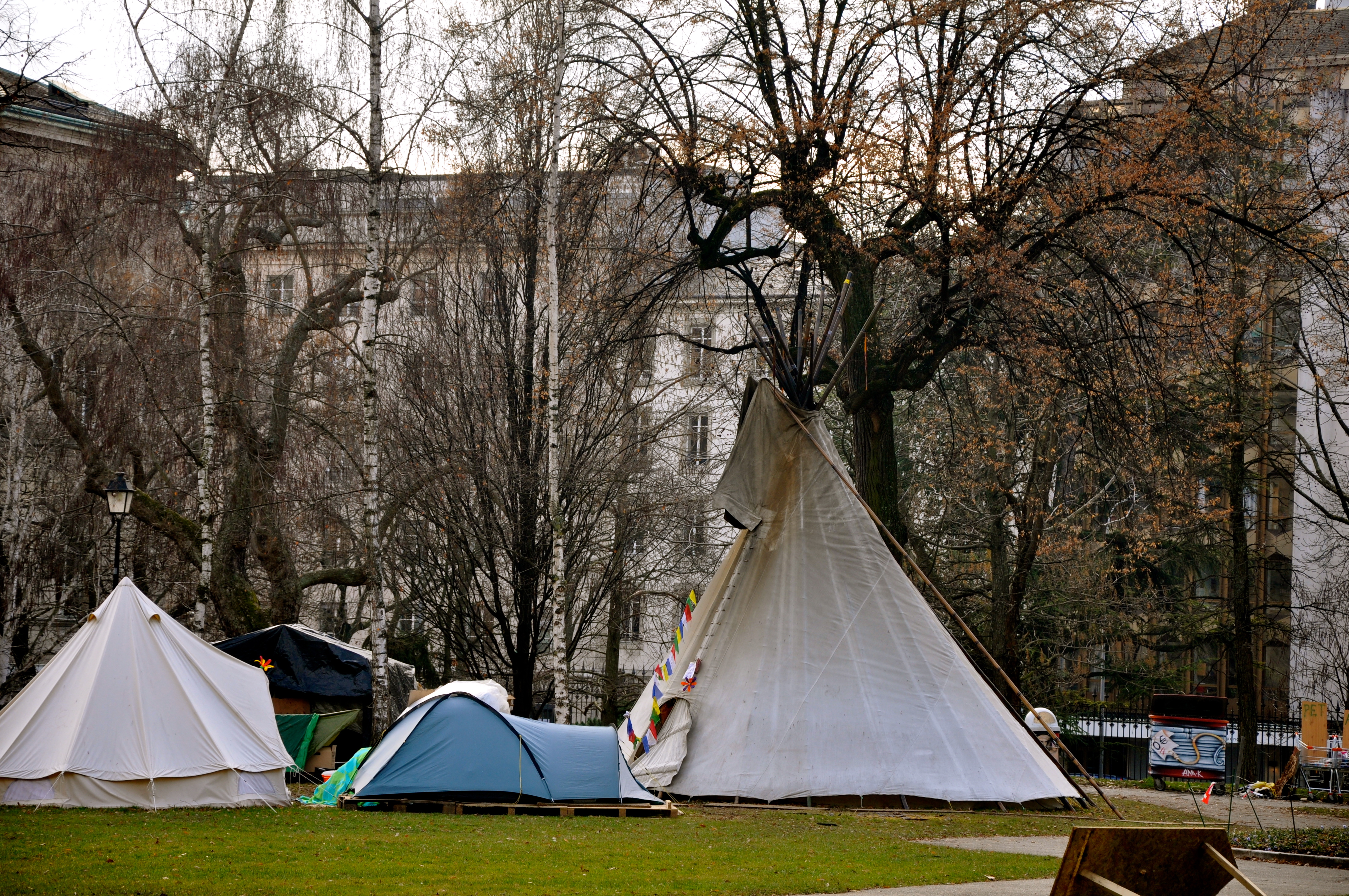
Nope, not talking about WW2 efforts. Thought the Occupy Wall Street movement was just for the States? Mais, non! We have our very own Occupy Geneva, camped out in Parc des Bastions. The first time I passed this site on the #12 tram, I had no clue what it was until I saw signs about banking in English…then it clicked….its part of the Occupy Movement.

From what I know, most of their protests are against the Swiss banks. Checking out their site, they have a video of using dusters and cleaning cloths to “clean up” the large Swiss banks on Rue de Rhone.

When Pascal, Giselle and I took a walking tour of Geneva, shivering every step of the way, we were concerned that they might all freeze to death out in the park. However, taking a closer look, we noticed that, they have hooked up some type of heat.


Occupy Geneva


In a city where homeless are kicked and prodded to move along by the police, its kind of interesting that they would tolerate a group camping in this famous park.

Beats me.

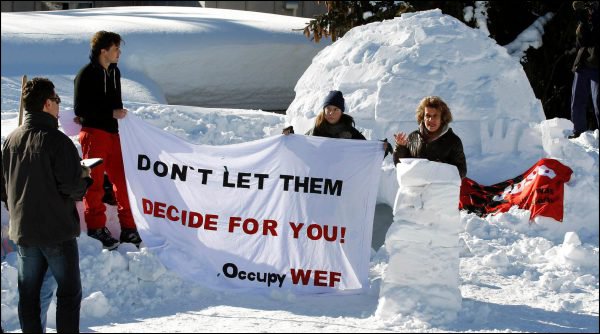
However, they have some competition for most clever Occupy. This weekend in Davos, they are going to Occupy WEF in igloos….take a look!


Gratitude Friday: My Health

This Friday, I want to dedicate this post to my health.

Just in general, I am thankful to feel good. I realize this is quite a special thing. I have no major health problems (except needing a really simple foot surgery) and I feel better than I have right now, than I have in a long time.

I also wanted to take this post to explain my rationale for why I feel better.

First of all, I have less stress here. I explain it to others that my stress is mainly short term. A bad day is not being able to communicate or having an issue buying snow chains. Those go away fast when I either laugh it off or have multiple glasses of wine. And while I enjoyed my full time job that I had in the States, it provided more “long term” stress, as most jobs do. So this major health affecter has lessened for the meantime until I start working again.

Second of all, I think a lot of it actually is rooted in food. My husband has been on this bandwagon for a long time, but this has taken me a long time to admit the cause/effect. I am now fully there. I just had to be forced to feel the difference in my body.

Here are a few reasons why I think my body feels better with the food here:

–In Europe, they don’t really eat processed food that has been manufactured for convenience, not for nutritional value.

–In Europe, they don’t have a lot of “shortcut” food like low fat and sugar substitute types. No diet ice cream here or fat free pastries here, folks. It’s the real deal.

–In Europe, genetic engineering of animals is illegal.

–In Europe, basically all the produce is organic by nature, they don’t use chemicals or alter the seeds in any way as is done in the States.

–In Europe, it is taboo to “eat on the go” or eat while walking, so it makes for more conscious meal enjoyment.

And its not just me. This topic has come up various times with friends here. One friend reported that she felt gross the entire time she visited the US for Christmas because her stomach had grown used to Switzerland’s foods and it couldn’t take the processed ingredients anymore. It was rejecting them. Another friend commented that she couldn’t cut the chicken into bits for a recipe at her mother’s house because the texture was so unlike the chicken she has become accustomed to here. Just this week, I met a lady who dropped 10 pounds in her first few weeks living here this Fall because of the positive change of the food.

If you are interested in learning more about this topic, I recommend two forms of media. The first is the book Food Matters, which I read with my book club. It encourages conscious food consumption to protect the environment. My two takeaways were:
–Buy things with less packaging
— Try to cut your meat intake in half to lesson the environmental impact that big business meat farming has. After reading the book, I did cut down my meat intake, using nuts and beans to replace half my protein. I didn’t really miss it.

Also, Gabe and I are big proponents of the movie Food, Inc which outlines the danger of the current systems of agriculture. It suggests that we are on a slippery slope; our concern with producing food at less cost for masses of people has altered the food in a way that makes it unhealthy. It suggests that government subsidizing of our food supply creates a few harmful scenarios.

–For example….beef and corn manufacturers lobby the government for subsidies and thus, beef and corn are more affordable in the US. Thus, a typical mid-range US family can’t afford fresh vegetables but can stock up on sodas, packaged foods and other things contained corn oil, etc that might not be a balanced diet, creating health issues. Many US families literally can’t afford to eat healthy.

–Also, in the case of meat, the demand for certain types of meat has encouraged genetic manipulation so that we are raising animals that meet the demand. One of the most disturbing scenes in Food, Inc. is one in which a chicken continually stumbles and falls over…all because he was designed for a breast bigger than he could manage.


However, even after seeing this 3 years ago, my coupon-cutting-self continued to scoop up only the large chicken breasts at the local Charlotte grocery store, as every 6 weeks, they were Buy 1, Get 2 Free. So I could get 3 huge packs of chicken for $9 USD total.

It’s only now that the cost equation has been taken out, as well as I am not given a choice – its forbidden to alter the meat production here – that am I now consistently eating “normal” food. Eight months later, I can feel an incredible difference. When we move back, I am going to certainly prioritize buying grass-fed, non-antibiotic meat items and organic vegetables.

Finally, the healthcare is very good here. It is very holistic in nature. I saw my first “general” doctor this week, in an attempt to solve the Cambodia food mystery. She spent an hour with me – asking every single question possible. Asking detailed family history. Information about every health issue I have ever had. Detailed questions about every part of it. It was like she had all day. But she was trying to get at the root instead of solve my surface issue.

My Swiss chiropractor does acupuncture before adjusting as a standard part of the visit. Also, he doesn’t require a pyramid of visits like my US guy did…simply just tells me to make an appointment when I hurt again. In the US, I had chiropractor appointments twice a week, acupuncture once a week and massage every three weeks to try to fix the chronic back pain that I carried – I was spending about $500/month in pain management.

In the last 8 months living in Switzerland, I have only had two visits to the chiropractor and one massage for back issues. I think its a combination of less stress & natural food that has been the remedy. Those who have seen me during my visits say that I look like a different person because of the lack of pain.

And we haven’t had a single cold here since our move. Those who know me well know that I always caught things so this is a big turnaround. This surprised me as well because of how often I am riding in public transportation, sharing air and touching buttons. However, I think its the stress and food that are helping to build my immunity.

Today’s post is not meant to be anti-US. These methods exist in the US, but they have become harder to find because of the effects of food and healthcare economics. I was lucky enough to discover it only by it being the default for us, so I just want to share my firsthand story with two encouragements:
1) If possible financially for you, don’t buy genetically engineered meat.
2) Seek doctors with holistic approaches. It can make a world of difference.

Bon weekend, everyone!


Discovering Geneva: Bel-Air

Post by Lauren

Today’s post is going to cover an area in Geneva known as Bel-Air.

I know I got you all excited by my recently celebrity post, but I hate to inform you that Will Smith does not live in our Bel-Air.

Nope; Will Smith is not in our Bel-Air

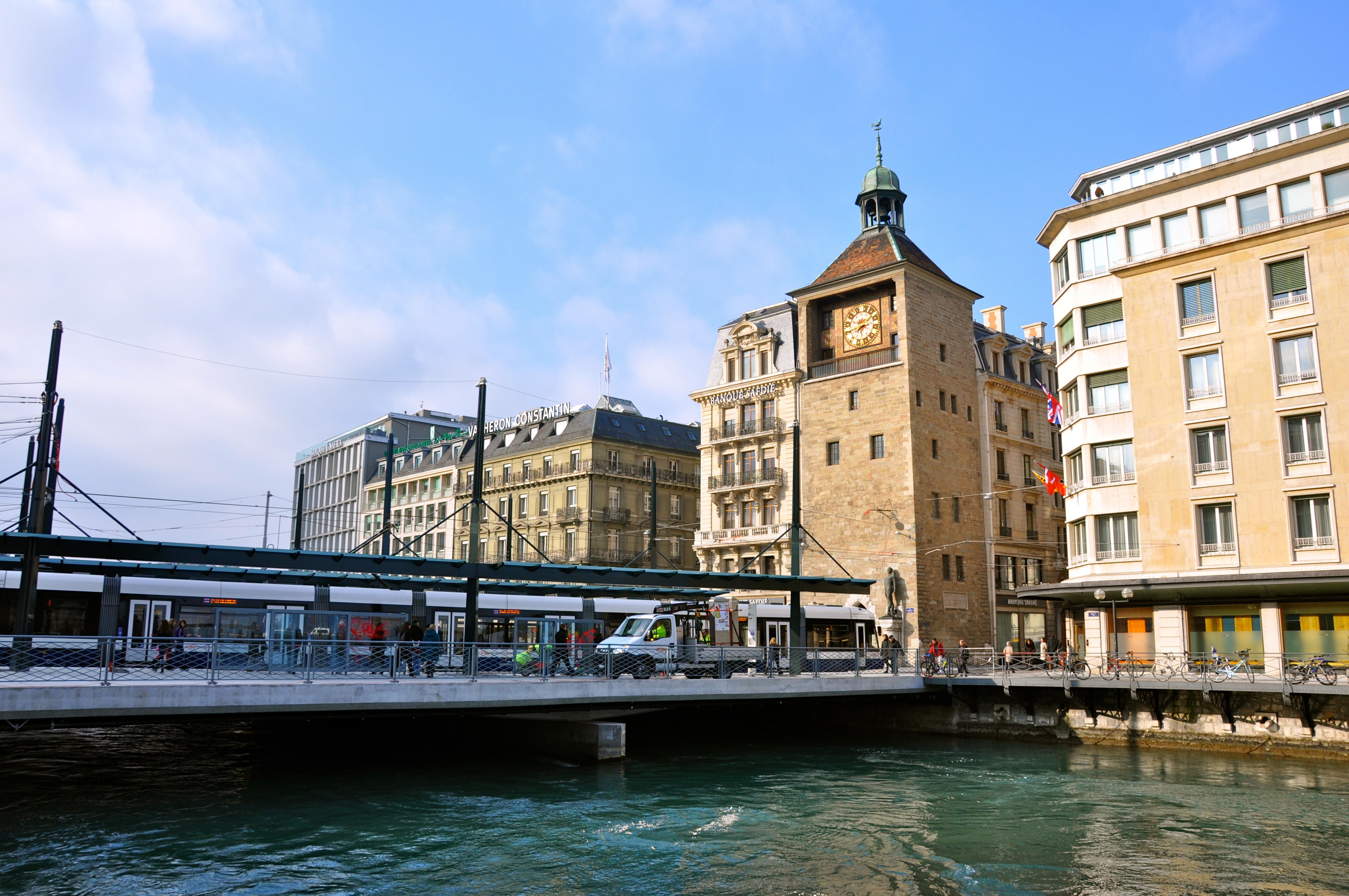
Bel-Air is an area in the centre ville that serves as a major hub for the TPG transportation system. It actually even has two stations, regular Bel-Air and Bel-Air Cité.

It was recently made an even larger hub and there are a lot of folks who are angry about how the new system works. For more on this, and why it might not have been smart to build a hub on a bridge, see Schwingen in Switzerland.

Bel-Air hub

However, before this bridge / island was a highly debated tram stop, was actually part of the Geneva fortifications. On the map we introduced on Tuesday’s Old Town post, you can see an island in the middle of the two banks. This is Tour d’île / Bel Air.

This island/bridge is one of the reasons why Geneva was so coveted. This bridge was the only route over the Rhone in olden times. In 58 BC, Julius Caesar actually made the trip to Geneva to destroy the bridge so that the Helvetians couldn’t advance.

Later, in the 13th Century, it had been rebuilt and there was a chateau / castle built to help in the defense against the Duchy of Savoy and protect this crucial passageway to France.

During this time, the island also became a market. Butchers built their shops so the blood could run directly into the Rhone.

During Reformation times, the chateau was converted into a prison.

After surviving multiple fires, the bridge finally burned down in 1677. Only the clock tower (seen in the top photos) survived. My french professor at UNIGE said that the reason it is called Bel Air as when everything burned down, the air smelled a lot better since there was no longer a rotting meat stench. I’m glad as I spend a lot of time there connecting trams these days.

Bel-Air


With or without a fresh prince, now you know a little bit more about our Bel-Air.

Geneva Museums: Swatch Museum

Post by Lauren

Unfortunately, many Geneva museums are closed on Mondays*. However, one that is actually open is the Swatch exhibition in the Cite du Temps building. They have an entire floor dedicated to the quirky Swiss watches.

So, Monday, Pascal, Gisele and I enjoyed browsing the Swatch timeline and seeing the models from all the different years.

Everyone had a Swatch story. I actually have a vivid memory of mine. We were all visiting my family in Eastern, NC. My cousin C was older and a lot cooler than me. He wanted to go to the department store to look at Swatches. You see, he’d been saving for a long time and just received a monetary gift during this visit that I think got him to the $25 that he needed for the Swatch. We got to the store and…..he realized the money was gone. It was confirmed that it had been lost.

I was probably 6 or 7 at the time but I remember thinking that was the most awful thing in the world. He was so upset. Poor guy!

I think my other aunt & uncle actually volunteered to buy him the one he wanted. We’ll have to see via their comments if this is how the story went as I can’t remember that detail. All I remember is the lost money that was supposed to buy the watch.

Years later, in 1988, I received my first Swatch. Yup, used to rock this baby out in middle school:

In addition to me finding my gem, Pascal found the one his brother used to have. Then we started going around and finding our favorites which were the kooky ones.

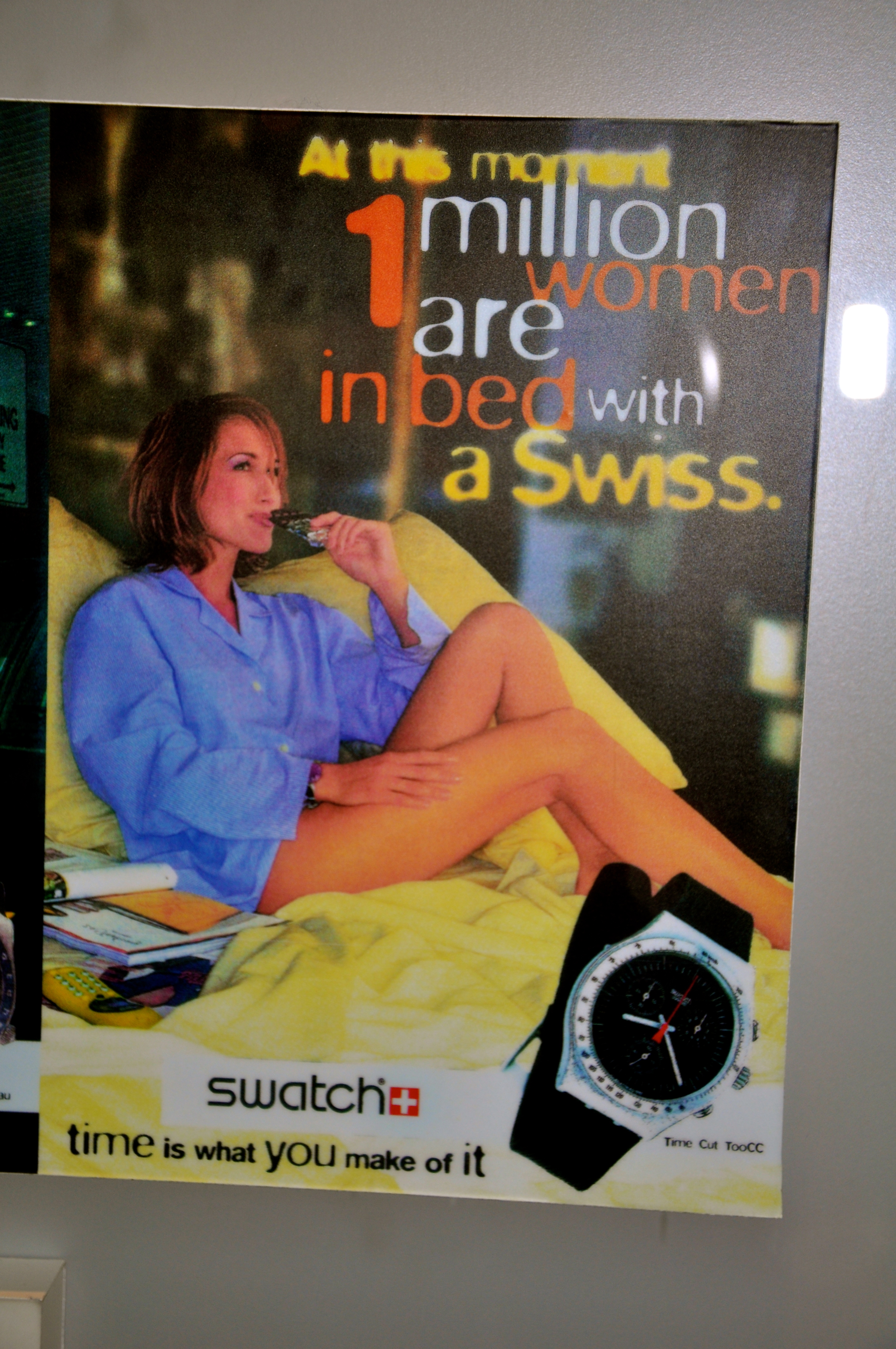
They even used to run some risqué Swatch advertising. Check this out…..


I actually received my second swatch this year for my 32nd birthday, a gift from Gabe’s parents. I had been eyeing it because it was casual chic and if you can believe it, I didn’t own a watch for 10 years prior to this one. Since I didn’t even have a phone the first four months in Geneva, it was really hard to know what time the bus came without a watch. They were kind enough to give me this nice gift. Good timing (no pun intended) as it is embarrassing to be late in Switzerland.


*Fast fact – Patek Philippe makes the most expensive watch ever sold at 11million USD. After checking out the Swatch museum, we headed “upstream” to the Patek Philippe museum to check out their collection of watch history. However, it was closed. Monday. Very rookie mistake of me to not know this Monday museum thing. Oops! I promise I’ll be better by the next visitor!

Discovering Geneva: St. Peter’s Cathedral

Post by Lauren

It’s always nice to have folks in town because you can see the city through different eyes and also in different seasons. On Monday, Gabe had to work, but Pascal, Giselle and I set out for an afternoon of Geneva exploration.

We started with a walk to Old Town, or la Vieille Ville, in French. I have talked about this part of Geneva before on the blog, but case you are just joining us, it is the old walled city.

When I took a tour as a student of University of Geneva, one American frat guy asked our professor which side of the wall the city was on – the really high hillside, or down below. The teacher held it together. Of course, the town was on the hill. Towns in that day and age had to build high and fortify for their protection. Geneva was an extremely coveted independent state and had a very desirable bridge across the Rhone at a strategic point…actually, the only bridge in the Roman era. When I recapped the Escalade Festival , the post recaps the most famous attempt to take Geneva.

It’s actually pretty neat that underneath the St. Antoine parking structure, you can see the original Roman walls that still exist and are well preserved in the transformation to parking garage. They didn’t know they were there until they started work on this parking structure and now they have a little exhibition underground so you can get an idea of what the city looked like when it was walled and surrounded by moats for protection.


This city model in the Maison Tavel museum depicts how the city was perched above and how moats/dredges were dug so that enemies were kept out.


St. Peter’s Cathedral (St. Pierre’s in French) commands the view in Old Town as the tallest building/steeple. It was originally Roman and from the 8th to 10th centuries, it was one of three different cathedrals to co-exist on the site. Underneath the present cathedral, excavators found remains of 4th Century Christian sanctuaries, portions of mosaic floors from the Roman times and a crypt.


St. Peter's Cathedral - present day


However, St. Peter’s is most notably known for being where John Calvin gave his sermons in the mid 16th Century.

Ferdinand Hodler’s painting of Calvin preaching in St. Peter’s

In the 1530’s, Martin Luther had just started in Germany, the printing press had begun to print copies of the Bible, and Geneva had just opted for the Reformation. Calvin, a young French man, was passing through Geneva (he stayed at a hotel in nowadays Place du Molard) on his way to Strasbourg. He hadn’t planned to stay, but later returned to contribute to the foundation of Protestantism.

Geneva then became a refuge for Protestant people to escape persecution in France, Italy and other neighboring countries. More on this and its contribution to Genva society as we know it can be found here in an earlier blog post.

Someone who doesn’t know the teaching of Calvin might characterize St. Peter’s cathedral as the most bland church in all of Europe. However, it was intentionally so. Calvin was very strict in his views that money should not be spent on embellishing the church. So much so that all its altars, statues, paintings and furniture were stripped away during his time. There is still very little decoration, only tiny stained glass windows.


Recent trips to cathedrals in Madrid, Siena, Florence and Lyon show that the Spanish, Italian and French have different theories than Calvin on church decoration


Despite its very simple interior, there are really amazing views from the top of the cathedral. This were actually taken in the Fall vs. our winter trip as it was a bit cloudy that day.


I find it interesting Geneva still serves as a haven for those escaping religious and political persecution. Makes me grateful that I was born in a country in which we didn’t have to fear for either.

Gratitude Friday: My French Teacher

Post by Lauren

This week, my gratitude post goes out to my French teacher at the women’s club.

Celebrating 86

A few weeks ago, I was the only one to show up for Beginner’s French. I took advantage of the opportunity and asked my French teacher, E, if she would instead teach me about living through World War II. You see, E is in her upper 80’s. She was a teenager during the war and has made various references to her life during this time in French class. Even better, she used to be a history and geography teacher so she weaves in references which I happily soak up. She learned to speak English at the American Women’s Club (one of five languages she knows) so pays it forward by teaching French. In her upper 80’s. Wow.

So, as you can imagine, I was thrilled to get an hour with her to learn about this fascinating topic. Here is what I learned:

She was 15 when the war started.

Switzerland was never occupied during the war. However, all Swiss men served in the Swiss army. They were posted through various spots in case they were invaded to defend Switzerland. Her father was posted in the Jura mountains.

She said, “it was difficult to find professors (teachers) because they were all in the army.”

She remembers riding her bike and there were no cars ever on the roads, because the fuel was not available.

After the war, her father told her that her bicycle was given to her so that in the case of the resistance, he was going to summon them to his hidden camp in the Jura. She was to be the messenger on bike back to the village if needed.

She said Switzerland was safe because it was a huge advantage for the Italians and Germans to use the Swiss railroads. They wanted to keep them in order, to not be bombed. The railroads were Switzerland’s saving grace.

Every night she woke up to flights of the Allied. She said they went over Switzerland because there was nothing to fear in that air space.

She saw an air battle when she was playing with her friend in the mountains.

Prior to the conflict, the infamous Swiss Lavaux vineyards had employed French Savoy women to work. When the war started, they could no longer leave France to work in Switzerland as they were occupied and forbidden to cross the border. So the young Swiss girls and teenagers went every day of harvest to cut the grapes and fix the branches. They had no school during these times.

The boys went to the farms as they were stronger.

Her father had bought many acres of fruit trees – pear, apple and cherries. Her mother had hard work while her father was in the army – she made compotes, confitures (jams) with their harvests.

They grew potatoes to keep from being hungry. She told me “we had very little to eat but we were never starved.”

In fact, in the cities, like Geneva, every park was parted so that apartment dwellers could harvest potatoes, since they didn’t own land.

Because this area was French speaking Switzerland, they could take in French children for three months at a time to nourish them. They took a little boy, 5 years of age, from the South of France into their home. They dressed him in her old clothes. She smirked and reminisced that all her village people gave all the French children French-Swiss accents.

They were given cards to allocate how much sugar, milk they could buy so that the rich weren’t advantaged.

“I lived like a normal Swiss girl,” she said, “I had no problems.”

I find myself pretty lucky to have such an interesting lady as my French teacher. My grandparents were a bit older than E during the war, but I never had a chance to talk to them about their lives in that era. All of what I know was through a scrapbook my dear Aunt J made me of my paternal grandparents which detailed their lives including a sampling of letters from their WW2 romance. And I have a snapshot of my maternal grandfather in uniform. Talking to E about this time makes me feel like I know a bit more….and it turn, a bit closer to them.

Bon weekend, everyone!


The day I almost cried over snow chains

Post by Lauren

We are going skiing today. Luckily, we already had snow tires. In Switzerland, you have to switch out your tires twice a year. So everyone owns two sets – a summer and winter. It seemed fair to me, but friend S pointed out that he grew up in Michigan where it snows just as much as Switzerland and they weren’t required to have snow tires or snow chains. Good point. I am sure that someone in the Swiss government has a friend in the tire business who has earned a fortune.

We are lucky that through the arrangement with Gabe’s company, they provide a place for us to keep our extra set of tires. Gabe takes the car there, they swap ‘em out, and we are good to go. This all happens in quasi-Franglish but its relatively easy for us.

We have other friends who have had to do the swap themselves – on the street – and figure out how to store the tires in their tiny cave. What a pain!

We thought we were ready with our snow tire ownership, but recently were told that we may need snow chains to drive up to the ski resorts. The women’s club has a ski group and they require all volunteer drivers to have a set in the cars at all times. We also have some friends who haven’t needed them so far, but others advised them that they hear its required. Apparently, as the snows increase they do checks to make sure you have them.

Simple enough. Just go buy some chains. Gabe was away in Belgium all week and wasn’t set to return until late last night. So we chatted on the phone Thursday night about what to do and Google searched how to select snow chains. We learned you just need to note the numbers on the tire to know which you need.

I started my chain adventure in the morning at MParc. I can take a tram then a bus to get there. MigrosParc is like the Walmart of Switzerland. Except its not. You can’t find everything you need. You can also be damn sure you are not going to get the lowest price. But it is the only thing comparable to the US “one stop shop” since they have a grocery store, home store, appliance store, ski store and a sports store in one parking lot. They also happen to have a Migros DIY+Garden there.

I didn’t have a hard time finding the chains:

Snow chain aisle

However, I couldn’t understand how my tire numbers translated to a package. I searched for a sales associate. I finally found one. “Bonjour! J’ai une BMW X3. Je voudrais chaînes à neige, sîl-vous-plait.” And I thrust forward my little paper. He took me to a little chart nearby.

“Deux cent cinq soixante cinq….hmmmm. Pas possible!”

“Pas possible?”

“Trop grande, madame!”

Okay, MParc didn’t have our size. I had heard that Jumbo might have them too. I knew that Tram 14 got there. I connected on Bus 21 then Tram 12, then to Tram 14. An hour later, when I was almost there, i realized my stop wasn’t listed. I had taken a Tram 14 with a different deviation than my destination. Crap. I hopped off and waited for the next CERN train which was scheduled for 8 minutes. A tram arrived and I hopped on. I glanced up and saw that I had hopped on the same stupid tram that didn’t go my direction. So I got off the next stop, waited, trammed backwards and waited again for the CERN tram. What a rookie mistake.

Wrong Tram

Right Tram

30 minutes later, I got off at the correct stop and walked the rainy 10 minutes down the side path to the entrance of Jumbo DIY.

This time, I found the chains and the chart myself. I grabbed a pack of 80’s – what it said I needed from the chart with a 205-65. However, I saw an associate nearby and asked him and showed him the package I’d selected to get his confirmation that was right.

“Non,” and he lead me back. “Deux cent cinq soixante cinq….hmmmm. Pas possible!”

“Trop grande?” I asked. “Oui,” he replied.

I walked back to the tram. This time 15 minutes until the next one back to town. I was freezing. I didn’t wear enough clothes for a 3 hour tour.

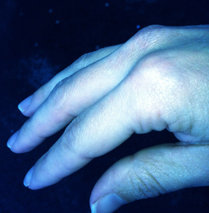
Okay, I photoshopped this hand photo. But it was how it felt out there!


I got the brilliant idea to go to the BMW dealership. I found it and figured out the best way to get there on public transport. Go iPhone!

I arrived and was greeted. Apparently, I didn’t look like a BMW shopper in my yoga clothes.

J’ai une BMW X3. Je voudrais chaînes à neige, sîl-vous-plait.”

“Oui. Le département des pièces s’ouvre en une heure.”

I looked down. It was lunch time. Momentarily forgot that retail takes lunch breaks here. “Oui. Je reviendrai.”

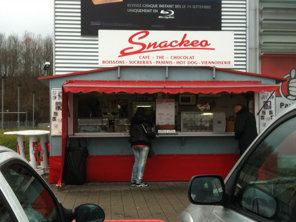
After the post-Jumbo freeze and walk, I was getting light-headed. I hadn’t eaten for a long time and I was still a little weak from my misadventures with Cambodian food. It was a lucky turn of fate that I was nearby another store. And that this store had a food cart out front. Double luck.

We don’t have any budget for eating out this month (we spent it all in Thailand) but I had no choice but to wolf down a delicious 10 franc panini. And it was so nice to be warm and dry in the store for 45 minutes. Got lots of looks. Apparently not dressed appropriately for shopping.

And I returned to BMW an hour later. I walked upstairs. One door locked. The other door opened and I stepped into….a supply closet. I actually looked in it it for chains but only folders and office supplies.

Back downstairs. Guy just wasn’t back yet.

Waited some more. Finally a man came to open it and I went into my spiel.

“Oui. Quand la voulez-vous?”

“Demain” (Tomorrow)

“Pas possible. Lundi – c’est possible.”

He saw the distraught look on my face. He handed me a slip of paper with an address and said “Peut-être….avez-vous conduit?”

“Non – j’ai pris le tram.”

“C’est loin. 3-4 kilometres.”

I was getting desperate, “C’est possible de marcher?”

He frowned. “C’est loin”

I pulled out my iPhone. He said it was too far to walk but I wasn’t going to go home if there was even the slightest chance of this size existing in the canton of Geneva.

So, I walked. 4 kilometers. In the snow and rain. Along a highway.

I walked so far that I passed a train station. But finally I reached my destination. The door was locked. At this point I almost cried. Then, I found another entrance with a sign. They were just closed for lunch. I waited.

The doors finally opened. A young man met me. I think they’d been watching me outside shivering. I did my spiel. He led me back to his desk, consulted a notebook and said. “Oui – quatre-vingt huit franc.” (88 CHF, about $100)

“Oui ????i!!!” I exclaimed. I tried to tell myself not to get excited until he produced the goods.

He came back with one box. I did sign language to try to determine how many were in a box. Two came in a box. A set. “J’ai quatre tyres.” I said. He laughed. Apparently they only had one set to sell me.

Five hours, 14 bus/tram connections, and a hike later, we now have chains for half our car. I desperately hope this is going to be good enough.

La Poste

Post by Lauren

The post office is called La Poste. It’s French for post office. Ladies and gentlemen, this is not your ordinary operation.

Here is what you can do:
-Send mail & buy stamps, of course.
-Pay your bills and fines – just bring the originals in with your payment and they handle the bill paying for you (there are no checks in Switzerland). Don’t ask us how we know so much about the proper way to pay fines.
-Get permits for driving on highways, for your bicycle, etc. It’s 40 CHF to drive on the highway here. Anyone who drives on a Swiss road has to pay this. Think twice about a little joyride in the Alps other EU peeps….it costs a pretty penny here. It’s only 6 CHF for the right to drive your bike on the road here. What a steal! Since I have taken mine out twice, I’m at 3 CHF a pop.
-Pick up a package that is bigger than a standard 8 x 10 envelope or sometimes just a 4 x 6 cardboard envelope that looks important (they won’t leave at your door, you have to walk 3 blocks to pick it up). Oh and watch out. You’ll likely have to pay 30 CHF VAT for the right to pick up your package. Enjoy!

Here’s what you cannot do:
-Do not try to pay by credit card.
-Do not attempt to pick up a package for your hubby without your marriage license. Especially if your last name is different. Not happening.

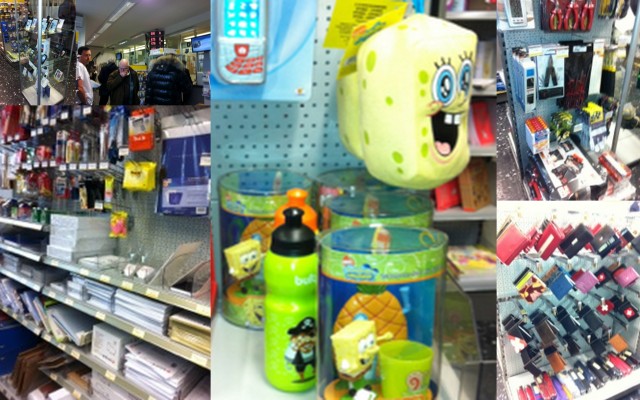
When you enter La Poste, you take a number slip from a machine. You don’t have to stand in line, you just wait until your number appears . That frees you up for…..SHOPPING! You can buy a ton of stuff at the post office:

Office supplies! Makes sense.

A rather large assortment of wallets.
At least 4 types with Swiss flags.

Lots of tools. Even a 100 pc set!

Need a new cell phone? No worries, there is quite a variety here!

How about Spongebob??

They also have tons of recipe books, gift cards (iTunes, department stores) and small appliances.

It’s really more like a gas station convenience store than what we know as a post office.

Like most things, sending mail is not cheap here. Its $1 for a stamp inter-Switzerland. $3 for one to the US. I had a normal sized envelope yesterday and they said it was abnormally large for Switzerland and charged me $5. This is why a lot of you get photos from us instead of real cards. Sorry.