Discovering Geneva: Palais des Nations

On E-dawg’s second day we had pegged the Palais des Nations as a possible stop for the rainy Monday.  It was a good choice because, by default, it was literally the only museum open on Monday.   Also E-dawg had it on her Geneva “must visit” list.

She had read there was a lot of walking and warned me but I decided I was up for it – couldn’t be more than a km or so. We took the bus to Nations.   This was our first mistake.  Or my first mistake.  I just assumed that tourist rolled right through the colorful flags into the Palais des Nations to enter.
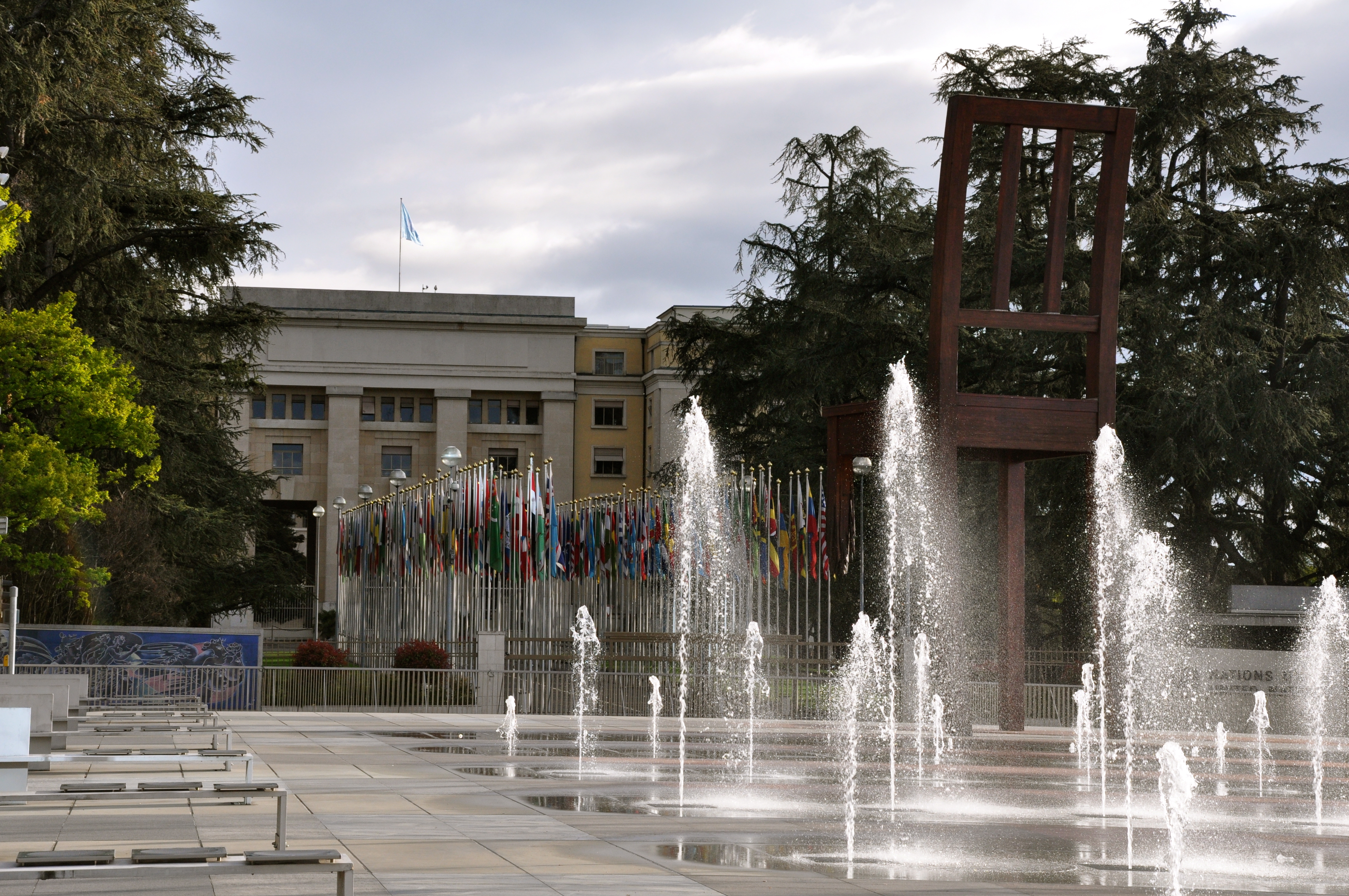
The grande entrance to the Palais des Nations. This is the oldest building and is bigger than the Palace of Versailles.

However, the actual tour entrance is was a 1 km walk away from the grande entrance.  This detail would not have been very important to the old me.  However, it is very important to the present-day me with healing feet.    Thus, I wanted to show those readers who might be a little walking challenged where the entrance is.  The #8 bus, Appia stop, gets you considerably closer.   It’s important to conserve energy as this tour does include a lot of walking.

They are very protective of the safety of UN workers.  Rightfully so, since 3000 have died in operations or just by being in UN offices in times of terror.   So, checking in for the tour required multiple steps.  First, you go through an airport-style metal detector.  Then, you approach a desk to register by showing your passport for scanning, getting a new picture taken, and  that photo being printed into a picture badge.

Next you go down an escalator, pay 12 CHF, and walk a distance to the entrance and gathering group of the tours.   You approach the desk, give your language preference and wait.  Then you get a bright orange lanyard indicating you are a tourist so that you can be easily spotted.

We were very lucky to have an amazing tour guide.    We started the tour by seeing some of the conference rooms.   There are over 9000 meetings a year so they need a lot of conference rooms.

We learned that in the traditional rooms, the member states sit in alphabetic order.  Then comes the observer non-member states  (like Palestine, Vatican City), then the NGOs that provide the link between civil society and UN.  Then approved media.
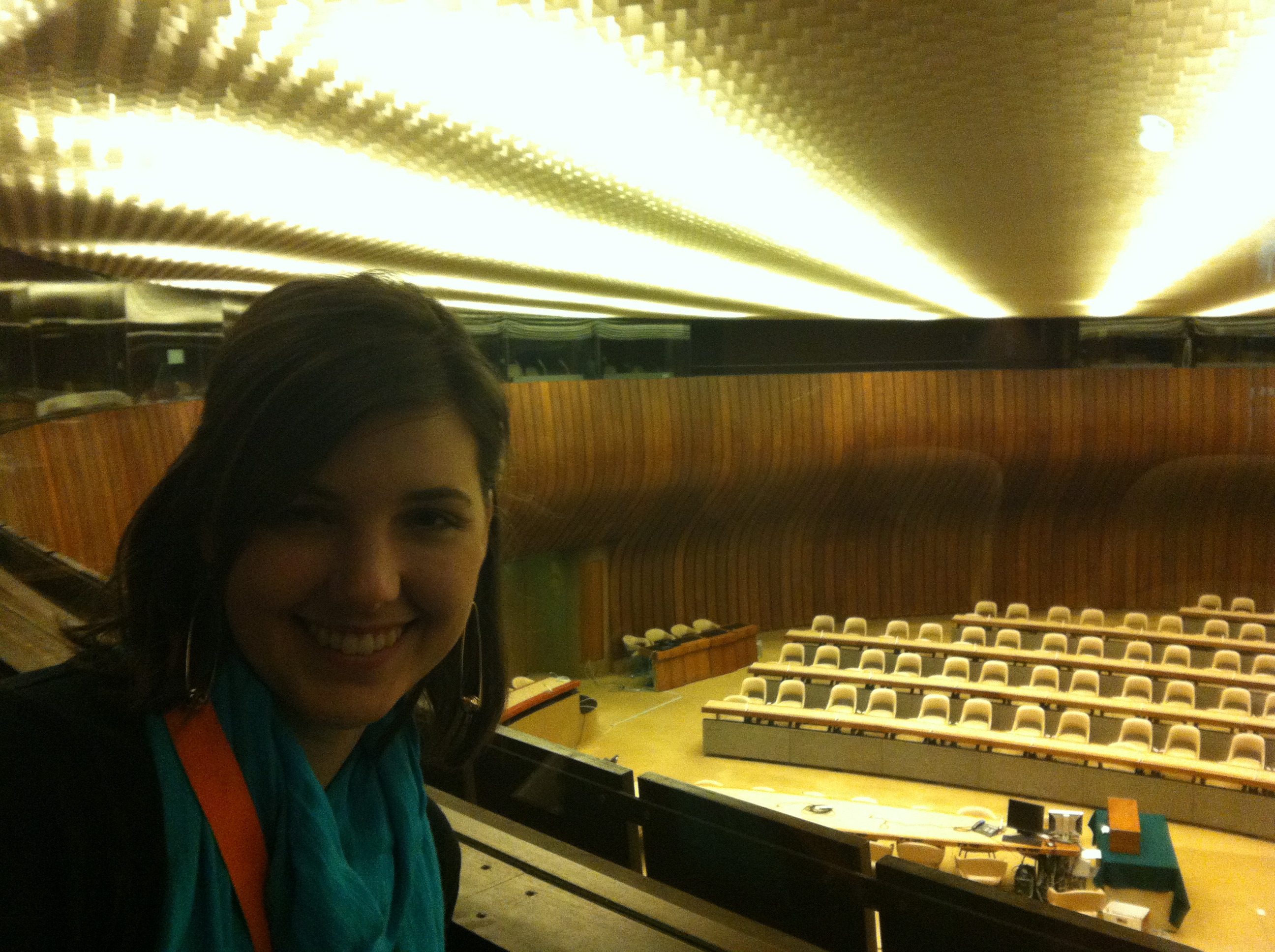
E-Dawg overlooking a traditional UN conference room

The UN has six official languages – English, Arabic, French, Mandarin, Spanish and Russian.    If you want to address the UN in a non official language, you have to bring your own translator.
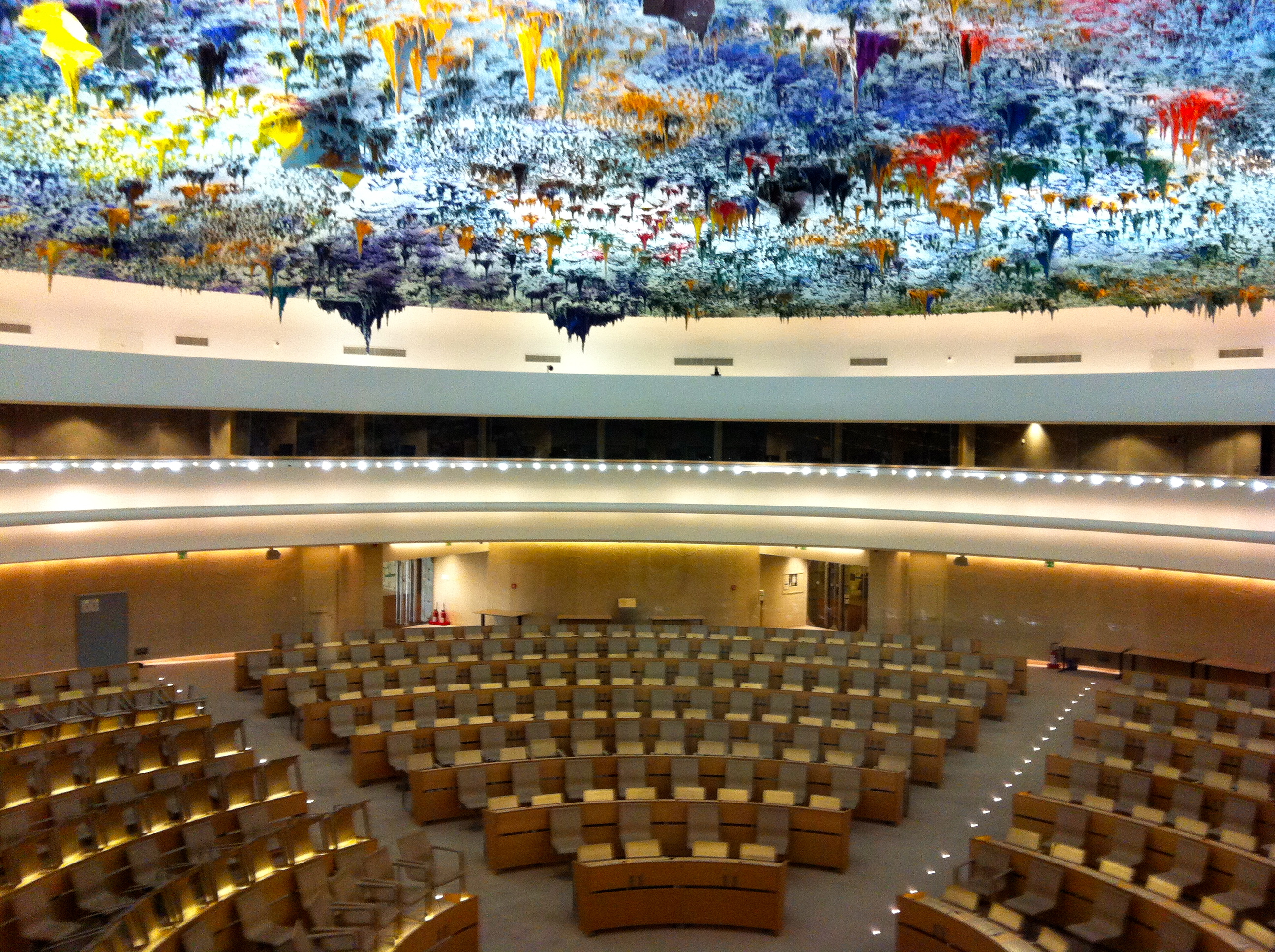
Human issues conference room. The ceiling was done by a Spanish artist and was donated by the country of Spain. His intention was for the textured color to peak like waves of ocean. The color represents the diversity of opinions in the world. The art was unveiled and conference room reopened in April 2009. The current issues in Syria are discussed here.

E-dawg and I in the grand assembly room in the Palais des Nations. The UN logo is different in this room, with the globe view from the top, showing no country is in the middle at the UN.
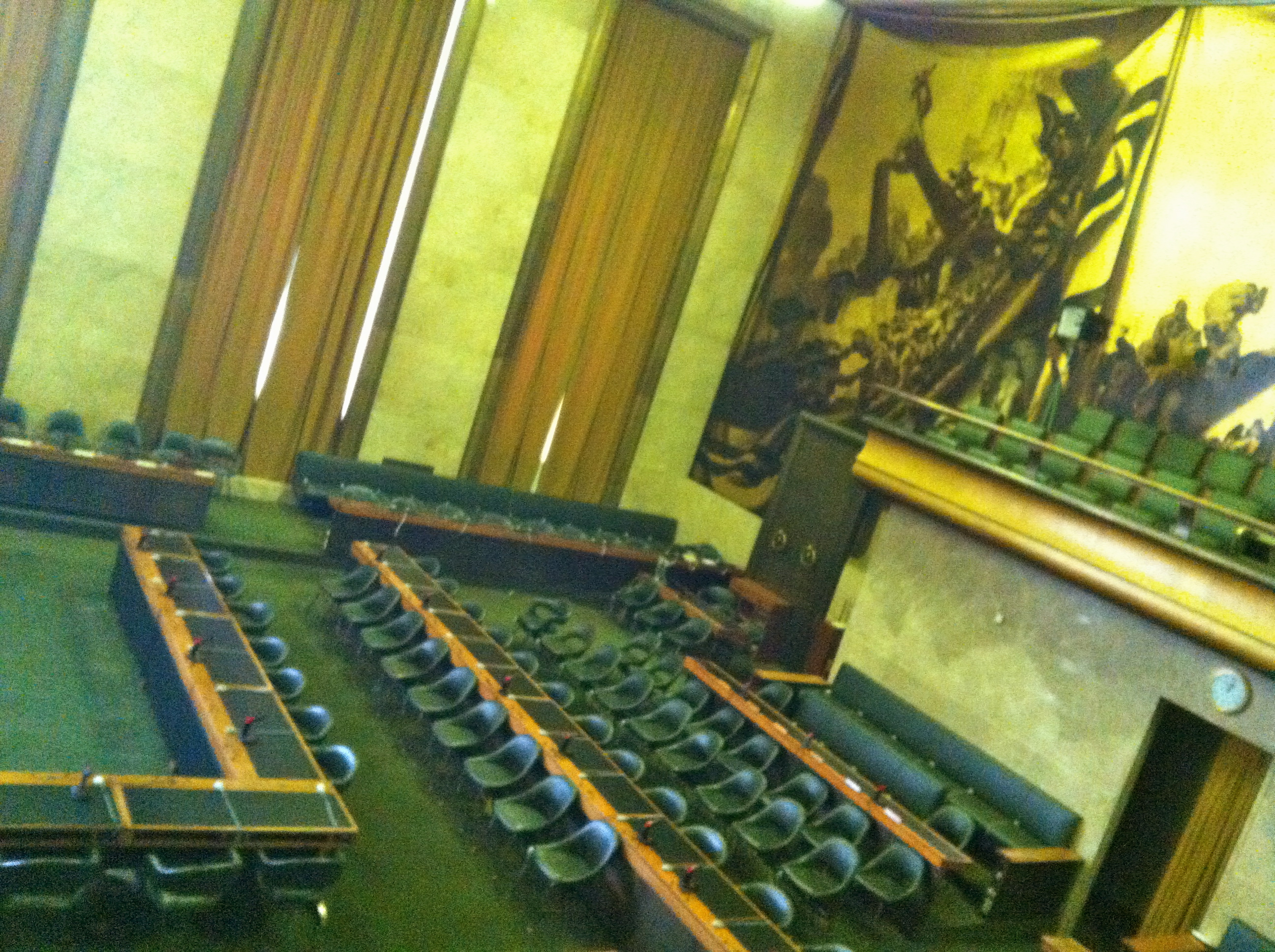
Original council room of the League of Nations. The League of Nations was formed after WWI. However, they failed at preventing WW2 so it disbanded. Mr. Pettyjohn would be proud I was seeing this place as we learned a lot about it in Freshman History. Now this room serves as the council of disarmement, preventing nuclear and chemical means of warfare.

Some fast facts about the UN:

-It was formed in 1945 after WW2 with the UN Charter

-It started with 52 members.  Now there are 193.  South Sudan was the last joiner.  Switzerland didn’t join until 2002!

-The UN is decorated with art from all over the world, to represent its diversity among member states.    In a grand entrance, there are colored marble in different designs.  Our guide pointed out that the marble comes from 3-4 different countries to show integration and how great works are possible with collaboration.  Pretty cool.
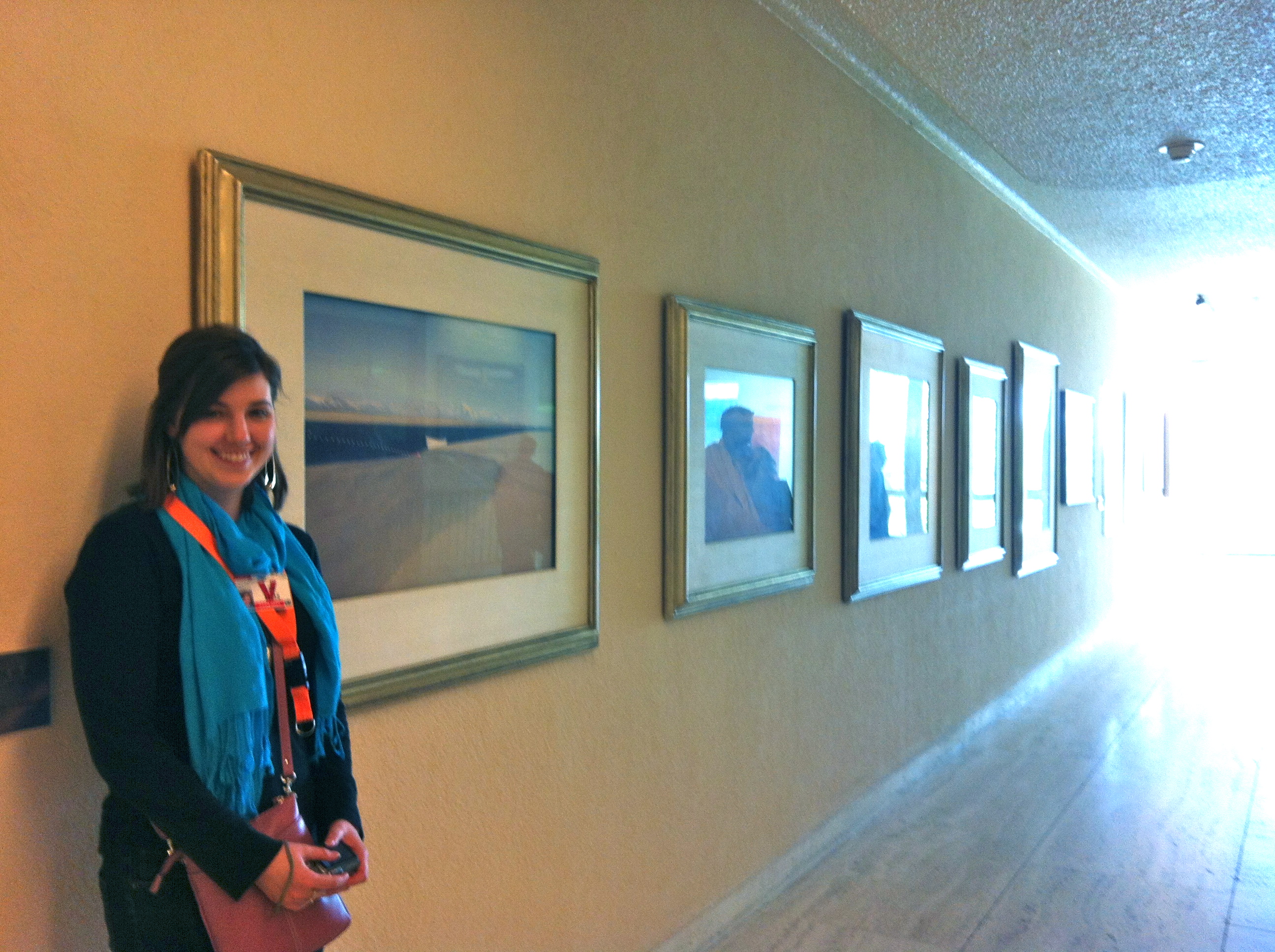
E-dawg stands by the hall of traditional artwork donated by member states
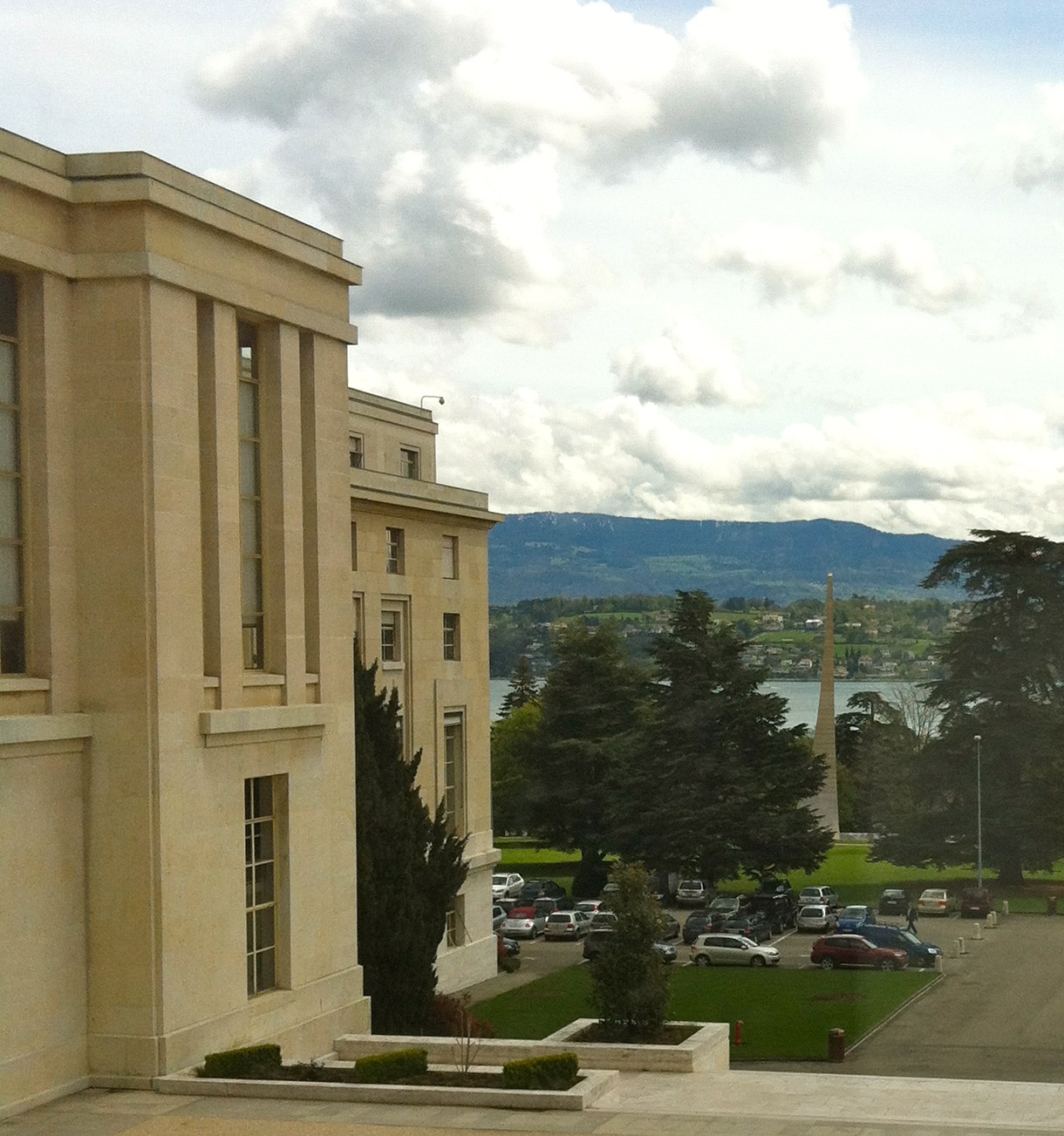
The Russians donated the Conquest of Space and Time statue - made out of titanium like space shuttles. Sorry, its the tiny thing in the distance - I took all these photos with my iPhone.
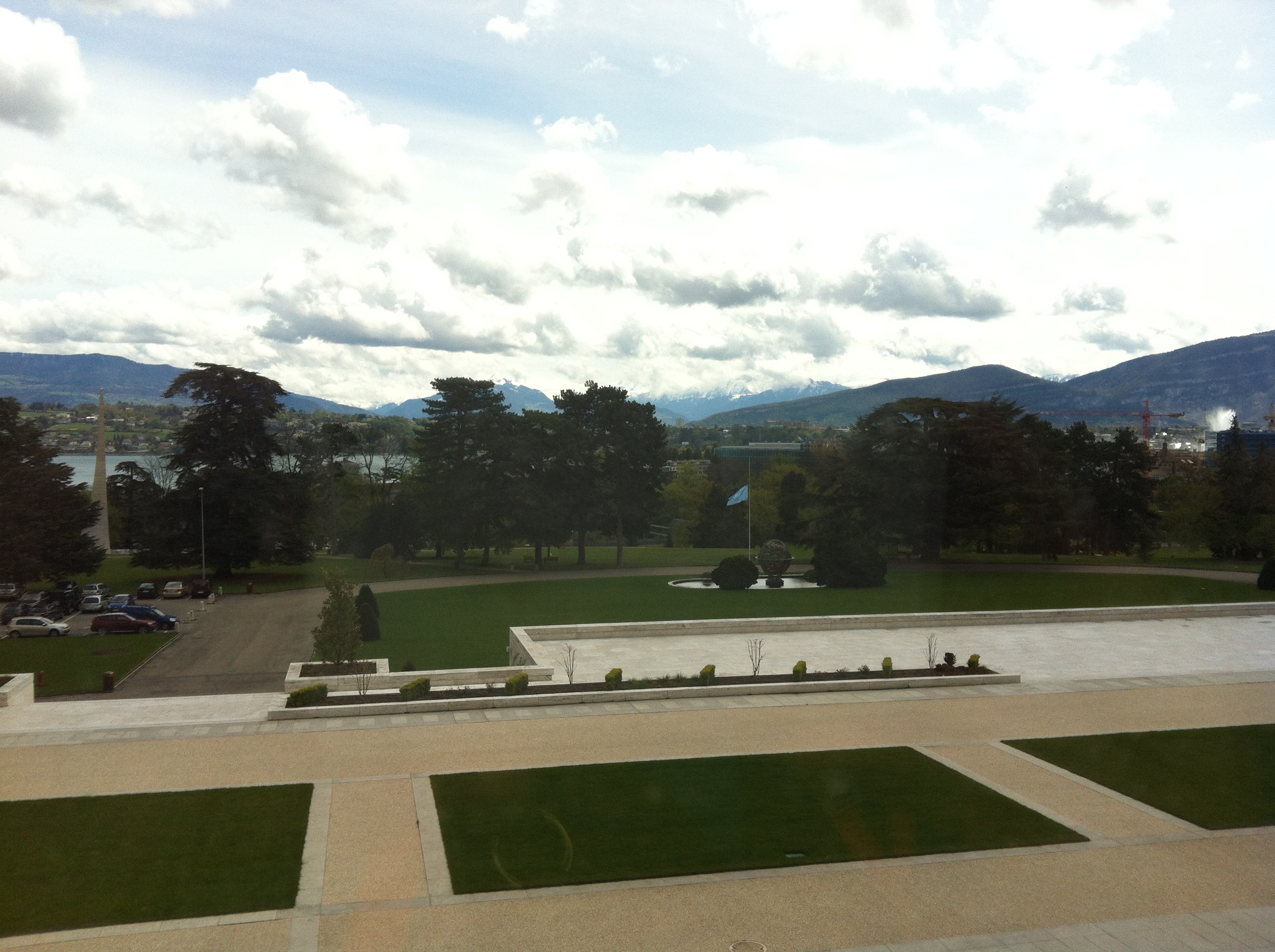
Trees are donated from all over the world to adorn the park, creating diversity in landscape

What is the difference in Geneva and NYC?

NYC handles more of the political and economical issues while Geneva focuses on human rights, science, technology, health, and world disasters.
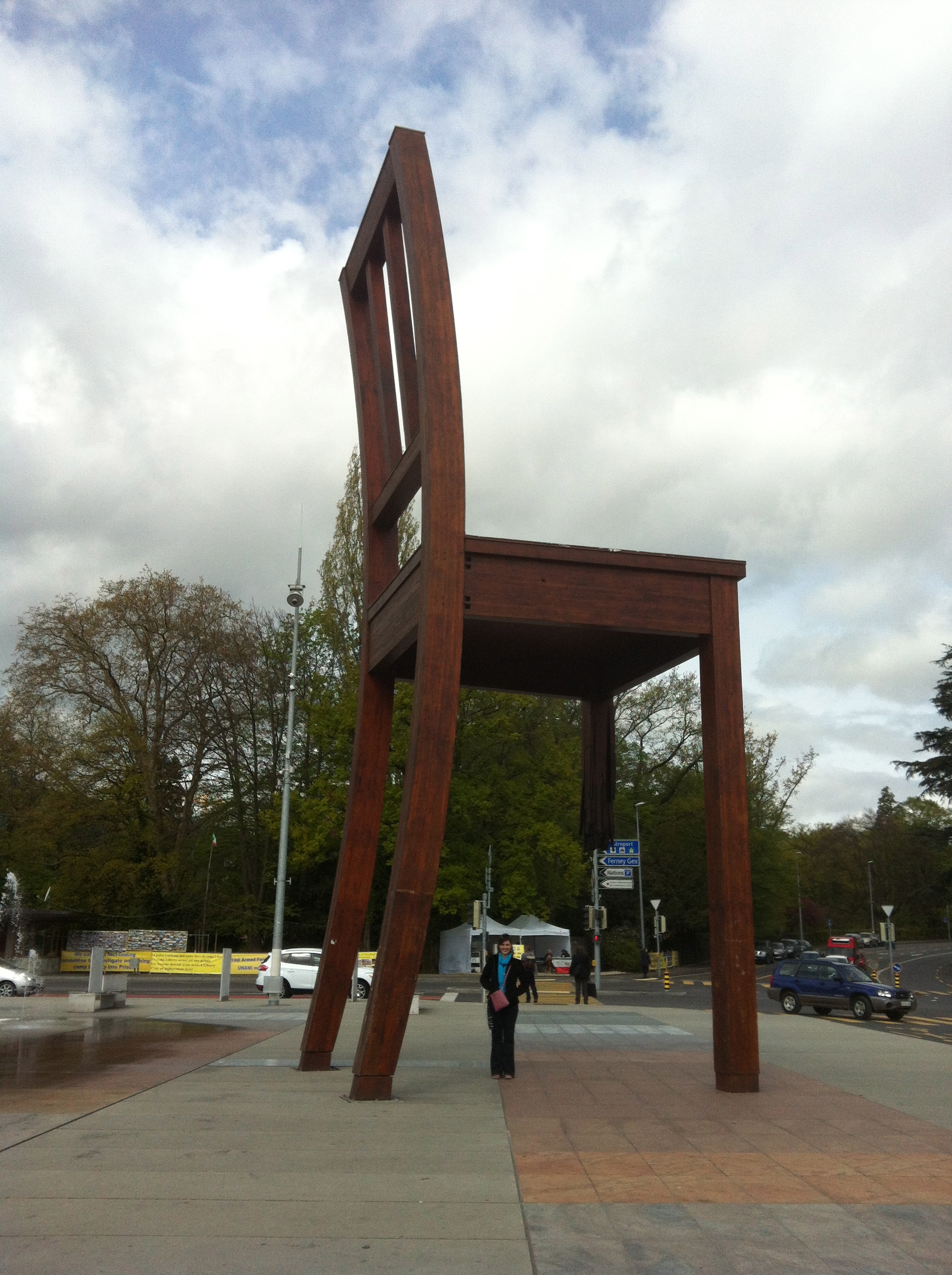
The chair with the missing leg was donated by Handicapped, Intl to represent the lives and limbs lost by unnecessary land mines

The WHO (world health organization) is one of the bigger departments here in Geneva.  Also, UNHCR – the high commission for refugees, which helps 20 million people a year!

Why did they pick Geneva?  

NGO, The Red Cross was already there (1863) and it had been proven to be a good place for a headquarters.  Plus,  Switzerland was a neutral country making it additionally easier to facilitate an organization such as the UN.   Third, Geneva was known as a very diverse city which helped exemplify what the UN’s goals are.  Finally, geography – Geneva is in the center of Europe and is accessible by train and airport.
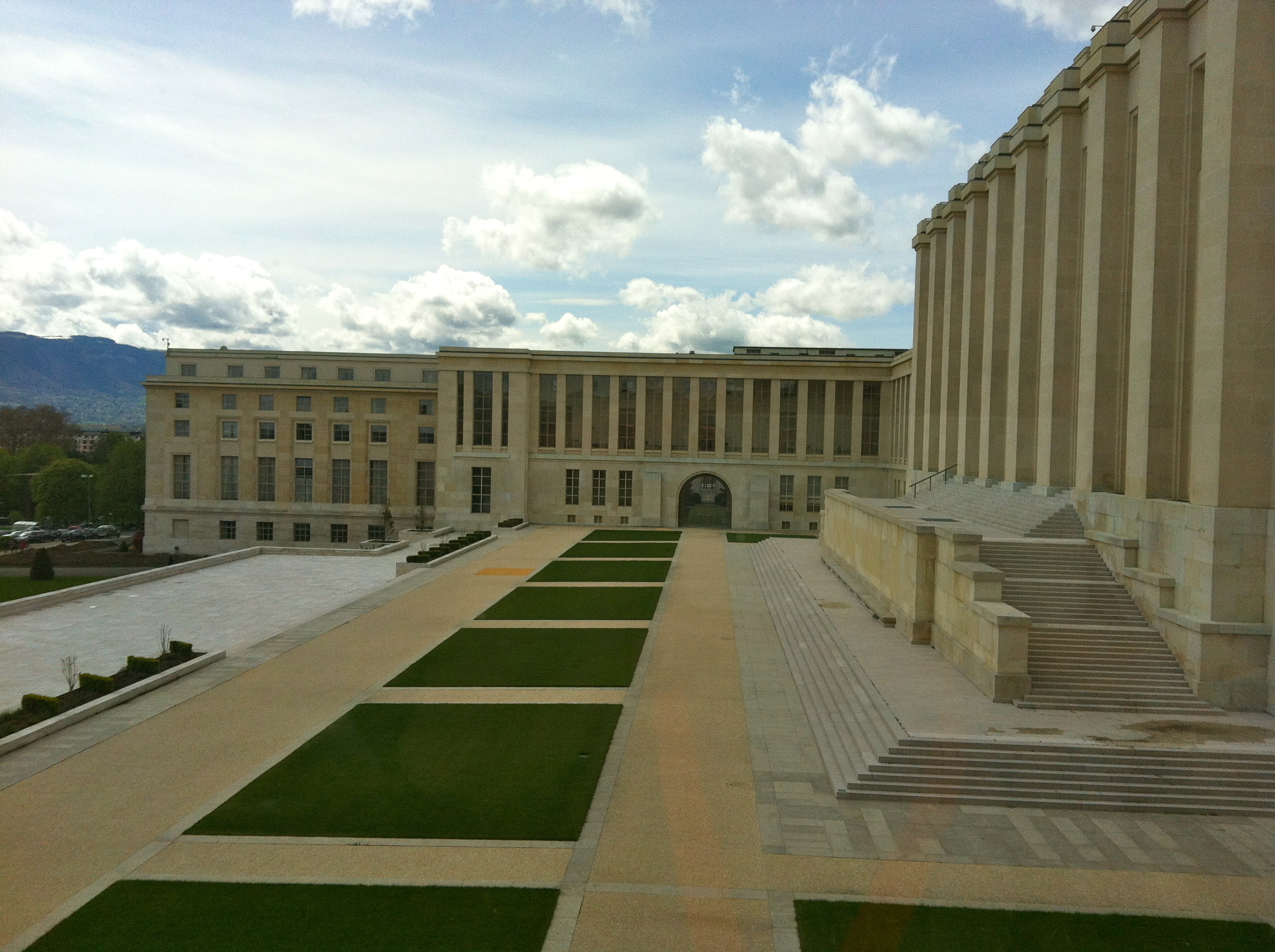
The views aren't bad here either.

Currently, there are 8500 employees in Geneva, but 25,000 delegates participating here each year.    Building on that, 163 of the 193 member states have permanent missions in Geneva.   I know a few women at the women’s club whose husbands work for the missions so this fact a was interesting.

All in all, it was a good tour.   I give it a 7 out of 10 and E-dawg rates it a 6.5 or 7 out of 10.

Gratitude Friday: Spring has Sprung!

A little delayed in my posting….but Spring has sprung in Geneva.  I admit I am late in this post.  But mainly since I have had mobility, all it has done here is rain, rain, rain so I wasn’t in the spring spirit yet.

However, we had our first day of non-rain yesterday and I am hoping that more sunshine and spring weather is on the horizon  (fingers crossed).  Although they do say that “April showers bring May flowers”, so I suppose there should be gratitude in the rain as well.

Speaking of flowers, E-dawg and I got to take advantage of Spring’s beauty yesterday on the AIWC photo group outing to Morges, Switzerland.  There we enjoyed lunch alfresco and explored the annual Fêtes de la Tulipe.

So, this Friday, I am grateful for the flowers and beauty of spring.  Finally!!!  But, better late than never!

Bon weekend, everyone!

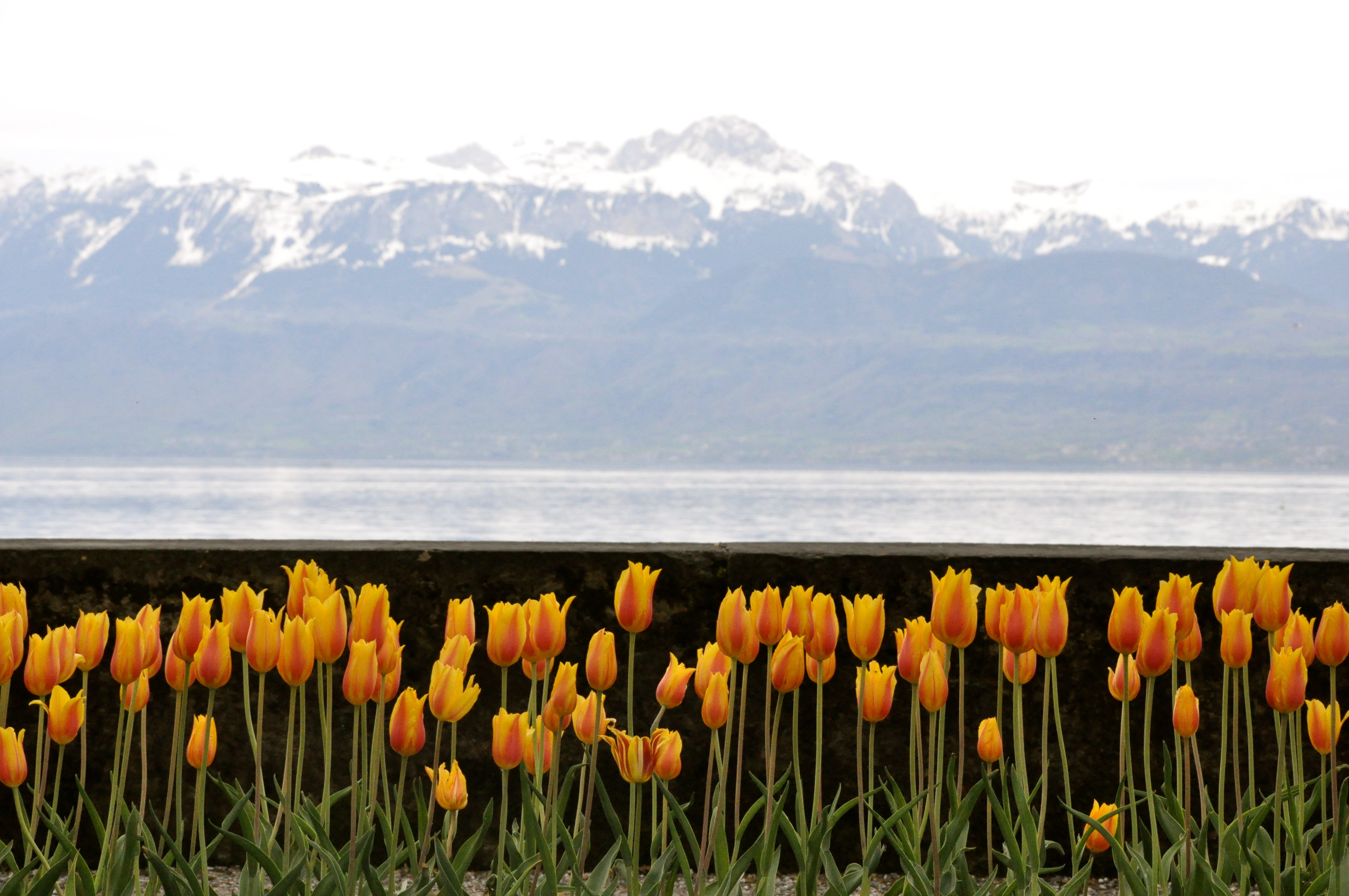
Tulips against an Alpine background

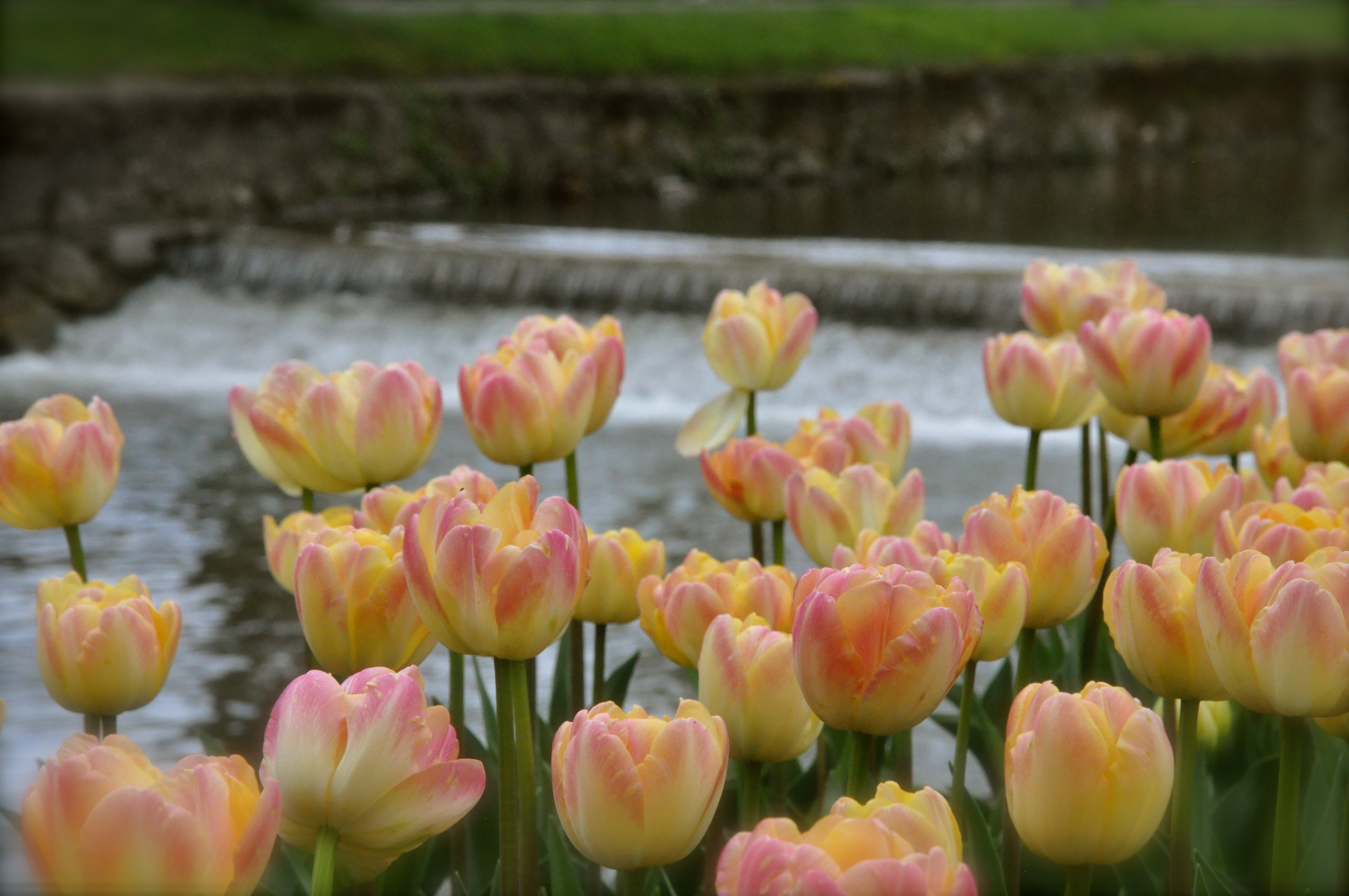
Wispy tulips in contrast to the Alps

Having fun at the Fêtes de la Tulipe

E-dawg amongst her Georgia Bulldog colors

Lazy waterfall

Caught her in action!

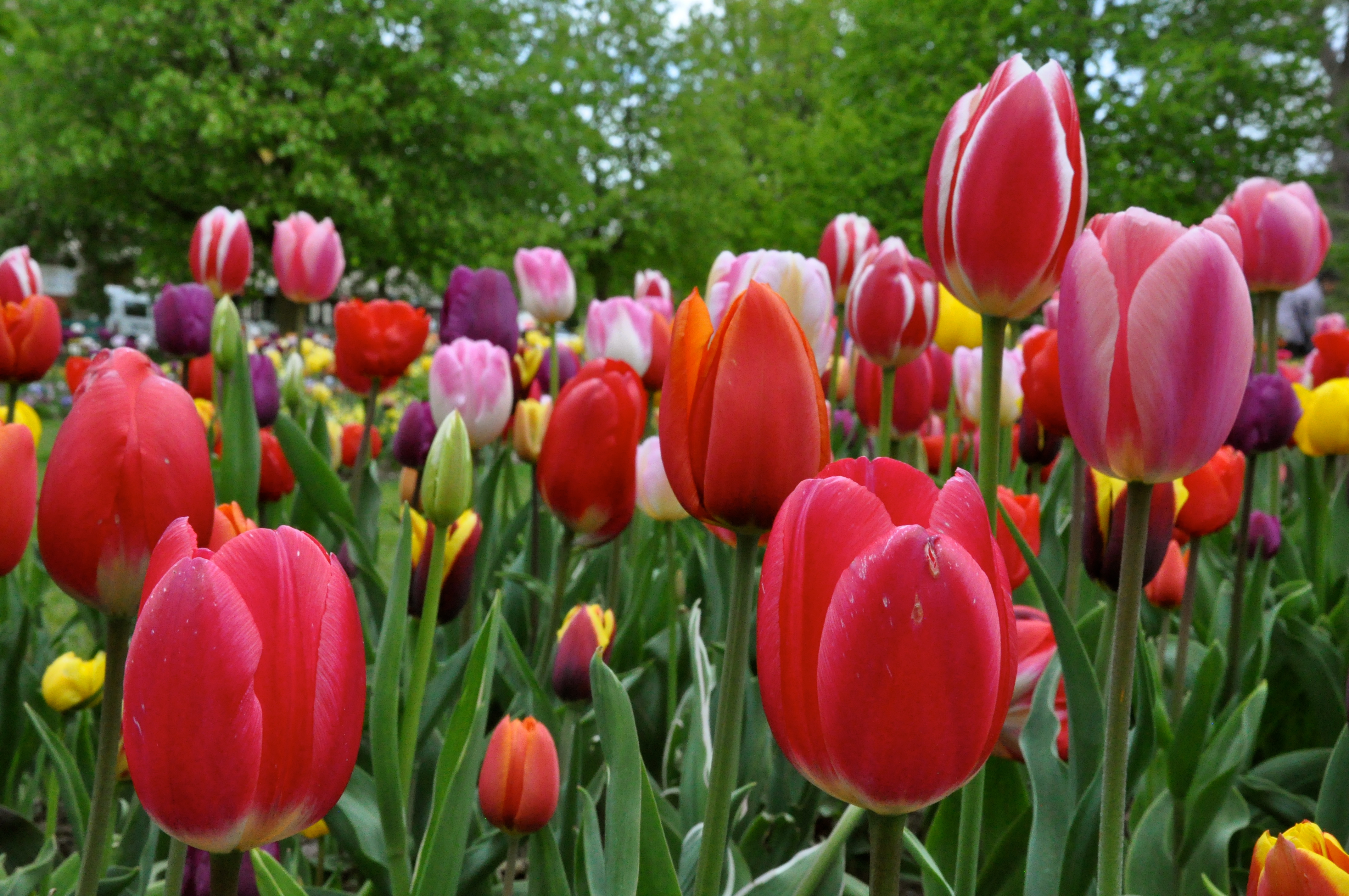
My favorite section – multicolored

A day with the butterflies

Recently, I visited Papiliorama to take a Digital Light photo workshop.  Papiliorama is a butterfly haven in Swizterland, north of Murten.   It is about a 90 minute drive from Geneva and even has a train stop at Kerzers / Papiliorama for those who prefer public transport.  Luckily, I was able to catch a ride with a friend who was assisting the class.

The class was meant for us to focus on a certain area that we wanted to develop.  During the day, I worked on my understanding of depth of field.   We continually brought our memory cards back to the workshop instructor for critiquing and guidance.  At first my butterflies are too shallow depth of field (I adore blurry backgrounds) which unfortunately kept my entire butterfly bodies from being sharp, depending on the focal plane.  However, then I learned how to expand the depth of field by closing the aperture and increasing ISO, still achieving the background result I wanted.

Unfortunately, my propensity for standing wore out before my desire to stop taking photos and improve on my technique.  However, here are a few of my favorite images:

Waiting to turn into a butterfly maybe

He likes to color coordinate

Taking in the view

Spreading out

Delicately hanging on

Patchwork colors

Climbing into the light

Geneva folks, you’ll have to add this to your rainy day to-do list!

I never thought I’d dread a free foot massage…

…but I do now.   I just got back from physiotherapy, which I have twice a week.   I don’t do any walking in PT yet.  What these appointments consist of is the physical therapist pulling and pushing my big toe joint  in ways it doesn’t want to go yet.  I call it “the most painful foot massage ever”.

The pink is where I would like to move. The blue is where he thinks I should move. I found the screw on clip art. Not sure if my screws are that big or not but I imagine it to be.

Above is a diagram of it.   I figured I’d spare you an actual photo of my feet currently.  Not that they are doing bad….in fact, today marks the 8 week birthday of the new joints.  However, because of the modified way I am learning to walk, they have like 17 blisters apiece from where my tennis shoes rub them differently.   It’s not attractive.  You don’t want to see that on your Thursday morning while enjoying your coffee.

My physio is a Swiss guy and so we spend the half hour of torture talking about the differences in Swiss and American culture in a combination of English and French.  Things like:

-Mexican food – I talk about this a lot. So much so that every time I go, he asks me if I am making Mexican for dinner.  He thinks this is bizarre that we make Mexican.  I don’t think he has every had Mexican.  Or else never been ripped away from a favorite food group and implanted into a new culture who doesn’t have those products.  Or else he’d understand.

-Coca Cola – he asked me if I drink a lot of Coca-Cola since I am from America.  I told him that when I was a kid that I drank a 2 liter a day, but now I refrain from the stuff. I think that maybe I helped build this stereotype up about the US with that comment.

-The state of Kentucky and the fact that people there don’t eat Kentucky Fried Chicken but they did just win the basketball championship.

-Skiing differences between here and the US.

-American politics.  We talk a lot about the election. I find it remarkable that people from other cultures know so much about the US government and current events.  It inspires me to want to soak up knowledge and know more about others.

-How much Swiss stuff costs.  I think everyone agrees with this generalization.

-The different approaches to food in Europe vs. the US and how much Gabe and I appreciate the change of offering and are glad to pay more for better food.   For more on my opinion, read this previous post.

Since I have gained a bit more mobility through PT, I am expanding my exercise routine on the days I don’t have sessions.   Like by doing quasi-yoga.   I call it quasi because all I can do is downward dog and a little “walking the dog”.   But still, its progress!!

I have 5 more weeks until my bones heal and settle.  Here’s hoping for more patience with PT and increased flexibility until then!


Enjoying Hermance

Post by Lauren

Geneva has a lot of lovely villages that surround it.  During the women’s club hikes, I have been able to experience a few of these little towns.  Since we walk fast through them, I just note which ones I should re-visit.

One such settlement is Hermance (pronounced Err-mance, with a silent H).   Hermance is about a half hour bus ride or car ride north of Geneva.   It is a lovely little village with a beautiful church and bell tower.

While the family was here, we decided to take a day trip up to it so that part of the crew could walk over the border to France. We took the bus which dropped us in the middle of town.

Hermance is on the border of Switzerland and France


Dunkel kindly pushed me around as I still wasn’t up for much walking.  We took a stroll down the streets of Hermance, noting it was like stepping back in time.  We only saw a few pieces of evidence of technology in bikes that had been left in the street — otherwise, just a peaceful quintessential Swiss village.

During our few hours, we ventured on the stone beach.  While walking near the shore, we noticed scuba gear.   Apparently the town is great for diving. They even have restrooms with showers for divers.

After the walk on the beach,  Dunkel, SweetWine, and The French Cougar took a quick walk over the border to France, which Mama Mia, The Gladiator and I just relaxed on the Swiss side.  Their passports weren’t checked as there is no border patrol at this quiet passing, but confirmed they were in France by some gentleman walking home from Hermance.

After the border crossing adventure, the group recharged with ice cream from the local epicerie (the only grocery store in Hermance) followed by some pastries and coffee at the lone patisserie in town.

Enjoying Hermance. In the photo of The Gladiator and Dunkel by the "creek", they are on the Swiss side, but the trees are in France.

The town is quite nice for guests to experience a quaint Swiss village.  And a plus for those wanting to add another country to their list.

Finally….The Matterhorn!

Post by Lauren

This post is dedicated to Pascal and Gisele.

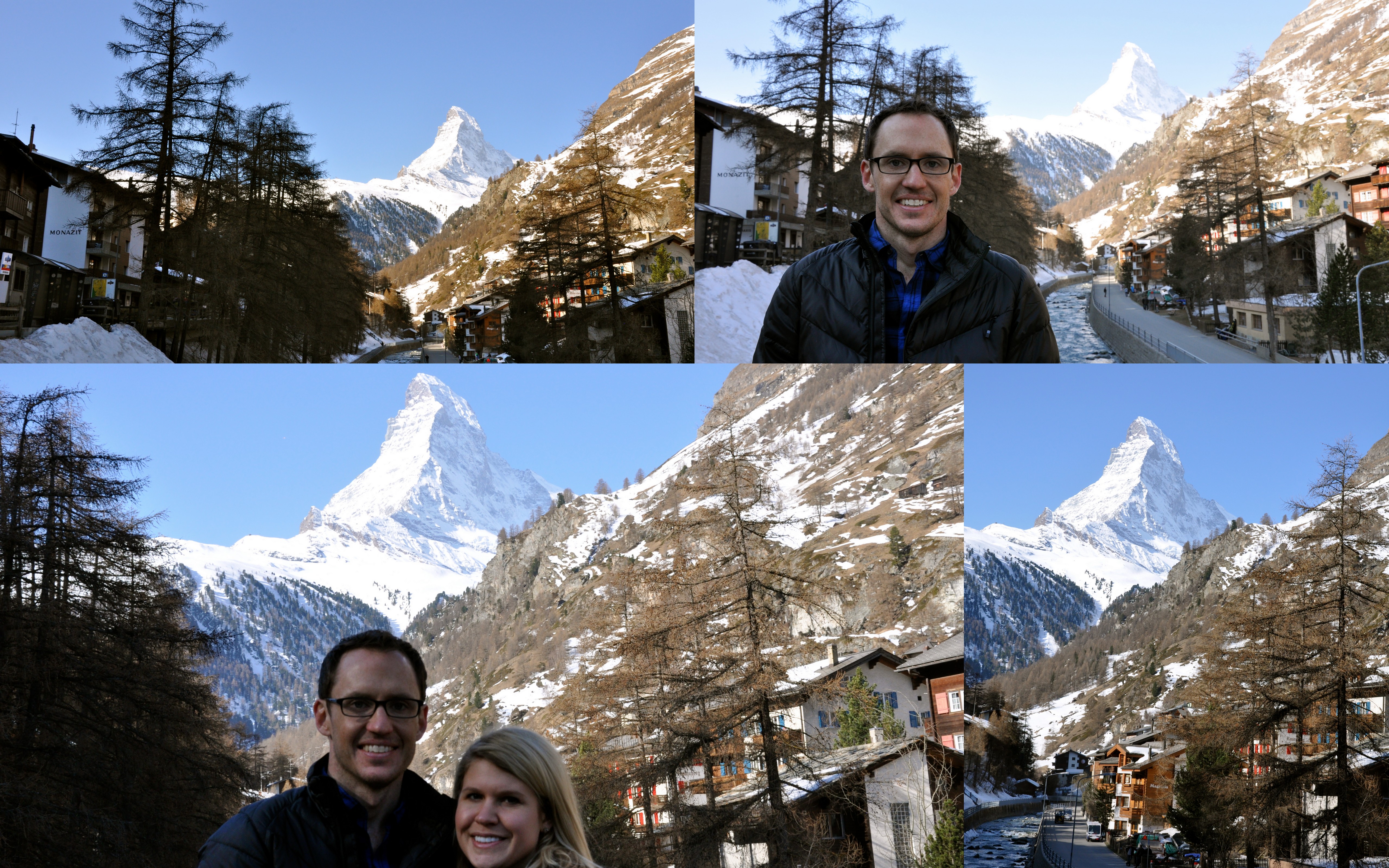
You might remember that we visited Zermatt before, but failed at catching a glimpse of the Matterhorn.

So when Gabe’s family put this iconic  mountain on the top of their Swiss wish list, we were excited at the thought we might actually get to see it.

We anxiously watched the weather forecast hoping for clear skies.  And…mission accomplished!

We stayed in nearby Tasch, the town where we had parked the car on our last visit.  Tasch has trains to Zermatt every 20 minutes, providing a less expensive hotel option (150 CHF vs. an average of 500 CHF ) since it was still skiing high season in Zermatt.

After dropping bags at adorable Hotel City in Tasch, we headed to Zermatt and immediately took an electric taxi  to the best overlook.  It was quite bright, but still magnificent.

Zermatt is known as a climbers destination although the Matterhorn is one of the deadliest peaks in the Alps.  It was one of the last peaks to be climbed in the golden age of Alpinism, and was first conquered by a group lead by  Edward Whymper in 1865.  Unfortunately, on the descent, there was a fall and four members of the group fell to their deaths.

We passed the graveyard for those who have died attempting to climb the Matterhorn.  It has been about 500 people in total who found their match in the 4,478 m high peak. For more information on this topic, Schwingen in Switzerland did a comprehensive post.

Mountaineer's cemetery, Zermatt

After wandering the town a bit, we dined on burgers and beers at Zermatt favorite, Brown Cow at Hotel Post, and then headed back to our own hotel in Tasch for the evening.

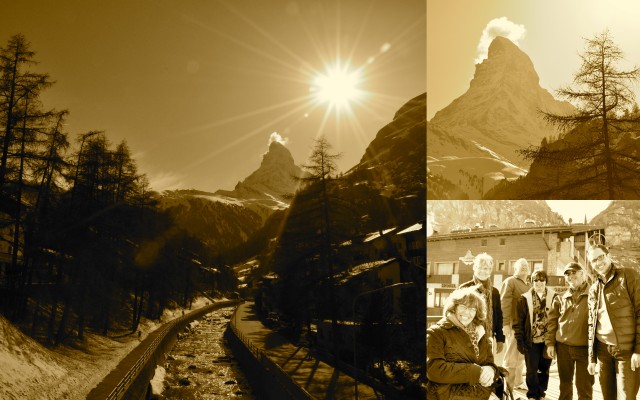
The next morning, we got up bright and early to make sure we were on time for the Glacier Express. We had an extra half hour to kill, so a few of us ventured back to catch a morning glimpse of the majestic Matterhorn.  Much better by morning:

Zermatt still remains one of our favorite Swiss towns.  We have visited it now in winter and spring.  However, I think it would be beautiful in the summer and fall as well.

Famous Swiss Foods: Cheese

Post by Lauren

Switzerland is famous for its cheese delicacies. I thought I would dive into this topic a bit more.

Why is cheese from Switzerland better?

Many say it’s the cows. Switzerland has a lot of grassland which is hilly and unfit for traditional farming. However, it is excellent for livestock breeding. On a recent tour of the Gruyeres cheese factory, they say that you can taste the flavor of the meadows in the cheese, just like you can tastes the hint of cherry, blackberry, and oak in wine.

The secret to Switzerland's cheese.

Which cheese is Swiss cheese?

Well, The Swiss will argue that all cheese in Switzerland is Swiss cheese, because it is made in Switzerland. They aren’t really familiar with the Americanized “Swiss cheese” with holes in it. But this type of cheese Americans commonly know as Swiss is in fact a general term for what the Swiss call Emmenthaler. However, in Switzerland, they have over 450 types, all which they consider Swiss cheese.

Check out this link for an interview with Matt Lauer inquiring about this same topic

http://today.msnbc.msn.com/id/26184891/vp/45240274#45240274

Where in Switzerland is known for good cheese?

Everywhere!!  See this map for specific types.

How much cheese do Swiss people eat a year?

47 pounds, compared to 31 pounds by Americans.

How do you eat cheese in Switzerland?

Fondue

Fondue is a special mélange of Swiss cheese ( Jarlsberg, Emmenthaler, and Gruyere ) mixed with liquors (wine and kirsch). You heat it in a fondue pot and you dip stale bread into it. The Swiss are not known for any fondue except for this type. So not oil fondue (bourgignonne) or broth fondue (chinoise) or chocolate fondue (like the kind you see at weddings).

This type of fondue is rare in Switzerland

However, they do add some variety by serving champagne fondue, and tomato fondue.

The first time we ordered fondue, we only ate a tenth. We were so stuffed. The waiter thought something was wrong as I think we ate less than anyone else ever had.

Nostalgia. Our first fondue experience in Switzerland at Café du Soleil.

We have never reached the bottom by ourselves. However, the bottom is the best part. A told us its like a crispy cheese-it. When we went snowshoeing the gals who sat next to us polished theirs off and offered us some of the bottom. Oh so good.

Also, it should be told that true Swiss folks dip their bread into a shot of kirsch first. It is like a cherry alcohol. On the same snowshoeing outing, one of the mean offered us his glass of kirsch to experiment. Not sure if I was a huge fan, but it was very kind for this gentleman to teach how the true Swiss do it.

Fondue comes along with responsibility. You should take care that your fork never touches the melty cheese, only your bread. Also, you should avoid your mouth making contact with your fork.

Raclette

This is our favorite cheese dish. In a traditional setting, a huge block of cheese, is heated under a heating element. When it starts bubbling, you scrape off the melty layer onto your plate and eat it with accompaniments which can be dried meats, breads, potatoes, pearl onions, or pickles.

Double dose of fondue and raclette. This is raclette Type 1 - Form A - wedge.

Me, mesmerized by eating the raclette. This is type 1 - form B - horizontal block of cheese.

Pascal learning how to do the scrape.

It can also be served two other ways that we have seen. The second way [Type 2]  is still a traditional method, but is easier for parties at your home. On a tiered platform, you have a central heating plate. Underneath, you slip individual (usually 6) dishes on which each person has ensembled their own concoction – slice of raclette, perhaps some dried meat. Then, afterwards, they scrape their individual serving onto bread or potatoes on their plate.

The Captain and Swiss Miss eating Raclette - Form 2. Notice the little dishes underneath. The top is keeping our potatoes and bread warm.

Finally, some restaurants just do the prep in the back and bring you a melty plate of gooey raclette. The taste is the same, but it lacks the fun. Make sure you ask the preparation if you really want a traditional setting.

What if you just want to buy it at the store?

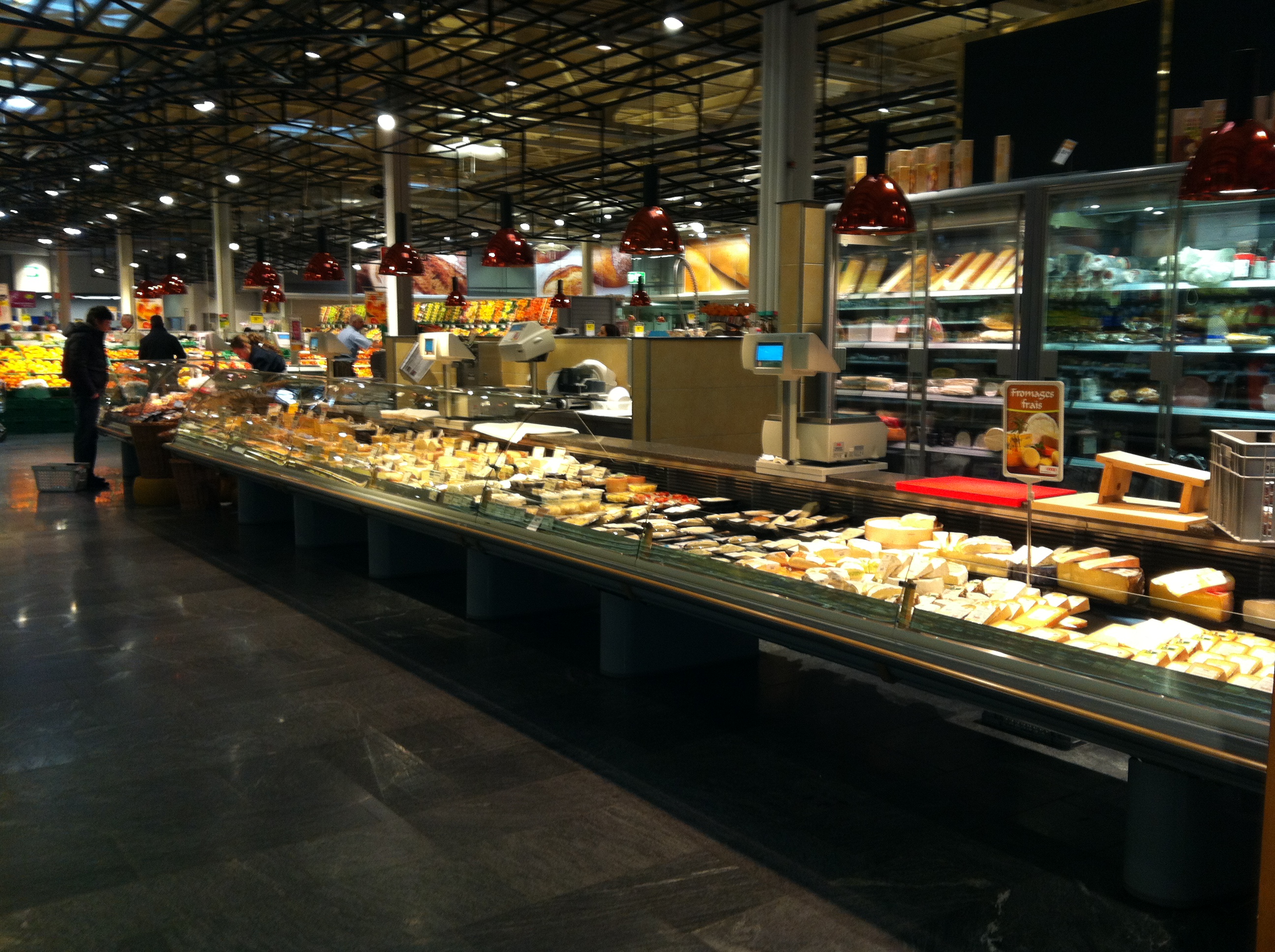
At the grocery store, the cheese section is at least double the size of frozen foods. These people take their cheese seriously. The only other nationality that comes close to Switzerland in the realm of cheese is France. I like French cheese too. Gabe doesn’t because he isn’t a fan of the soft types.

"Regular" cheese aisle at the grocery store near Gabe's office

"Specialty" cheese section at the grocery store near Gabe's office. Same store.

However, in either of these photos, you will not find any cheddar or orange cheese.  Nada.

You can also buy cheese at the farmers market, or at full-out cheese stores that only sell cheese.  I am intimidated still by these places. I’ll buy an occasional known type at the farmers market but want to practice my French a bit more before venturing to the unknown.

If you want to make fondue or raclette at home, no worries – they sell plenty of cheese heating instruments here.

Cheese prep aisle at local electronics store

Gratitude Friday: A Great Ski Season

Post by Lauren

Ski season is officially over for our household.  With temperatures warming up, the local slopes are slushy by lunchtime.

However, we wanted to dedicate a post in gratitude to the Alps and the ski opportunities that we have had this winter.

Last winter, it was unusually warm.  We heard people say that it only produced about 2 decent snow days and even still, the slopes weren’t ideal.

This season is a stark contrast – there was wonderful skiing to be had pretty much every weekend from the beginning of January until now.  Over the last 3 months, we have visited:

  • La Clusaz, France
  • Les Contamines, France
  • Megève, France
  • Chamonix, France
  • Verbier, Switzerland
  • Saas Fee, Switzerland

We feel lucky that we have had the chance.

Our friend A has major talents with the camera while skiing.  I don’t possess such talents as I always have to concentrate on not falling.  However, since I have a lot of time in the chair lately, I mixed her video footage with my own to create a recap video of our ski exploits.

http://www.youtube.com/watch?v=trPb_eHtZsw

Au Revoir Ski Season – until next year!

And bon-weekend to all.


The Snow Line

Post by Lauren

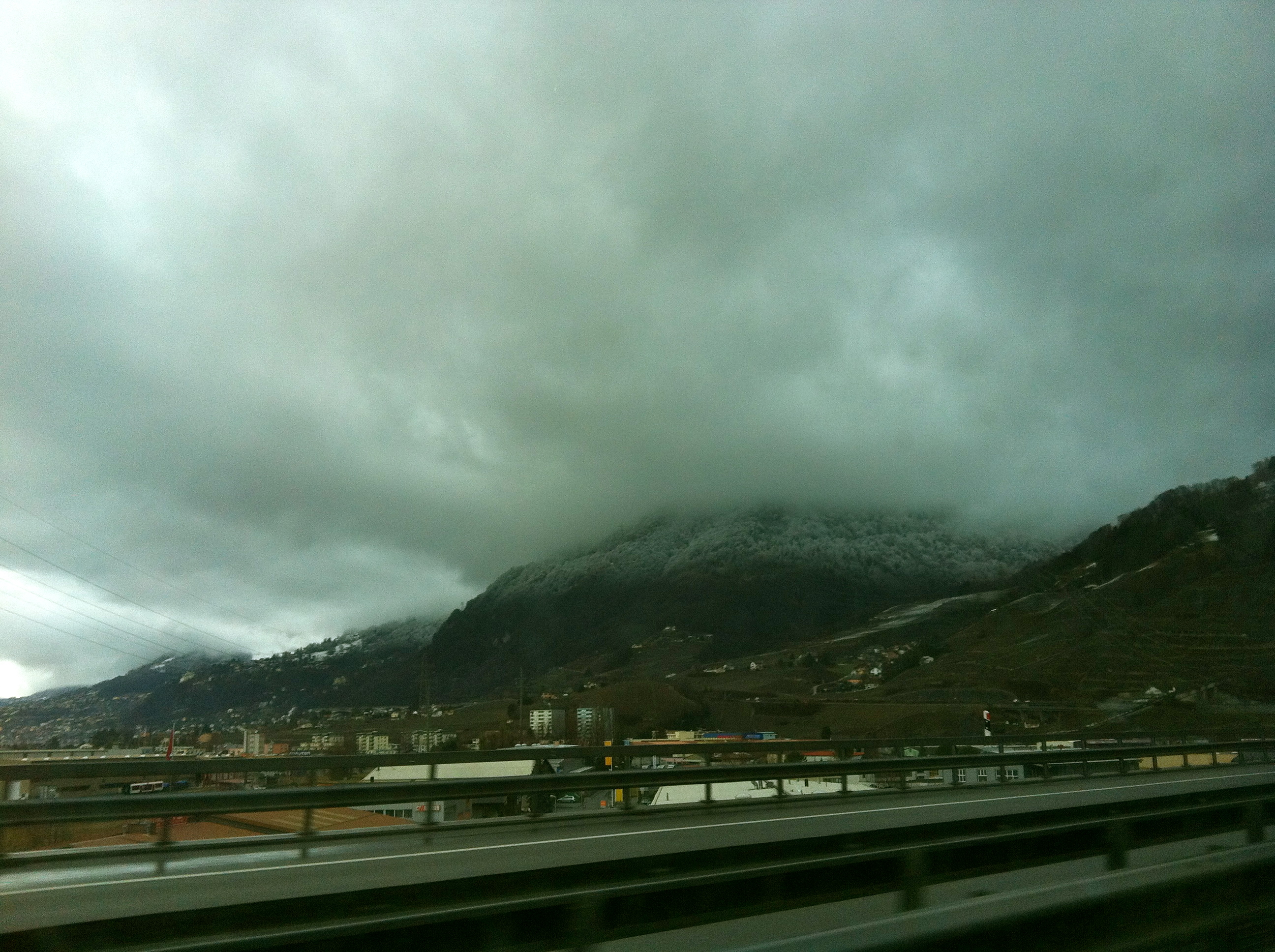
Where I grew up, we had hills; however, everything was relatively flat compared to the Alps. So when we moved to Switzerland, and live amongst exponentially taller mountains, it is first time that I have experienced “the snow line”.

This concept is one that different parts of mountains or hilly plains are either covered or not covered in snow due to elevation.

Take a look at some of our recent trips and where we’ve seen this in action:


And, where we live in Geneva, we get to live below the snow line, but still experience the beauty of the icy stuff in the distance on the Jura mountains.


I kind of like it that way!

The Röstigraben

Post by Lauren

Switzerland has many different divides based on its mountainous geography. Since many of the areas stayed remote for a long time, it prevented the ease of travel and communication. Thus, there wasn’t really ever a “melting pot” effect in transitioning into one Swiss culture. Still today, there are still four official languages, based on the geography.

A few months ago, we looked at this language divide. This divide can sometimes be expressed as the “Röstigraben” (rosti divide in German) or in “rideau de rösti” (curtain of rosti in French). While the divide is named for a culinary dish ( based on the farmers breakfast rösti which originated near Bern ), it is actually more commonly used to reference the attitudinal differences that exist on either side of the divide.

The Swiss Germans have political differences to their Swiss Romande neighbors. It includes voting (Swiss Germans don’t want to be a part of the European Union, and want to keep the franc vs. adopting the Euro) as well as general lifestyle differences (Swiss Romandes are less conservative, less strict on rules, etc). During the elections, you can see a lot of this exemplified in the political ads.

And what is Rosti anyhow, you might ask? It is a potato dish. The best way to describe it is like upscale Waffle House hash browns. Sometimes it is served as a side, but most times, times its a main course – usually smothered, covered with something yummy – cheese, mushrooms, an egg, or perhaps sausage. It’s simply delicious.

Rosti at Restaurant du Pont, Zermatt, Switzerland

Other countries have similar divides reflected in foods.

In Germany, they have a line called the Weisswurstäquator. It is known as the “white sausage equator” because the Bavarian region eats the white type, rarely consumed by those living in the Northern region.

In Italy, the pizza is better in Naples and Southern Italy. Why? Because the Southern part of Italy was notoriously more poor than the Northern part. Thus, they often scraped up simple inexpensive ingredients to make a meal….thus creating and perfecting the dish we know as pizza.

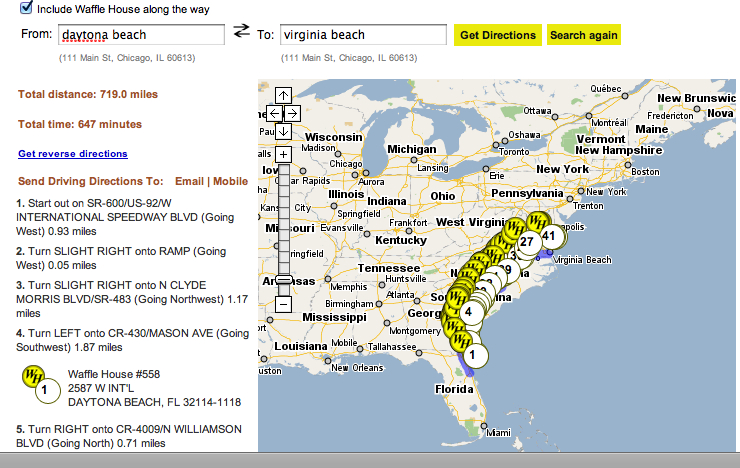
And, back in the United States, I believe we have our own version of a Röstigraben, if you count the succulent Waffle House hashbrowns as a national delicacy. There are far more WH’s in the South than in the North and the West.

I wonder if our forefathers brought this back from Switzerland?

Courtesy of Waffle House restaurants

What other places in the world have divides based on food?