Enjoying Hermance

Post by Lauren

Geneva has a lot of lovely villages that surround it.  During the women’s club hikes, I have been able to experience a few of these little towns.  Since we walk fast through them, I just note which ones I should re-visit.

One such settlement is Hermance (pronounced Err-mance, with a silent H).   Hermance is about a half hour bus ride or car ride north of Geneva.   It is a lovely little village with a beautiful church and bell tower.

While the family was here, we decided to take a day trip up to it so that part of the crew could walk over the border to France. We took the bus which dropped us in the middle of town.

Hermance is on the border of Switzerland and France


Dunkel kindly pushed me around as I still wasn’t up for much walking.  We took a stroll down the streets of Hermance, noting it was like stepping back in time.  We only saw a few pieces of evidence of technology in bikes that had been left in the street — otherwise, just a peaceful quintessential Swiss village.

During our few hours, we ventured on the stone beach.  While walking near the shore, we noticed scuba gear.   Apparently the town is great for diving. They even have restrooms with showers for divers.

After the walk on the beach,  Dunkel, SweetWine, and The French Cougar took a quick walk over the border to France, which Mama Mia, The Gladiator and I just relaxed on the Swiss side.  Their passports weren’t checked as there is no border patrol at this quiet passing, but confirmed they were in France by some gentleman walking home from Hermance.

After the border crossing adventure, the group recharged with ice cream from the local epicerie (the only grocery store in Hermance) followed by some pastries and coffee at the lone patisserie in town.

Enjoying Hermance. In the photo of The Gladiator and Dunkel by the "creek", they are on the Swiss side, but the trees are in France.

The town is quite nice for guests to experience a quaint Swiss village.  And a plus for those wanting to add another country to their list.

Milano

Post by Lauren

Italy was high on the list for the family to see while they were here.   We considered going to Venice but our schedule was already packed as it was.  With Venice being 7 hours on the train, we opted for going to Milan instead as it is only 4 hours from Geneva.  We thought 14 hours would be overkill, especially since we’d done about 20 hours on the train thus far into the trip.

Direct trains leave Geneva twice a day for Milan – 7:42am and 1:42pm.  We picked the early train so that we could maximize our time.

We arrived in Milan just around lunch time and started to figure out how to take the metro and get euros out for the group.  We spent about 2 hours in the Milan train station trying to navigate.  Hello Italy and chaos!  As it turned out, we couldn’t take the metro with the wheelchairs – only steep stairs provided access – so we hopped in two cabs to take us to the city centre.

It took us a little while to find our hotel, but when we did find it we were rewarded greatly.  Gabe had done the research and found apartments nearby the Duomo.  Little did we realize that the view would be this good:
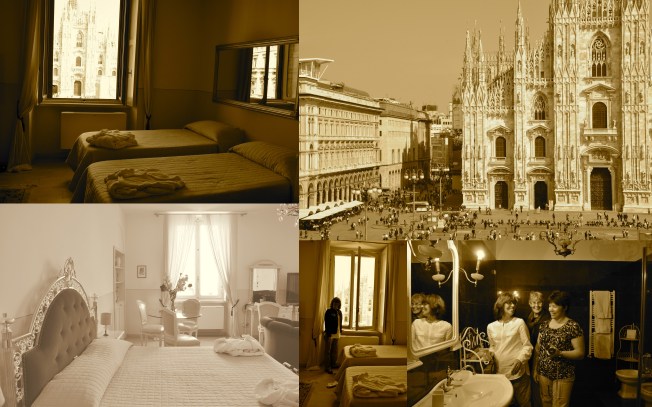
Glamour Apartments in Milan. Mama Mia, Sweet Wine and The French Cougar loved the marble bathrooms.

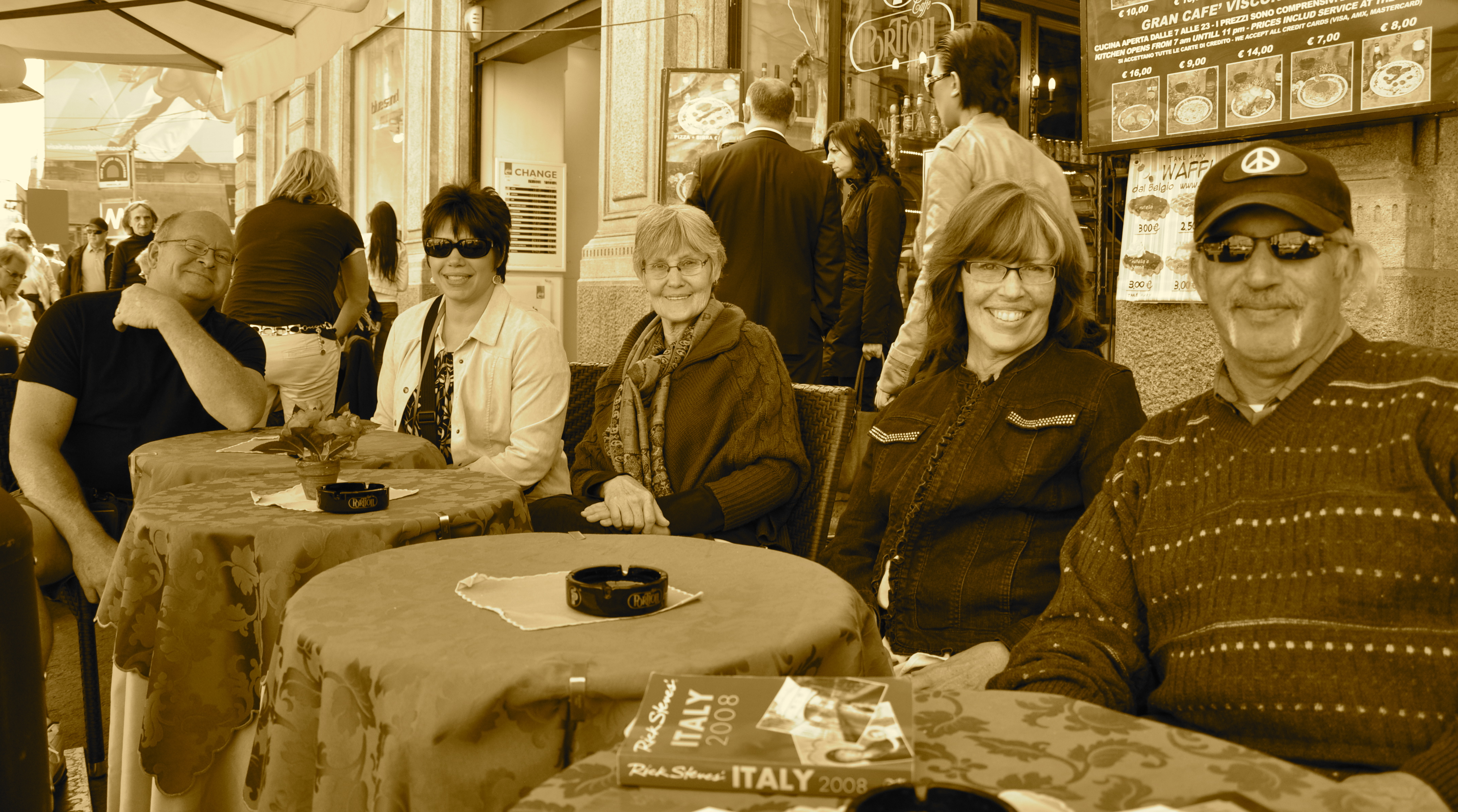
After marveling over the stately bathrooms and a quick lesson on bidets (see S in S for more), we dropped our bags and headed out for lunch.  We found a nice café directly in front of the Duomo and settled in for some wine and pizza.
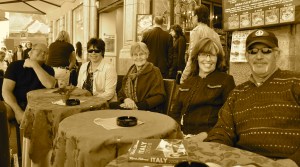
Pizza lunch in Milan

Italy's best....gelato!!

The Gladiator's favorite part about Italy

Hanging out in Piazza del Duomo

After lunch, we grabbed some gelato, and Gabe took Sweet Wine, The Gladiator and French Cougar to the tour office to see if we could arrange something for the next day.  We had another small snippet of Italian chaos when some guy passing by stole The Gladiators sunglasses that he had left on the grass.   Mama Mia and I really couldn’t chase him down in our wheelchairs, so Dunkel saved the day by chasing after the guy who gave them back.

After a little bit of free time exploring, we met up for walking to a close-by restaurant, Al Mercante, recommended by a few folks.  It was family owned, cozy and welcoming.  We ordered in the typical Italian way, with a primi and a secondi.  In Italy, this is customary – to start with a pasta and then move onto a meat or fish dish.  Real Italians also add on an antipasti prior, but our tummies weren’t conditioned to this treatment yet so we just left it with the two courses.   However, some of us did participate in dolci, dessert.  Special thanks to Sweet Wine for treating Gabe and I to this marvelous meal.

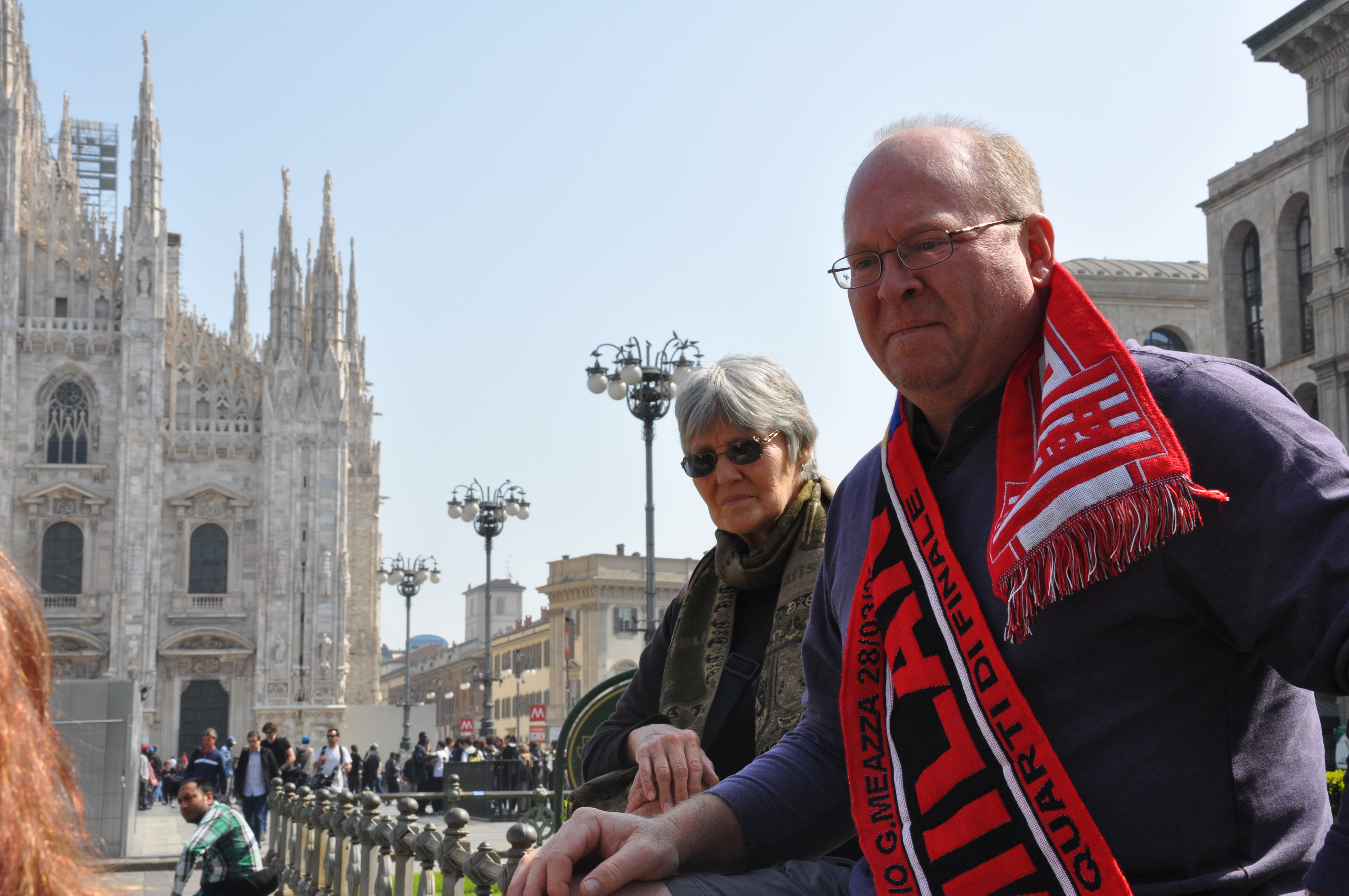
The next day, after breakfast, we took a guided tour.  The guide, Esther, was quite good.  We’d recommend her for anyone traveling to Milan.  We navigated through the thousands of soccer fans in Milan for the Milano vs. Barcelona match happening later that night.

Dunkel, embracing the soccer spirit

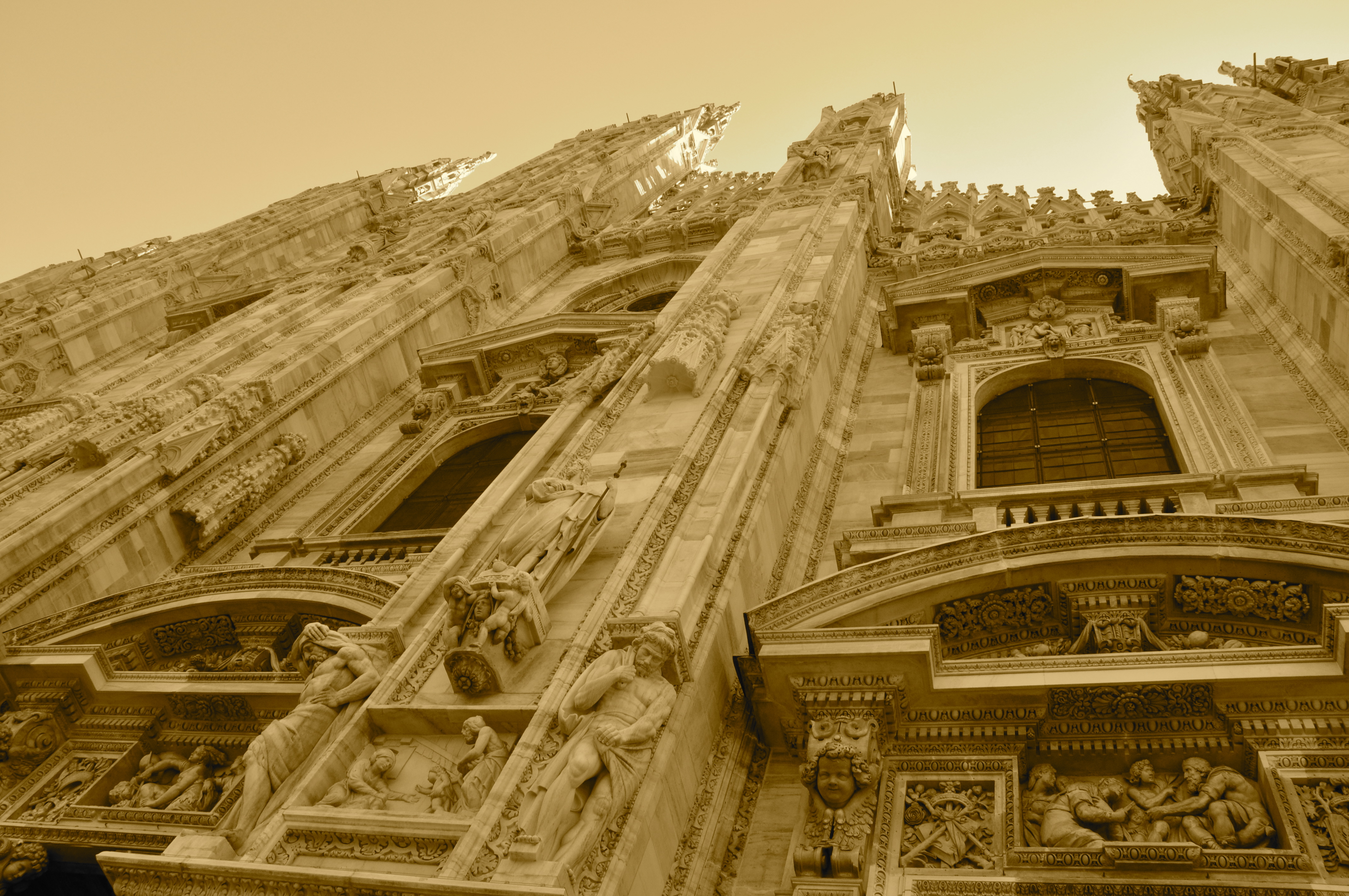
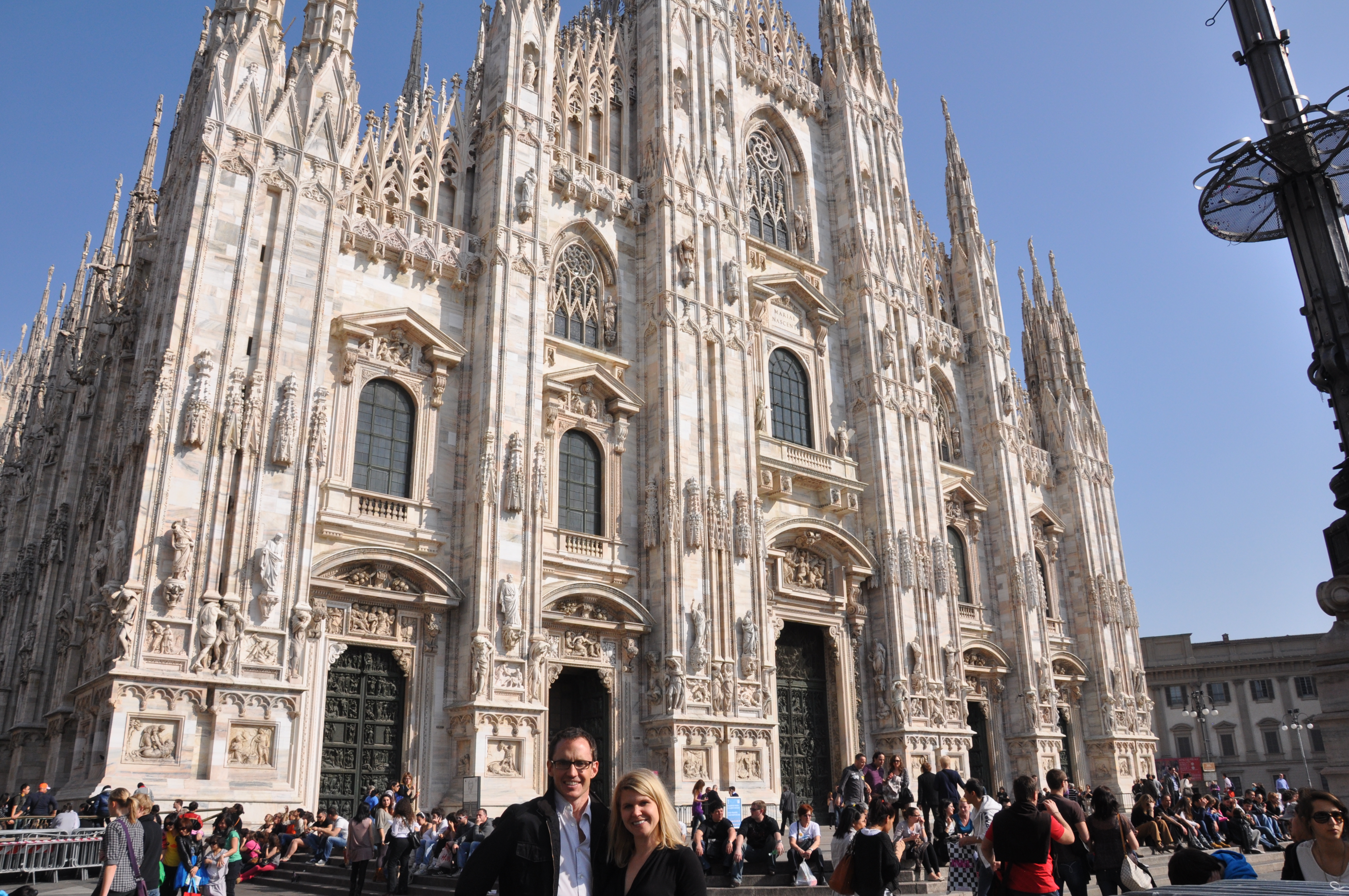
Our first stop was the Duomo.  We learned that it took 500 years to complete, constructed between 1300 and 1800 AD.  The Duomo of Milan  is the world’s 3rd largest church (behind the Vatican and Sevilla).
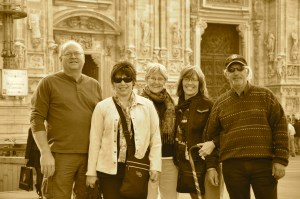
Waiting to enter the Duomo of Milan after learning that "an Italian 5 minutes" really means 15. Not very Swiss.

The Duomo of Milan was styled after Notre Dame of Paris, built 200 years later.  It can contain 5 times the people however, at 40,000.  It is a Gothic style and has 3000 statues.

Duomo of Milan

There are 91 masses a week.  However, no weddings or funerals with the exception of very important events.  Versace’s funeral took place here in the Duomo of Milan.

One of the Duomo’s most notorious events took place in 1805, Napoleon ordered the Pope to come to Milan and crown him.  No one had ever ordered the Pope to travel before.

The marble used inside and out came from Lake Maggiore, outside of Milan.  Back then, it was quite important that it was a local source because of the difficulties of transportation.  As I mentioned, the marble used outside is the same as inside.  However, inside, the marble is dark.  Because of the current economic crisis in Italy, they cannot afford the expense of cleaning it inside.

The inside of the Duomo, 2012

After learning about the marble, we studied the stained glass.   Esther taught us that before the Catholics who attended the Duomo could read & write, that stained class told stories of the bible.  This particular scene details the life of Jesus Christ.

Some arts don’t improve with technology.  Esther said that today, designers are still not able to recreate the blue color that the talented craftsman achieved in the 15th Century.
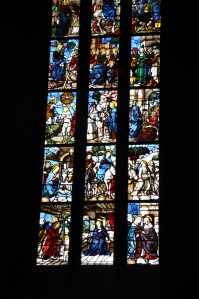
Stained glass in Duomo of Milan, circa 1450 AD, telling the story of Jesus Christ's life.

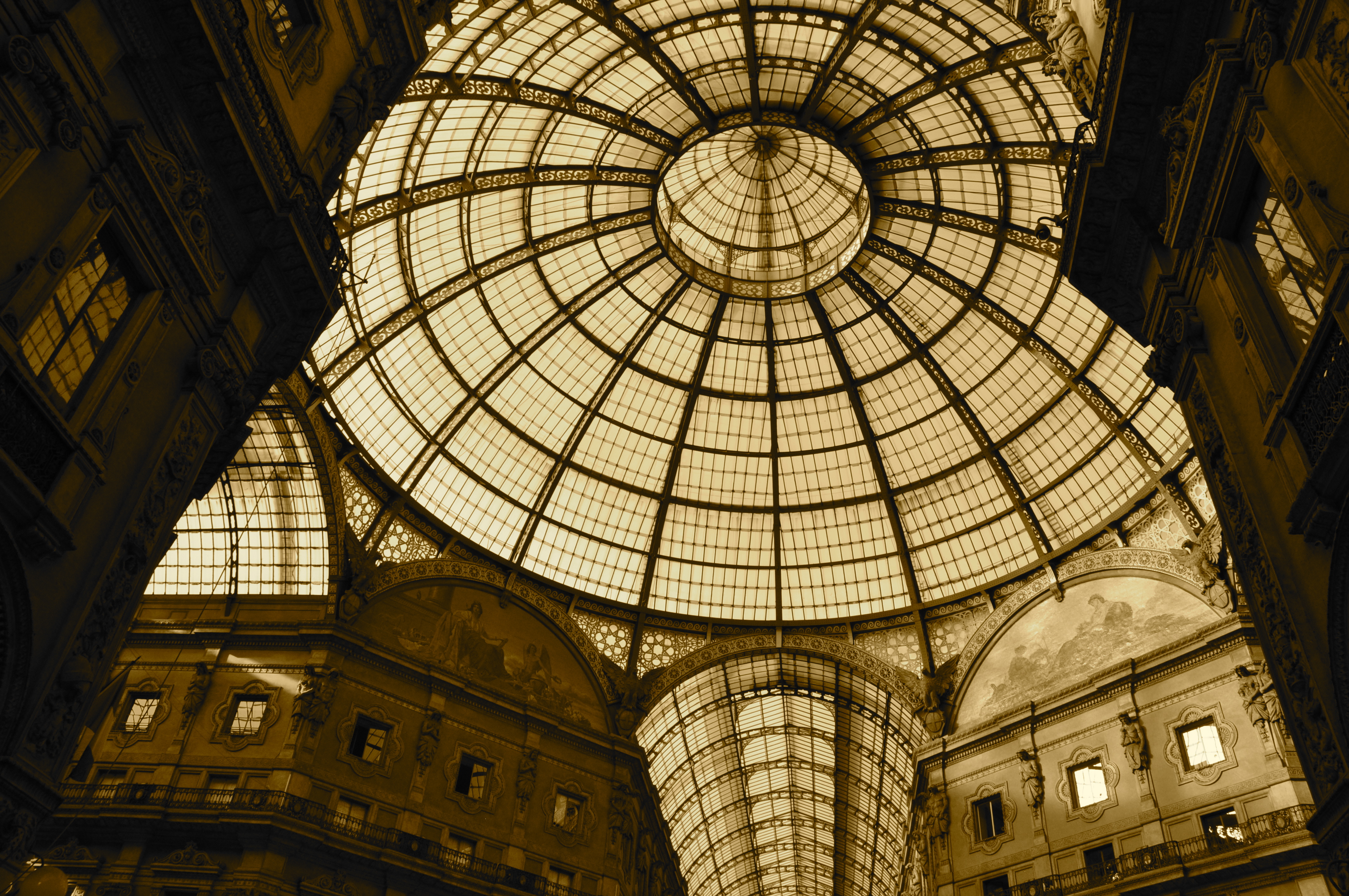
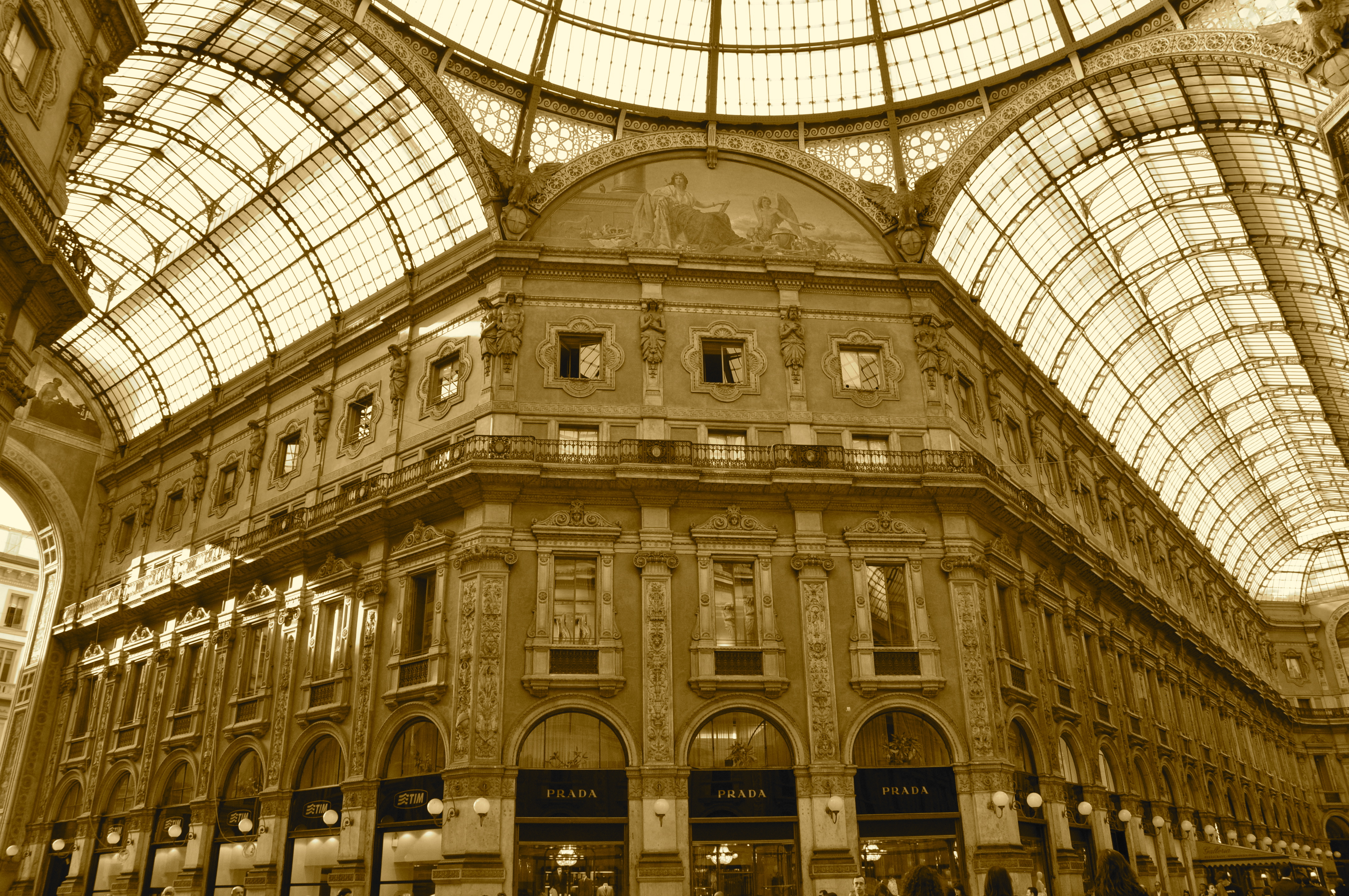
After the Duomo, we continued on through the Galleria, the “living room of Milan”.  Gabe and I had discovered it the day before so enjoyed the second look.  We saw the original Prada, which will celebrate 100 years next year.  Speaking of the devil, our guide had the pleasure of touring Meryl Streep herself when she visited Milan. She said she was a very nice person.

Galleria, Milan

The original Prada store, Galleria, Milan

Next was La Scala, the famous opera house in Milan.  It was finished in 1778.  Esther listed three reasons it was so famous:

-the superior technical / sound accoustics

-the history, particularly Giuseppe Verdi, the talented composer who put the crack-down on the social antics of the Milan well-to-do when attending the opera

-the fact that success in the Scala gives you an international passport for your music career

The final stop was The Last Supper.   This was my favorite stop.  Until recently, I didn’t know that The Last Supper was painted on an actual wall.  It was done in the dining room of the monks in the Convent of Santa Maria delle Grazie, in a style like a fresco.  During WWII, the church was bombed and the adjacent wall crumbled and so The Last Supper barely escaped.  It is now a UNESCO world heritage site.

They are very protective of the painting, with due cause, so we had to go through three independent air-conditioning chambers before we were let in the dining room.

Last Supper courtesy of Wikipedia Commons

It was simply amazing to witness Da Vinci’s perspective compared to the other art that day. If you stand back in the dining hall of the monks, the scene seems to go on endlessly.  Noticing the other painting opposite the room, which was painted during the same time, the perspective and depth simply wasn’t there.  It was a new concept which made Da Vinci stand out as an artist.

Also of note is Da Vinci’s use of emotion in The Last Supper.  Previous artists had used the same faces for all of the apostles.  In order to differentiate Judas, they put him farthest away from Jesus.

However, in his rendition, Da Vinci focused on the emotion of the men at the moment when Jesus announced that one of those at the table was going to betray him. Disciples are grouped in threes for further examination, each with different reactions.  Judas is now depicted in the middle of all of them, fairly close to Jesus; however, he is in the dark, not the light.

What a treat, especially a week before Maudy Thursday to experience this painting.

Ciao Milan!

Springtime ride on the Glacier Express

Post by Lauren

You may recall from the blog we took the Glacier Express to St. Moritz this winter.   When we took it while Gabe’s family was here, it was equally as beautiful only half covered in snow.

This time, instead of St. Moritz, we headed to winter sports capital, Davos.  We passed through in route to Klosters, which was the choice vacation getaway for Princess Di and family.  You see, I figured I’d class up the selection and provide us the lodging of royalty.  Just kidding, it was the only hotel in the entire region left since it was still ski season.  And I can promise you that they didn’t stay in the Swiss Sport Lodge, although it was fine for our tastes 🙂

You can see a pictorial recap of our journey below:

Starting out in Zermatt and heading to Brig. Not much snow at all this time!  We love watching the wonder on everyone’s faces!

Continuing on through Fiesch, Reckingen, Muster, Fulka and the canton of Ori.
Everyone in awe in Andermatt. It’s my favorite on the ride, too!

Cutting through the Rhine Gorge, passing through Davos and reaching our destination of Klosters.

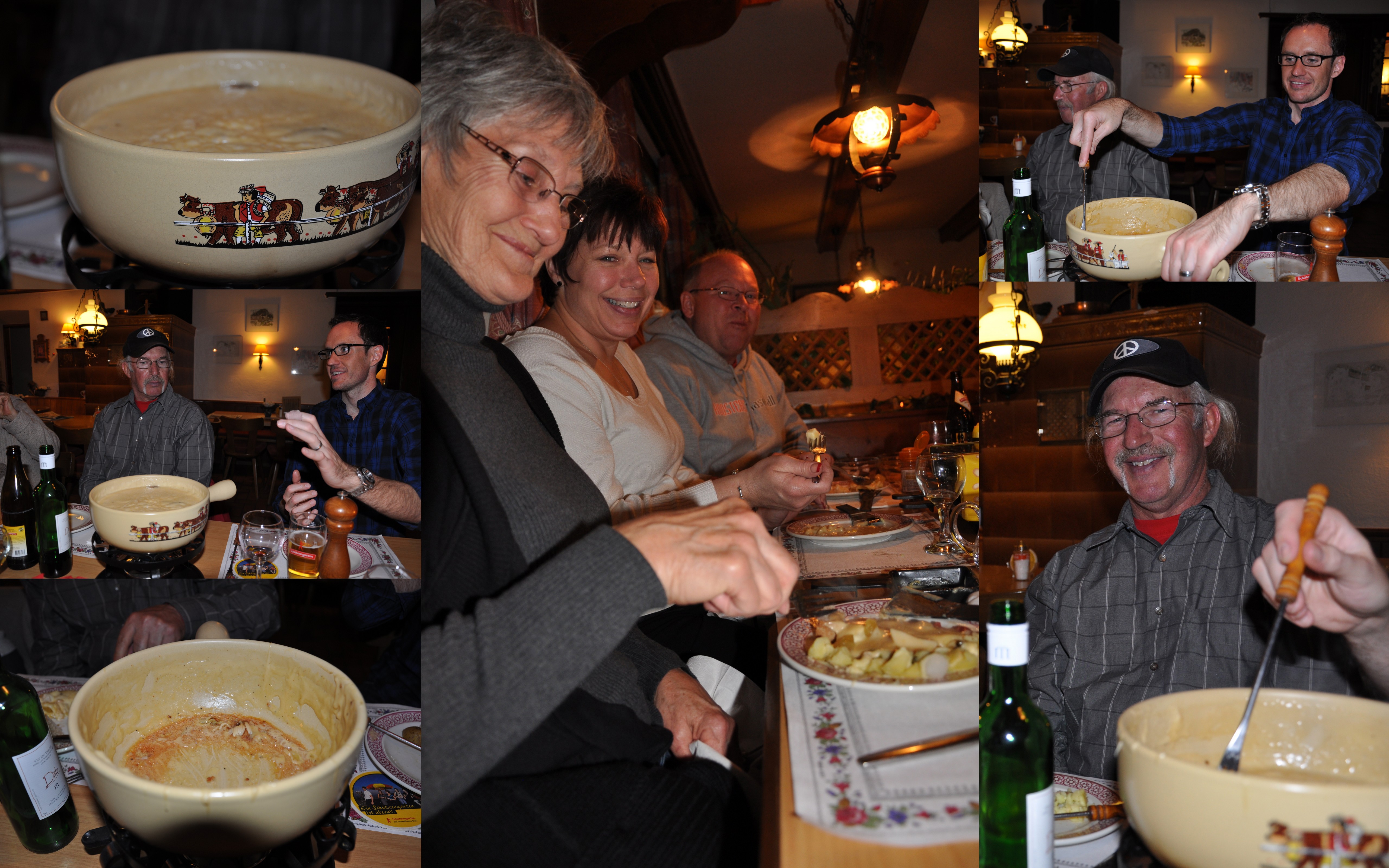
Enjoying their first Swiss fondue and raclette in Klosters. Since the raclette was Type 2 and served without meat, the group favorite was the mushroom fondue. We were the only ones in the restaurant with an exclusively German-speaking owner.   It was a really awkward fun experience!

We stayed at the Swiss Sport hotel in Klosters. We found Klosters to be small and tranquil – not a place for late night action.  We had to create our own!  The evening was fun of laughter and fun.  Don’t let The French Cougar tell you that is water in her hand – we believe its wine!   Also don’t even ask why Dunkel and Sweet Wine have those amused looks on their faces.  What happens in Klosters stays in Klosters!

A bonus is that The Gladiator and Mama Mia celebrated their wedding anniversary on this stint of the trip.   We are so glad we got to spend it with them!

Finally….The Matterhorn!

Post by Lauren

This post is dedicated to Pascal and Gisele.

You might remember that we visited Zermatt before, but failed at catching a glimpse of the Matterhorn.

So when Gabe’s family put this iconic  mountain on the top of their Swiss wish list, we were excited at the thought we might actually get to see it.

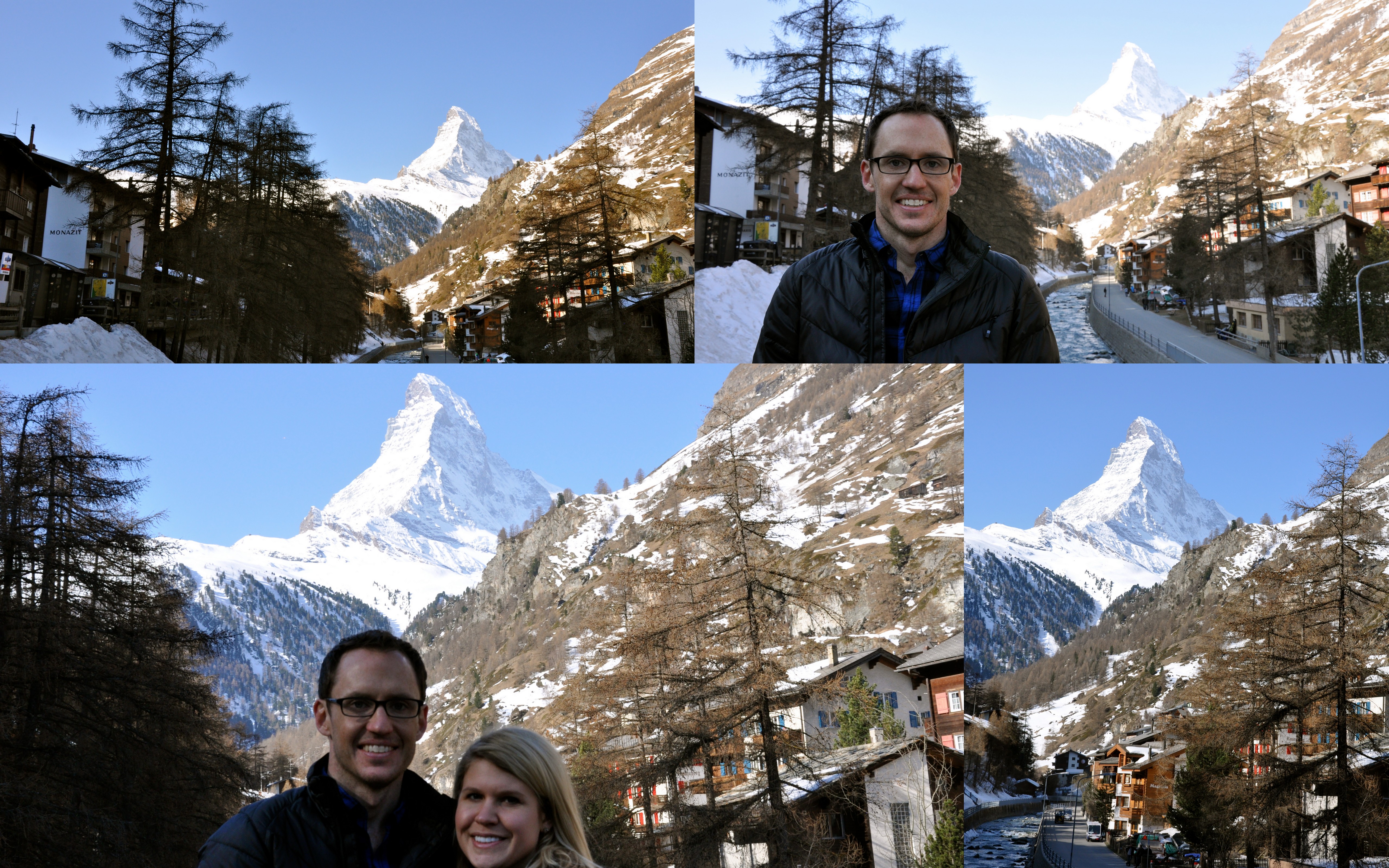
We anxiously watched the weather forecast hoping for clear skies.  And…mission accomplished!

We stayed in nearby Tasch, the town where we had parked the car on our last visit.  Tasch has trains to Zermatt every 20 minutes, providing a less expensive hotel option (150 CHF vs. an average of 500 CHF ) since it was still skiing high season in Zermatt.

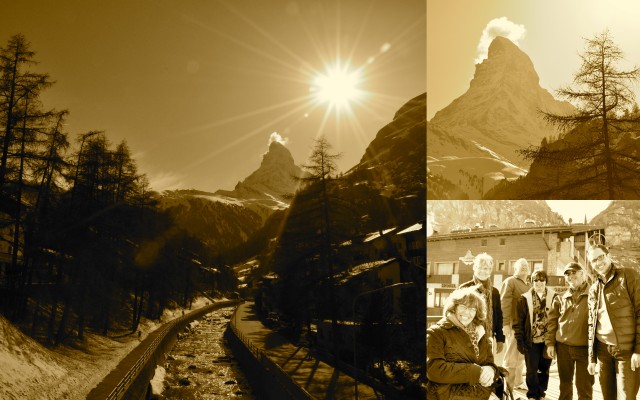
After dropping bags at adorable Hotel City in Tasch, we headed to Zermatt and immediately took an electric taxi  to the best overlook.  It was quite bright, but still magnificent.

Zermatt is known as a climbers destination although the Matterhorn is one of the deadliest peaks in the Alps.  It was one of the last peaks to be climbed in the golden age of Alpinism, and was first conquered by a group lead by  Edward Whymper in 1865.  Unfortunately, on the descent, there was a fall and four members of the group fell to their deaths.

We passed the graveyard for those who have died attempting to climb the Matterhorn.  It has been about 500 people in total who found their match in the 4,478 m high peak. For more information on this topic, Schwingen in Switzerland did a comprehensive post.

Mountaineer's cemetery, Zermatt

After wandering the town a bit, we dined on burgers and beers at Zermatt favorite, Brown Cow at Hotel Post, and then headed back to our own hotel in Tasch for the evening.

The next morning, we got up bright and early to make sure we were on time for the Glacier Express. We had an extra half hour to kill, so a few of us ventured back to catch a morning glimpse of the majestic Matterhorn.  Much better by morning:

Zermatt still remains one of our favorite Swiss towns.  We have visited it now in winter and spring.  However, I think it would be beautiful in the summer and fall as well.

Gratitude Friday: Four Hours

Post by Lauren

When we lived in North Carolina and Georgia, we could get to some pretty amazing places in four hours.  In that time, we could visit family in Virginia, check out North Georgia apple orchards, visit some vineyards and catch some NC mountain action.

However, here in Geneva, in four hours driving time, we can find ourselves what seems to be a world away.   We realized this even more when Gabe’s family was here and we did a lot of day trips.  Here are a few examples:

A 3.5 hour train ride or drive can put you in Zermatt, home of the Matterhorn. Just cross your fingers for visibility!

A 4-ish hour drive can put you in the 2nd smallest principality in the world: jet setting luxurious Monaco.

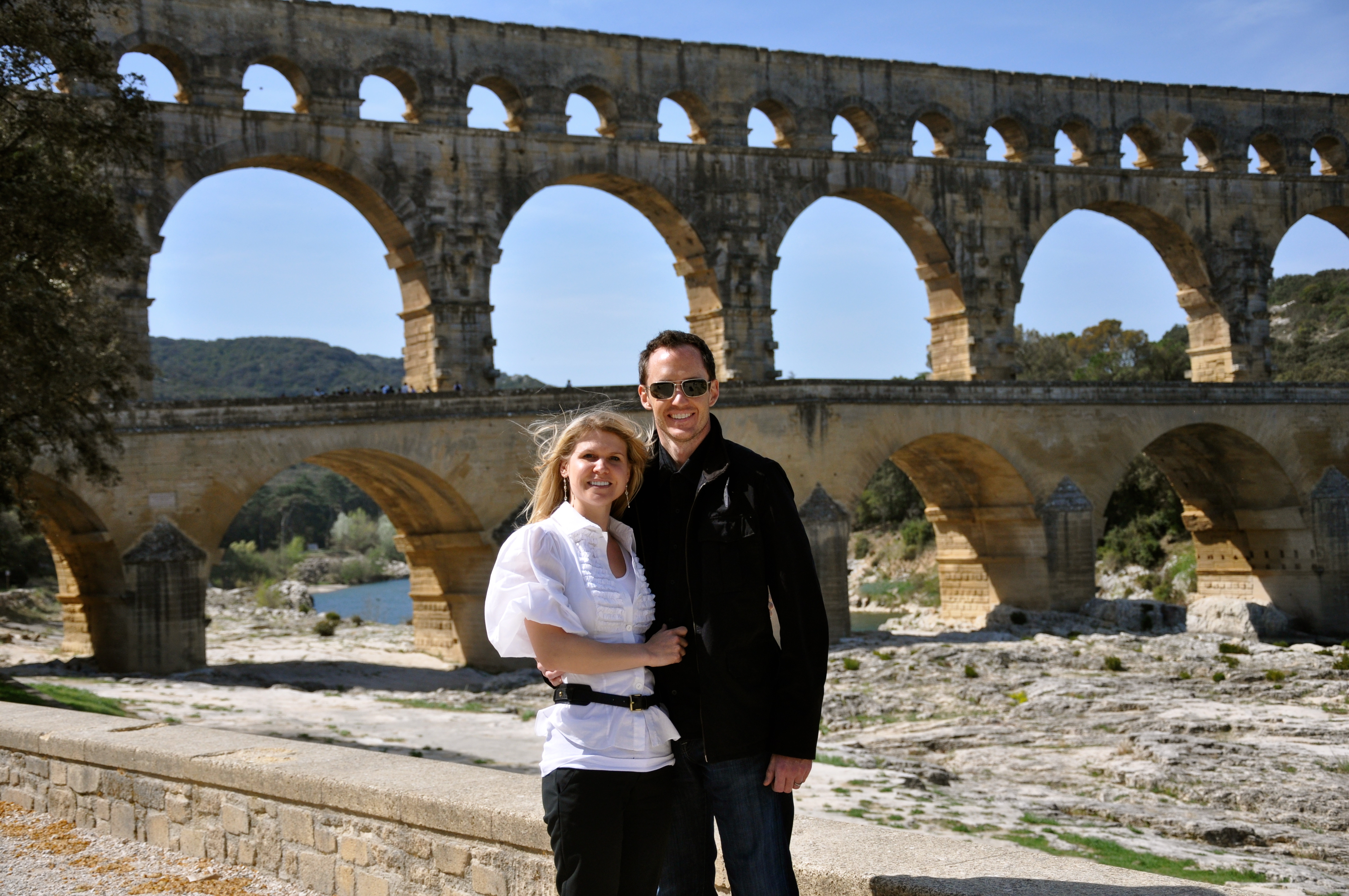
A 3.5 hour drive puts you near Nîmes where you can find evidence of the Roman times - the Pont du Gard aqueduct built in 19 BC and a UNESCO world heritage site.

A 4 hour train ride can put you in the heart of Andermatt where you'll feel like you are in a snow globe....even in April!

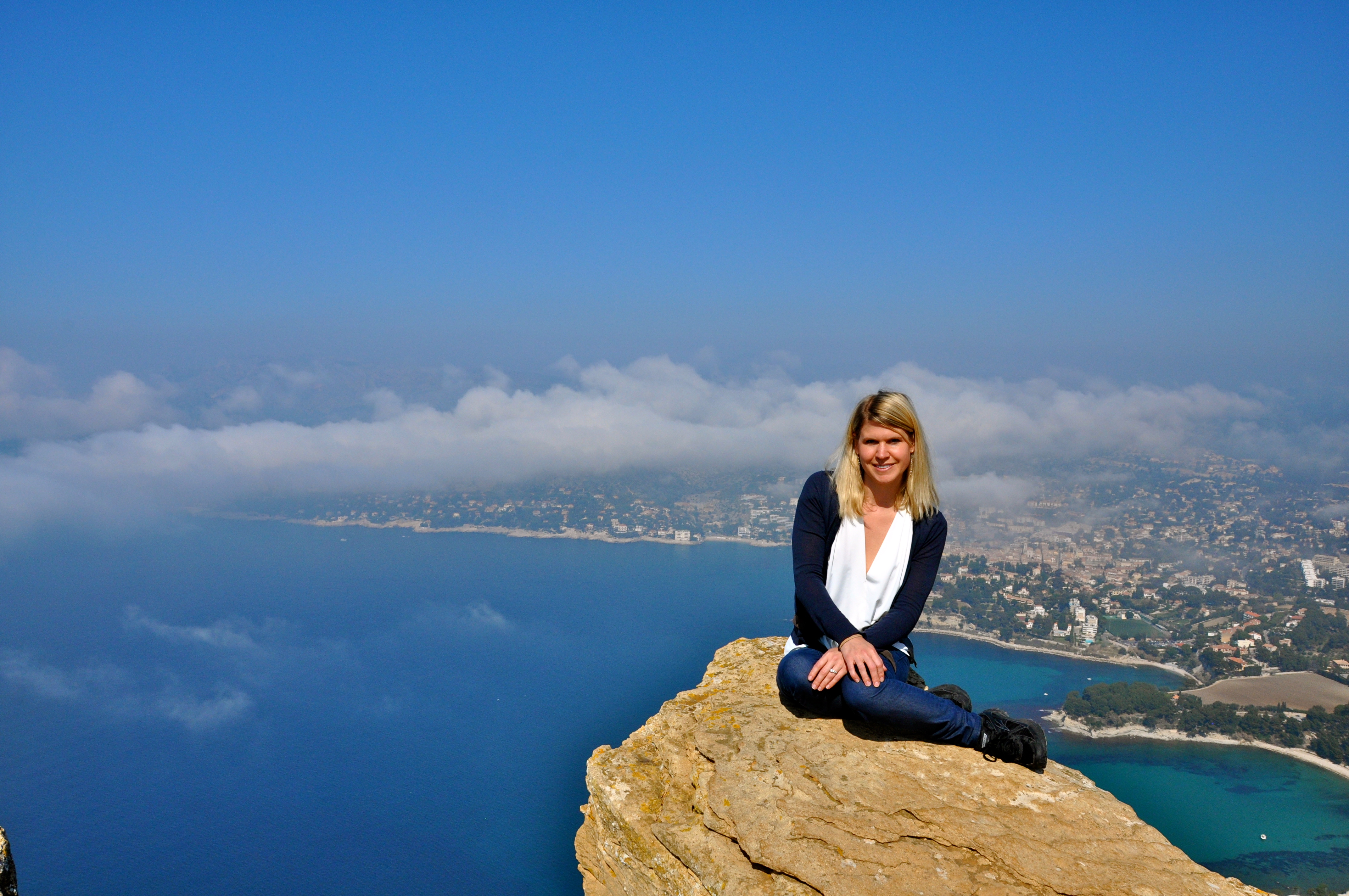
A 4ish hour ride can take you to the South of France to gaze on the magnificent cliffs overlooking Cassis.

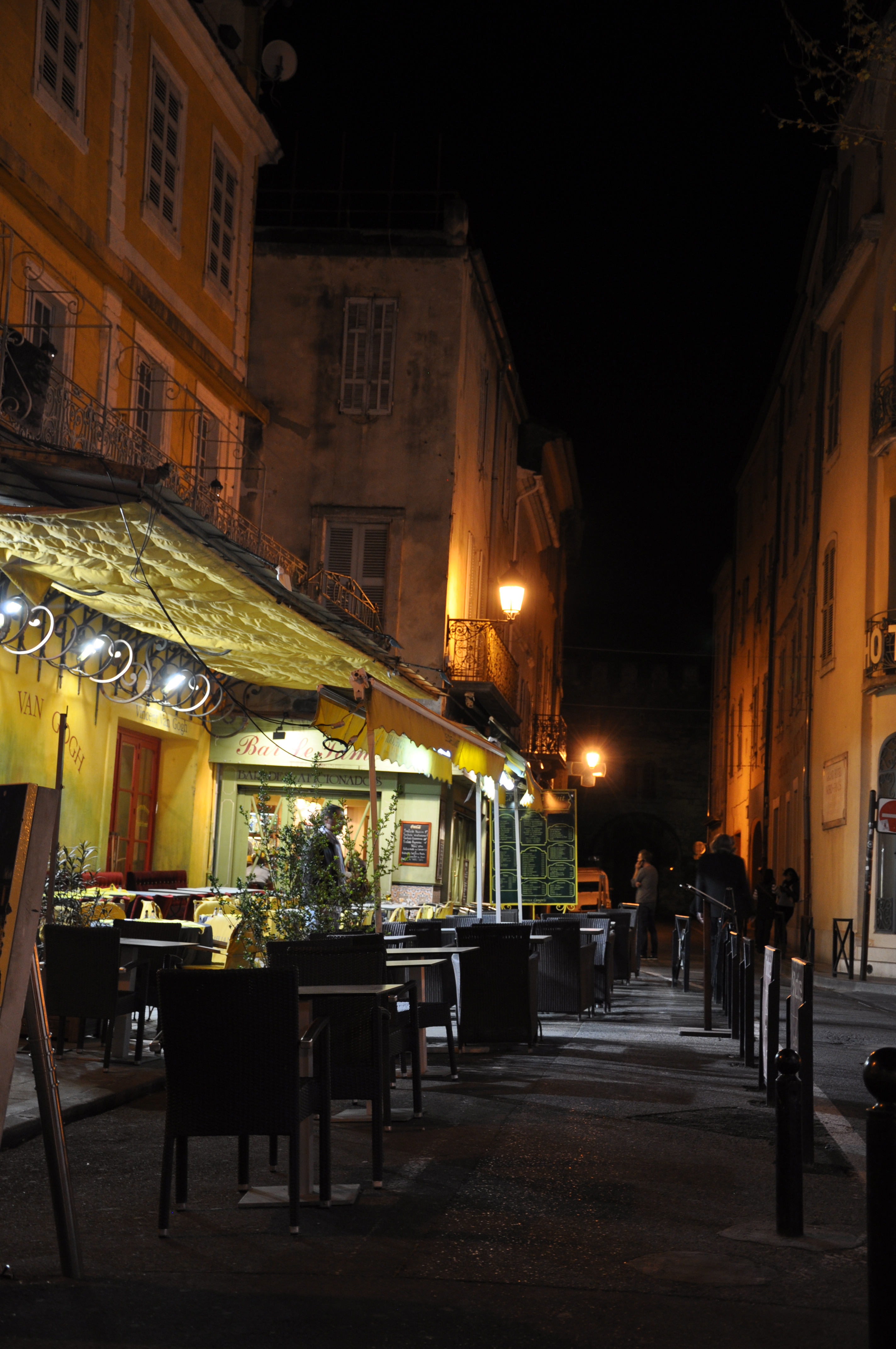
A 3.5 hour drive can put you in the heart of Arles, France where you can find yourself in the middle of a Van Gogh scene.

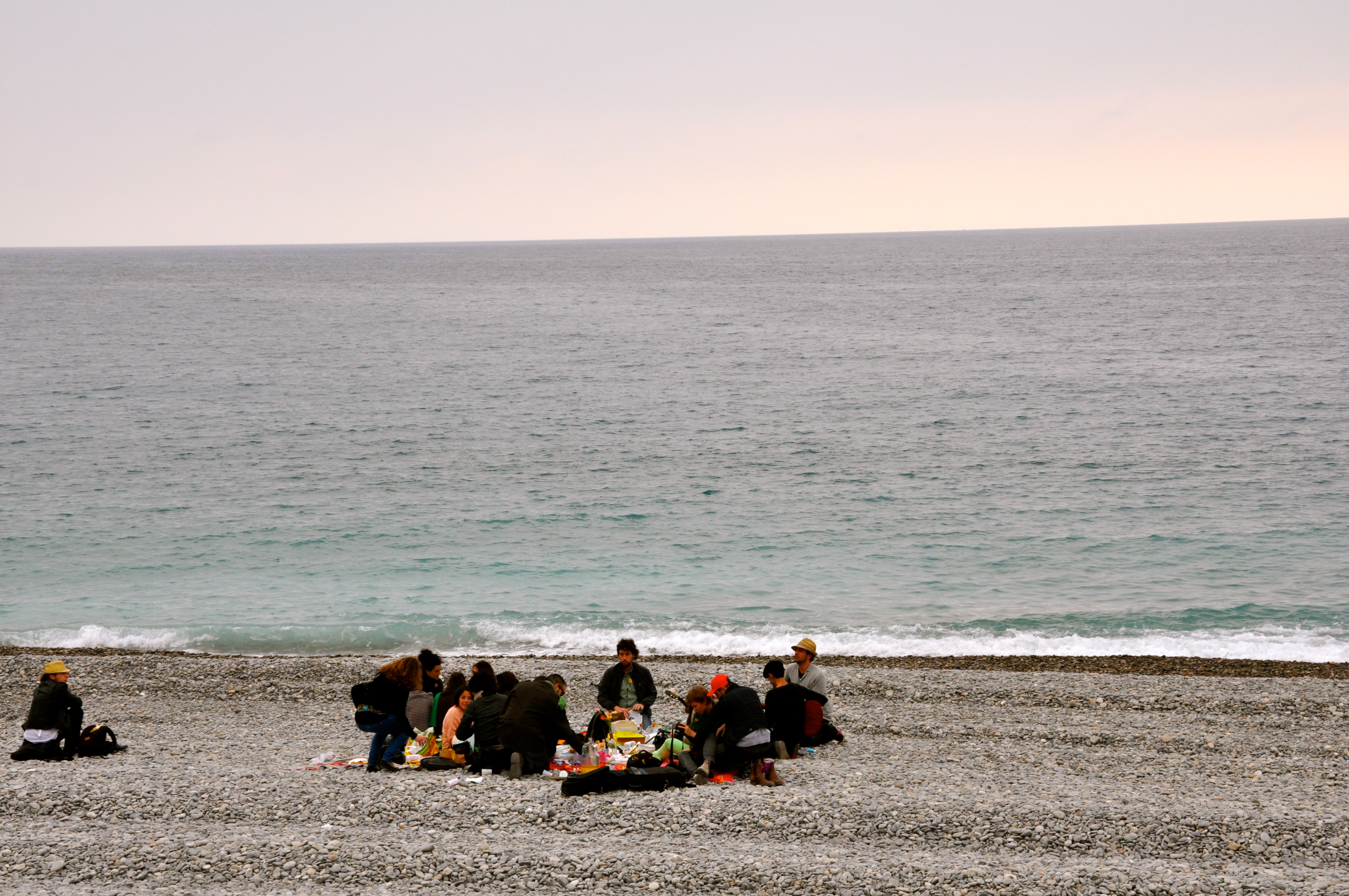
A 4-ish hour drive can take you to Nice where you can walk along the beautiful Promenade d'Anglais and watch the sunset.

A four hour train can take you to Milan where you can eat your fill of pasta, gelato and experience the liveliness of Italy alongside of appreciating The Duomo & The Last Supper by Leonardo da Vinci.

A four hour ride can have you in Cannes where the famous film festival takes place each May.

Look for posts in the coming days on each of these places we visited with Gabe’s family.

Until then, I am grateful for our location to be “four hours” from all these magnificent sites and the recovery of my feet so that I could keep up. Thank goodness for the wheelchair!

Château Chillon

Post by Lauren

On our second day with the fam, we planned to go to Château Chillon.   The group had unanimously voted that a castle should be on the vacation itinerary.

Image of Château Chillon courtesy of Wikipedia Commons / Dilaudid

However, we realized the day we were leaving that the castle closes earlier in the winter and with a later wake up time with jet-lag, we might not be able to make it on the train as planned.  We still yet had to take a bus to the train station, validate Swiss passes, wait for the train, take the hour long train, get to another bus stop, wait for the bus and take the bus to the castle.

So, Gabe took off work a little early and drove everyone sans me in Frau Hilda (our car) since they could go directly to the castle.  They fit six. Pretty sure that it broke some Swiss highway rules but nonetheless, everyone really enjoyed the excursion.

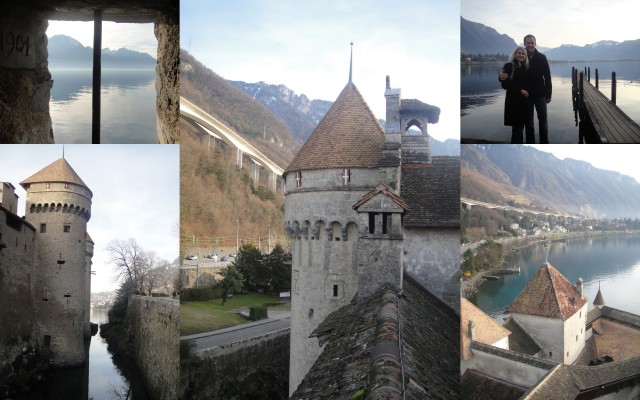
We knew that they would. When we went on our house-hunting trip last year, we really fell in love with the beautiful Château. The place dates back to the Bronze ages.  However, the castle itself only has records back to 1150 when it served as a guard point for the House of Savoy for roughly 400 years to control the passing of people along Lake Geneva.  After that, it still was a prison and fortress during the Bernese period until the Vaudese Revolution in 1798.

The castle inspired many writers and poets.

Our first trip to Château Chillon, January 2011

The family adventuring in the castle

I am so glad that Plan B worked out.   Kudos to Gabe and Frau Hilda for getting everyone there safely so they could experience this magical place!

Geneva’s Old Town Train

Post by Lauren

With my feet out of commission, I had been brainstorming ways to show our most recent guests around Geneva.

Luckily there are three tourist trains in Geneva – one that goes to Old Town, Left Bank, and Right bank.   The Left Bank train became my friend last summer when I didn’t know anyone.  It spoke English and was comforting to hear it pass now and then as I was sitting on the lake front.  Good thing I made friends and didn’t have to the rely on forms of transportation for my social life.

Anyhow, on the day that our crew of 5 arrived from the States, we took the Old Town Train.  This particular one starts at Place du Fusterie and winds around the middle of town for 35 minutes.  It costs 10 francs and passes by the following stops:

The little Geneva tourist train

The Statue of General Dufour

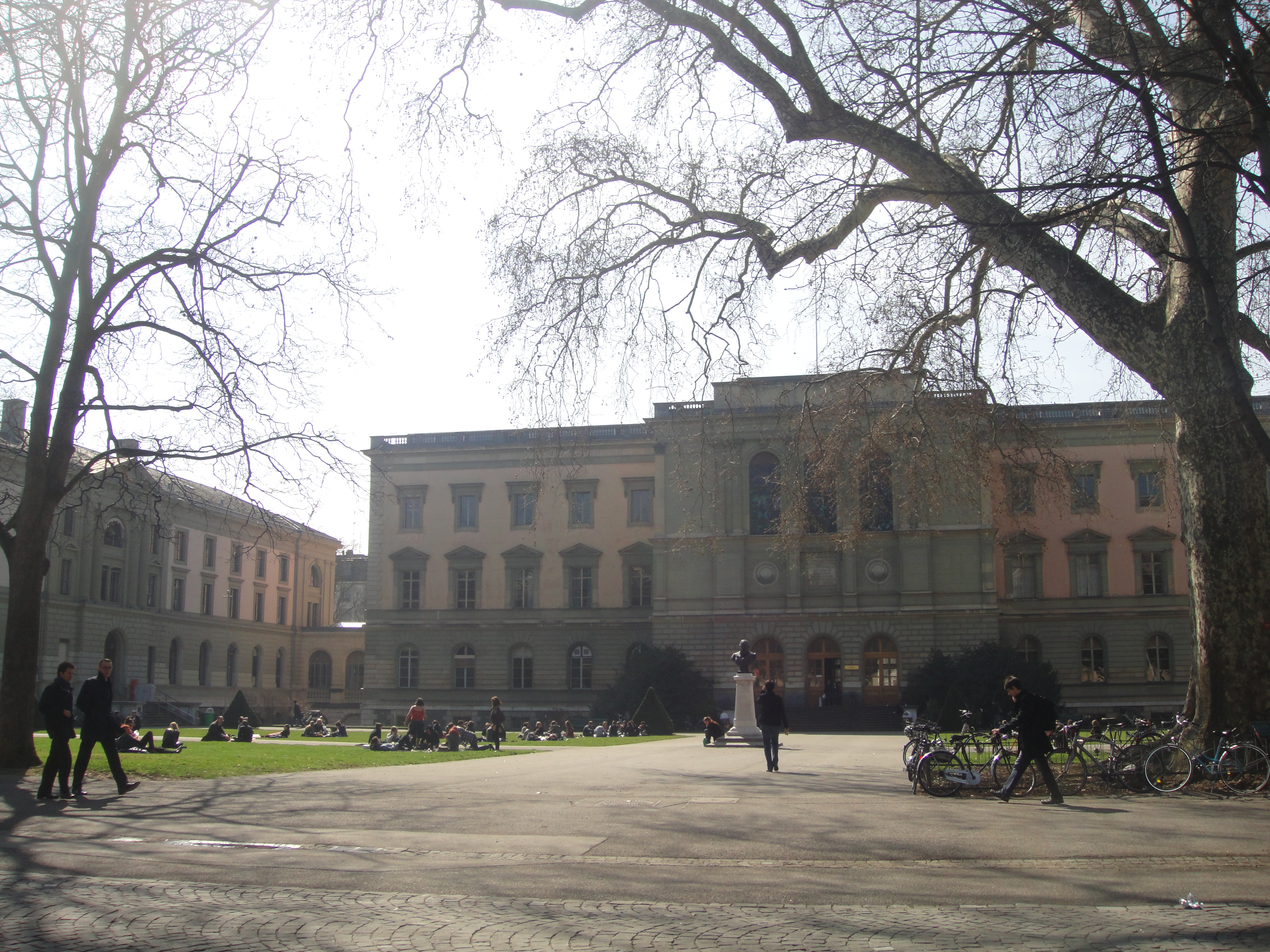
University of Geneva

The Reformation Wall

Palais Enyard

Palais de Justice

Bourg de Four*

L’Hotel de Ville

Statue of Pictet de Rochemont

Bust of Henry Dunant

La Maison Calvin

Calvin’s Auditorium & La Cathedrale St Pierre

La Maison Tavel

Le Musee Rath

Le Grand Théâtre

Le Conservatoire de musique


I would rate this train a 5 on a scale of 1 – 10.   It was hard to hear the announcements – they were muffled by the street noise.  Also, the website conflicted with the times that were posted at the entry point causing some confusion.   But for my current condition, a moving vehicle that took us by some Geneva highlights** so that I could fill in commentary was a great thing for us.  If you do have guests or if you are visiting Geneva yourself, email the company for confirmation when and where it will pick up the day you plan to take it.

*I have a friend who lives in Old Town. She detests the Old Town train because of the noise it makes passing her window.  I kind of felt guilty taking it but at least we were going in the middle of the day.

**Our guests asked the baggage guy in the airport what there was to do in Geneva.  He gave them a blank stare and said they’d come to the wrong place for activities.  He did mention Old Town was one thing that they should check out.  Good, glad we had this on the itinerary.


Lavaux Wine Tasting

Post by Lauren

The Lavaux wine region is definitely a place you should see in your lifetime. On our first trip to Switzerland we took a day trip to Montreux, and I remember driving through this area with my mouth wide open in awe.


This particular time was in the winter, but is truly beautiful any time of year. See the Schwingen in Switzerland blog for a recount on spending a summer day in Lavaux. I had the pleasure of hiking* in the Fall as well and it was gorgeous:


When The Captain and Swiss Miss were here, they had wanted to hike in Lavaux; however, the Geneva record low temperatures prevented us from doing so. Nonetheless, we still took the train from Geneva to Rivaz to check out the wine cellar, Vinorama.

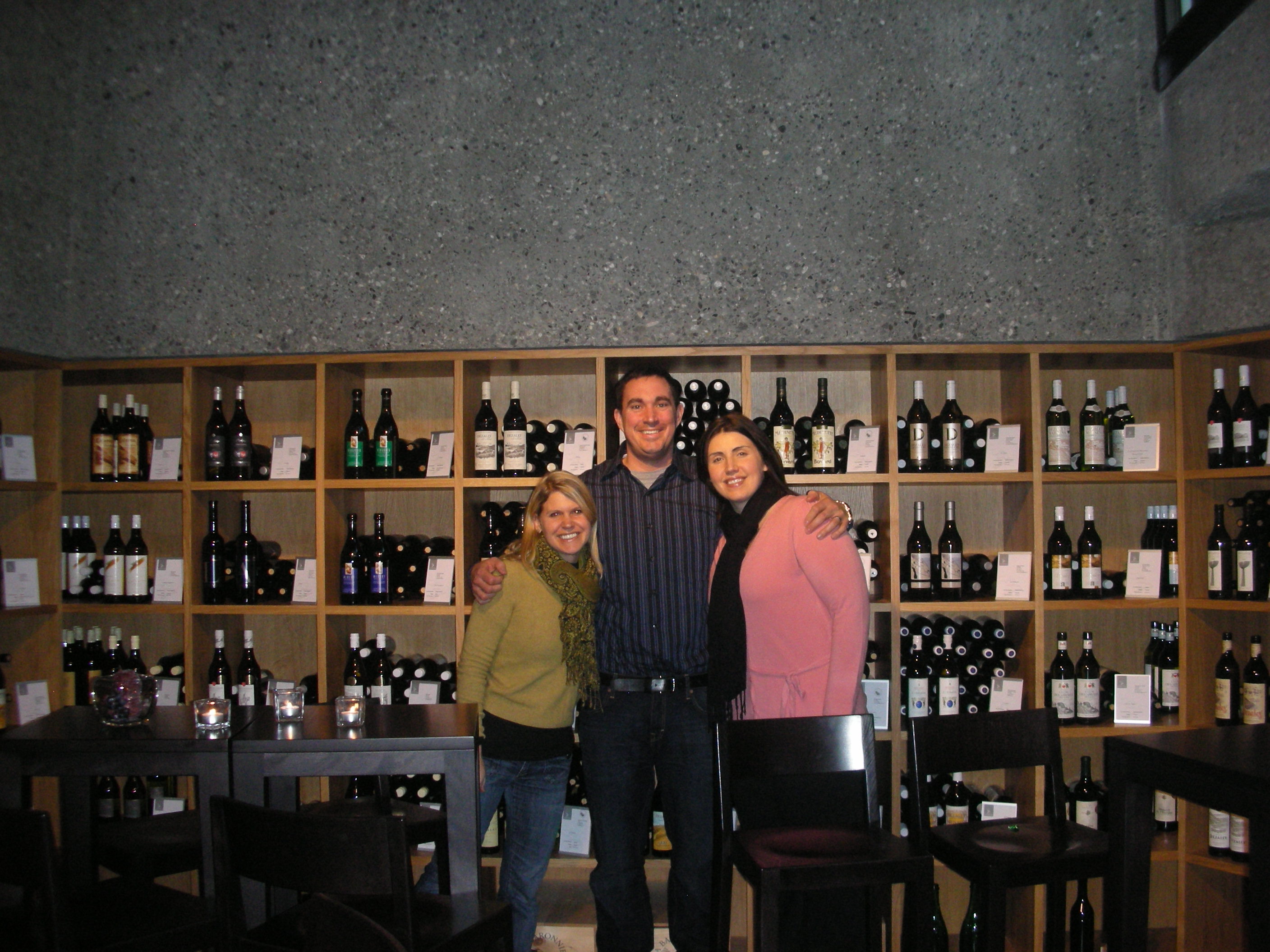
Vinorama is cut into the side of the Lavaux countryside. It offers “dégustations” (tastings in French) of different Lavaux varieties. It also has a wine store offering hundreds of Lavaux bottles .

Vinorama


During our visit, they showed us a short film about the region’s wine production. It was incredibly well done, depicting the ups and downs of a local farmer throughout the year. This helped to bring personality to this special region and to understand how hard it is to farm the land.

The primary reason Lavaux is special are its terraces. They are steep, staggered, and require a lot of maneuvering on the part of the wine workers. I have seen similar ones in Cinque Terre in Italy, but no where else in the world have I seen anything like it. It takes incredibly hard work to farm that land – both in the upkeep on a slanted slope and transportation of the grapes in the harvest. And they have been doing it since the 11th Century.

The film explained that it is the terrace that affects the taste of the wine. The heat from its walls warms the earth underneath the vines. This as well as the sun’s reflection off of Lake Geneva bodes well for the grapes.

Vinorama offers tastings in white, red and combinations. The tasting that we did included the following:

Epesses – La braise d’enfer
Vilette – Clos du roches
Domaine Moulin la Vignette Lutry
Lettres des Noblesse (malbec/cab) st saphorin
Epesses plant robez blaise duboux

My favorite was hands down the Lettres des Noblesse. However at 40 CHF per bottle, it didn’t make it into our cellar on that particular day.

A few days after our trip, my French tutor and I were discussing the Lavaux region. She is French and advised that of course, any agriculture product in Switzerland is very expensive. I totally agree with that statement. The terraced type of farming and harder labor can’t lend to an economical product. However, with the magic that can be found here in Lavaux, I’d also say that their wine is certainly worth it.


*For hiking: we got off the train at St. Saphorin and walked to the Lutry station. It was four hours and we had magnificent views every step of the way. This of course could be shortened or you could do the wine stop as we did.

All Aboard the Glacier Express!

Post by Lauren

When The Captain and Swiss Miss were visiting, we took the Glacier Express. No, this isn’t the train to Santa’s house….it goes to St. Moritz. Which is sort of like the North Pole, if you think about it, full of wonder, make-believe and furry suits.

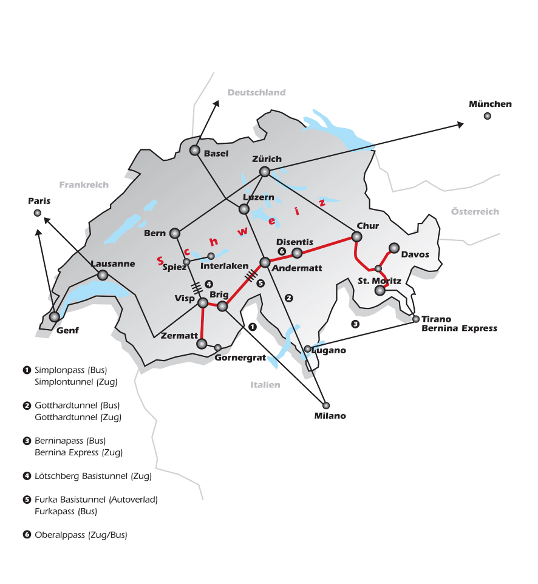
The Glacier express is a very nice excursion to do if you are visiting a short time, since it covers a large part of the country of Switzerland. It travels the path in red, below.

Photo credit: The Glacier Express

In its entirety, The Glacier express travels through 91 tunnels and 291 bridges. At altitudes of up to 6500 feet, it cuts through breathtaking mountain passes, glaciers, and by rushing mountain streams. From its windows you can experience a part of nature that has remained untouched. In fact, there is a certain part of the railway that has a UNESCO designation as a World Heritage Site, the Rhaetian Railway from Thusis towards Bergun. This was given due to its role in developing access to remote areas in the Swiss Alps as well as how the civil engineering blends seamlessly with the nature surrounding it.

The Glacier Express

The Glacier Express started in 1930, a remarkable feat considering the economic crisis that was happening during that time. It experienced a slow down as well in WW2 as it didn’t run between 1943 and 1946, during the war.

Up until 1982, it could only run during the summer months because the Oberalpass became impassable in winter with snow. In the 1980s, they made improvements in tunnels, allowing it to operate. Since that time, they have upgraded the cars to be equipped with panoramic windows* for tourist’s photo taking and comfort.

One of the many tunnels the Glacier Express travels through

While the Glacier Express isn’t really an express at all (average speed is 20 km/hour), I appreciated the extra time it took to get to our destination due to the beauty of the landscape it traversed.

We would recommend this to those visiting Switzerland. We also hope to check out some of the other scenic trains such as the Golden Pass, or Bernina Express during our time here.

What you should know :
–If you are interested in taking a scenic train, Rick Steves has some great descriptions about the differences on his site.
–If you are visiting, you can take the scenic trains on a Swiss pass or Swiss Flexi pass. Same goes for residents with a day card. For the Glacier express, you must get a reservation for 13 CHF in the winter or 33 CHF in the summer for a seat.
–They serve great meals on the Glacier Express; however picnics are also allowed. We brought an assortment as well as two bottles of wine.

*The large windows created a magnificent view. We were blessed with a lot of sunshine on our journey which was great for us, but made our photos a little worse because of the glare. Sorry.

St. Moritz and the Engiadina Valley

Post by Lauren

As you read from previous posts, we quite enjoyed the White Turf races in glitzy St. Moritz. What was left out of those recaps, was the stellar beauty of this region of Switzerland.

The Engiadina Valley is in Eastern Switzerland. It took 9 hours for us to get there on the Glacier Express but using faster trains, it can be done in 6 hours.

St. Moritz itself is a pretty town. At 6000 feet, its lakes are frozen most of the winter. I am standing on the lake while taking this photo.

The town of St. Moritz

Sunset also isn’t bad in this part of the world:

Sunset in St. Moritz

The day after the races, we took a little funicular / cogwheel up to Muottas Muragl. This point is about 2456 m high, roughly 8000 feet. On this particular day, it was about -12 C in St. Moritz, but about -20 C at the top. Brrrrr.

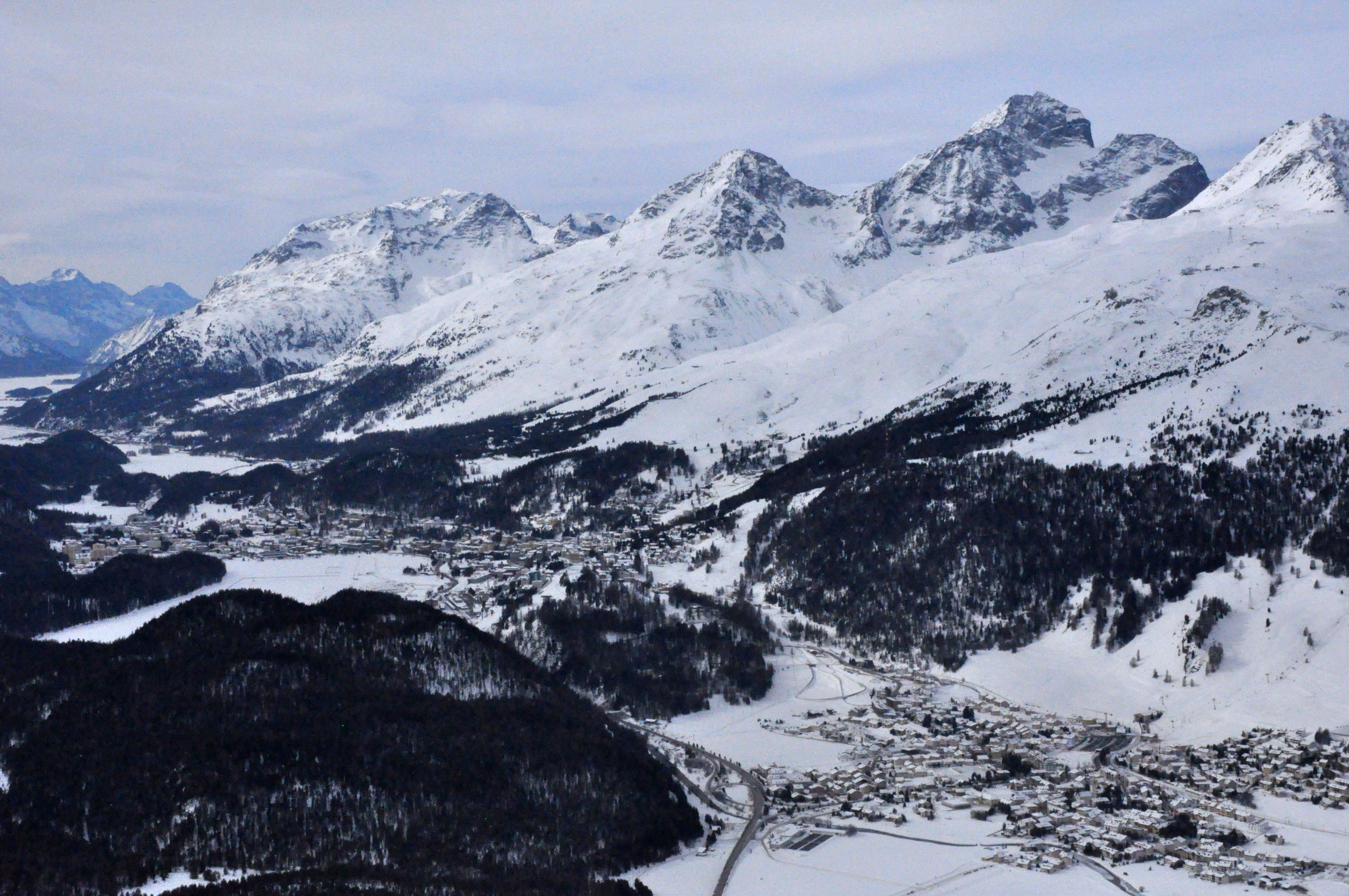
From the vantage point in the photo below, St. Moritz is the town in the center of the image. You can see the frozen lake to the left of it. Because we aren’t high-rollers, we stayed in the village of Celerina, which is the town in the foreground. Samedan and Pontresina are also nearby and came recommended.

View of Celerina & St. Moritz from the top of Muottas Muragl

This region is of course famous for skiing and outdoor sports. We saw a ton of cross country skiers, because apparently the valley is quite suitable for that sport.

It is also popular for tobogganing. From the top of this mountain, there is a 4.2 km toboggan run down to the bottom. You can see the little specks (people) zipping around the track.

Nearby Bergün boasts a 6 km track. Its the longest in Europe and travels on a road that is turned into a sledging track since its impassable in winter.

About a year ago, Forbes published an article entitled, “Don’t try this at home”. The article talked about the irony of how cautious this Swiss are, but how this popular sport is so very dangerous.

However, Gabe would still like to try this out before we leave. Perhaps we’ll put it on the docket for next year!